
Years ago, I read Why Nations Fail by Daron Acemoglu and James Robinson. As someone who had spent a lot of years thinking about why some countries are rich and others are poor, I thought its central thesis was wrong. I forgot about the book for a while, but have recently seen Acemoglu making a lot of what are, in my opinion, misguided arguments about topics like AI and labor unions. Since I had read Why Nations Fail, I could see why Acemoglu was coming to certain conclusions. I was glad to see The Economist take a similar perspective, with the magazine calling him “oddly unconvincing.”
For that reason, I thought it would be a good idea to explain why Acemoglu’s most famous book is wrong, and from there critique some of his contemporary political opinions. I honestly hesitated for a bit before writing this, because Acemoglu only follows 356 people on X, and I am one of them, which is flattering. We’ve had a few pleasant interactions and he seems like a perfectly nice man, so I didn’t want to be too negative about his work. But ideas matter, and I hope he finds this criticism useful.
In Why Nations Fail, Acemoglu and Robinson summarize their main thesis in the preface:
Countries such as Great Britain and the United States became rich because their citizens overthrew the elites who controlled power and created a society where political rights were much more broadly distributed, where the government was accountable and responsive to citizens, and where the great mass of people could take advantage of economic opportunities.
The rest of the book tries to explain how the histories of different nations and regions of the world are consistent with this idea. In the colonies founded by white settlers, like the US, Canada, and Australia, elites shared political power, which led to broad prosperity. In Latin America and post-colonial Africa, elites have hoarded power, lined their own pockets, and created poorer and less functional societies as a result.
This post is sponsored by Mechanize. AI alignment is perhaps the most important issue of our time, and if you’re interested in being part of that effort, Mechanize is hiring software engineers at a base salary of $300K-$400K/year, plus substantial bonuses. They also have openings for other positions, including Recruiter ($200K). Here is their website, and you can apply here.
So in Acemoglu’s telling, political rights lead to economic opportunity, which leads to prosperity. Why some nations end up with political rights and others don’t is based on historical contingency. The ultimate question in the study of economic history is, of course, what started the Industrial Revolution, and here the authors place their emphasis on the struggle between kings and nobles in England.

Yet the Acemoglu reading of history is selective. Are widespread political rights necessary for countries to become wealthy? One way to ask whether this is true is to look beyond the history of England and its offshoots and see which nations have succeeded since 1945, the year that gave birth to the modern world order. Looking at countries outside Europe that are not European-derived, there have been a handful that have achieved first-world standards of living. South Korea, in particular, is a nation that achieved rapid growth before citizens had political rights.
How do Acemoglu and Robinson explain this, particularly the divergence with the North?
These striking differences are not ancient. In fact, they did not exist prior to the end of the Second World War. But after 1945, the different governments in the North and the South adopted very different ways of organizing their economies. South Korea was led, and its early economic and political institutions were shaped, by the Harvard- and Princeton-educated, staunchly anticommunist Syngman Rhee, with significant support from the United States. Rhee was elected president in 1948. Forged in the midst of the Korean War and against the threat of communism spreading to the south of the 38th parallel, South Korea was no democracy. Both Rhee and his equally famous successor, General Park Chung-Hee, secured their places in history as authoritarian presidents. But both governed a market economy where private property was recognized, and after 1961, Park effectively threw the weight of the state behind rapid economic growth, channeling credit and subsidies to firms that were successful.
The situation north of the 38th parallel was different. Kim Il-Sung, a leader of anti-Japanese communist partisans during the Second World War, established himself as dictator by 1947 and, with the help of the Soviet Union, introduced a rigid form of centrally planned economy as part of the so-called Juche system. Private property was outlawed, and markets were banned. Freedoms were curtailed not only in the marketplace, but in every sphere of North Koreans’ lives—except for those who happened to be part of the very small ruling elite around Kim Il-Sung and, later, his son and successor Kim Jong-Il.
There’s nothing wrong with this analysis on its own. Acemoglu and Robinson use a lot of words to describe the post-World War II history of Korea, without seeming to notice that it undermines the entire thesis of the book. You had two dictatorships. One chose capitalism, the other chose communism. The first succeeded, while the other failed. Neither of the governments in question had widespread political rights, yet they took completely different paths due to ideology. This is in direct tension with Acemoglu and Robinson’s view that political rights are what ultimately matter.
South Korea isn’t the only non-Western country that has achieved prosperity without democracy. We might also look at Singapore, Taiwan, and the Gulf Arab states. None of these countries gets any substantive analysis in Why Nations Fail. The words “Qatar” and “Emirates” do not appear once in the entire book. Acemoglu and Robinson spend a lot of time on prosperous democracies, and nearly none on prosperous dictatorships, because the former support their main thesis while the latter do not. Yet the majority of non-Western countries that have achieved first-world levels of income over the last three-quarters of a century began their economic ascents under authoritarian governments. Meanwhile, Latin America has been mostly democratic while seeing sluggish growth.
Here, you might think that human capital — in terms of the underlying traits of different populations — might have a role to play in explaining divergent outcomes. Why Nations Fail has a chapter devoted to refuting cultural explanations of national success. Here’s a flavor of the type of arguments you’ll find there.
Maybe the cultural factors that matter are not tied to religion but rather to particular “national cultures.” Perhaps it is the influence of English culture that is important and explains why countries such as the United States, Canada, and Australia are so prosperous? Though this idea sounds initially appealing, it doesn’t work, either. Yes, Canada and the United States were English colonies, but so were Sierra Leone and Nigeria.
Come on. On this point, see Tyler Cowen pressing Acemoglu in 2019 on human capital as the ignored variable in his theory.
I do think that there is merit to the idea that inclusive political institutions are good for growth. On average, they probably are. But the correlation is relatively weak. Democracy is neither a necessary nor sufficient condition for impressive growth under modern conditions. Maybe inclusive political institutions do a better job of explaining why the Industrial Revolution kicked off in England than elsewhere. But in the modern world, all of the evidence indicates that the two most important variables in terms of growth are, by far, human capital and the embrace of markets. Democracy is way down the list, and it prevents growth-enhancing policies at least nearly as often as it facilitates them.
I suspect that whether democracy exercises a positive or negative effect on growth changes with historical circumstances. Throughout most of the eighteenth and nineteenth centuries, pro-democratic movements sought to remove feudal privileges and open up markets. Yet beginning with the rise of socialism near the end of the nineteenth century, calls for more democracy have usually coincided with favoring growth-killing policies in the name of stability and equality. This would explain why Acemoglu and Robinson can be right about the origins of the Industrial Revolution, while their theories do a poor job of explaining how nations have developed since 1945. The collapse of the Soviet Union was an exception, with democratization and market liberalization going hand in hand, and in that case most of the former members of the Eastern Bloc have seen rapid growth as they have embraced capitalism and policies like free trade.
My disagreement with Acemoglu and Robinson is a matter of emphasis. We are on the same page that markets are better than central planning, and that democracy is better than authoritarianism. But I think that, if you care about nations having high living standards, you need to put a lot more weight on capitalism than democracy, while they seem to believe the opposite. I think that nearly everything notable that’s happened in the world since 1945 supports my view of political economy.
Acemoglu’s intellectual blind spots are his neglect of human capital, his excessive love of democracy, which he sees through the lens of Marxian class conflict, and his insufficient emphasis on free markets and economic growth.
These days, Acemoglu is calling for “pro-worker” AI policies. In Redesigning AI, a 2021 book in which he is the main contributor, Acemoglu takes the position that AI will not replace all jobs. But he worries about a decreasing demand for human labor. Acemoglu acknowledges that previous generations of Luddites were wrong. Why haven’t their predictions ever come true? He says we can’t know for sure, but he seems to consider this a quirk of history, looking past the possibility that the consistent record is telling us something fundamental about the way the economy works.
We have now had two and a half centuries of more and more automation, along with living standards going up practically the whole time. This is not an accident. Human labor keeps being necessary because human needs, wants, and desires are unlimited. Once we have machines that can automate the process of making food, we don’t just sit around happy to enjoy the diet of nineteenth-century peasants at a wooden table, withering away because we can’t find any other way to occupy our time and be productive. We care about status, and always want more convenience, better forms of entertainment, and nicer things. Billionaires do not seem completely content with what they have, and we are a long way from normal people living like billionaires.
Some people say that AI is a special case because it will replace all human labor. I’ve written that this is still a bad argument, but note again that Acemoglu denies that humans will become redundant. To believe that AI won’t completely replace human labor and yet we must still worry about job loss is to bet on a particularly unlikely combination of outcomes. The standard AI argument about complete automation at least can say that this time is different. Acemoglu believes AI is a normal technology, and also that this will be the first time in history that a major productivity-boosting technology is something to worry about.
If you look at labor’s share of GDP across the world, the number ranges between 50% and 70% in most advanced countries. Now consider that US GDP per capita has increased two and a half times just in the last fifty years. What was labor’s share of income or the Gini coefficient in ancient Babylonia? Who cares? World GDP per capita was roughly $1,000 in modern terms before the Industrial Revolution. It would have been deeply misguided at that point to worry about what the distribution of income would be after a century or two of economic growth. Throughout history, the countries with the richest elites have also generally had the richest citizens at the median, and the richest bottom 10%.
Here’s a map showing the Gini coefficient, the standard measure of income inequality, for countries across the world.
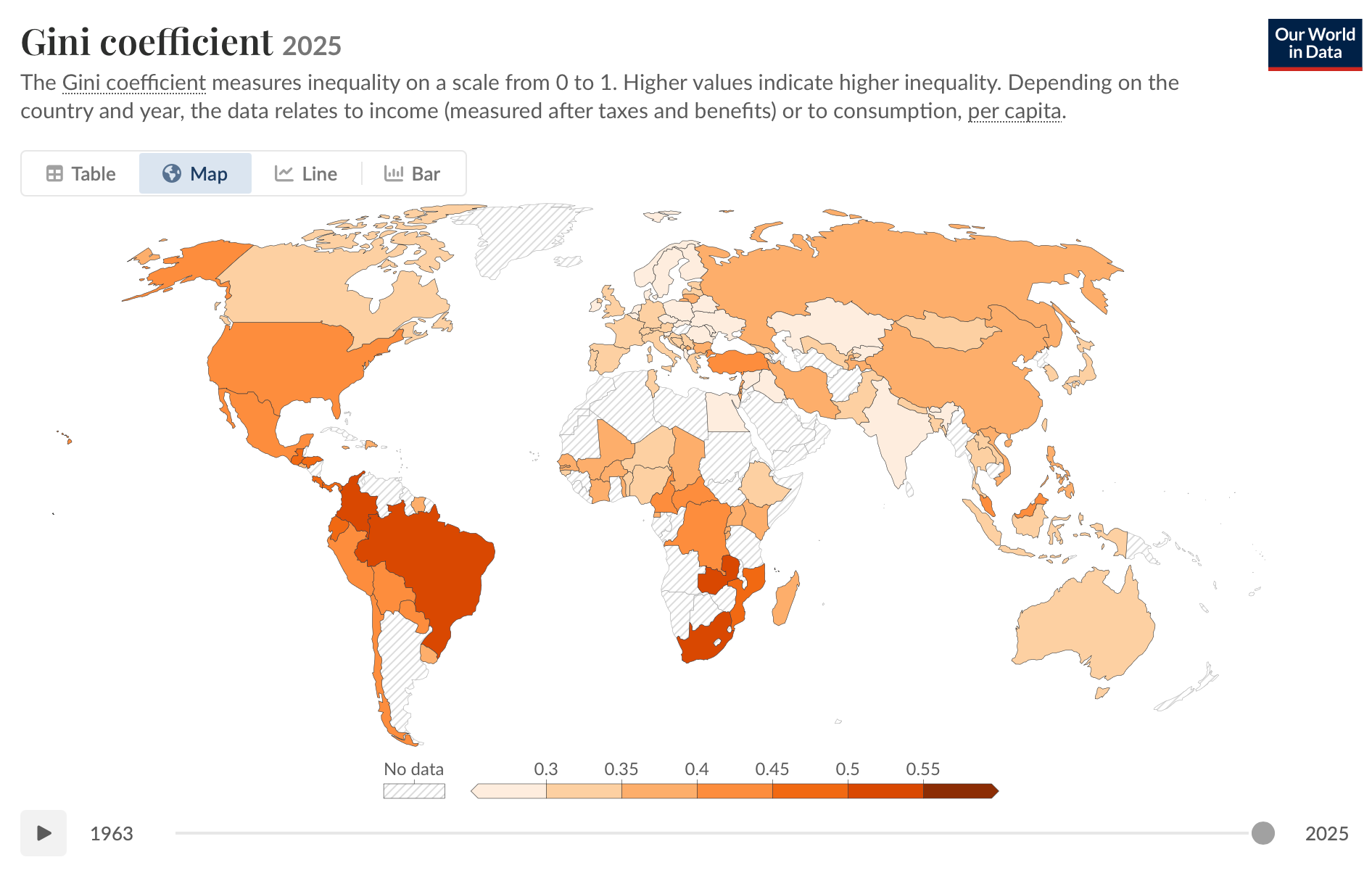
Western Europe is relatively equal, but so are Egypt, Ethiopia, India, Niger, and Nigeria. The US makes the list of the top 20 most unequal economies in the world among those for which we have data, yet it has the highest living standards among all large countries. Meanwhile, if you look at billionaires per capita, excluding the small countries with ten or fewer, the top ten nations and territories are Hong Kong, Singapore, Switzerland, Sweden, Israel, the US, Germany, Taiwan, Norway, and Ireland. The number of ultra-rich citizens in your country is much more strongly correlated with GDP per capita than any measure of inequality you can find.
In other words, if someone asks you, “Would you rather your nation have more billionaires in thirty years or be more equal?” this is not a difficult decision. You should choose more billionaires, in which case nearly everyone in your country is going to be better off. AI will create trillionaires, and this is something to celebrate.
The case for not worrying about more billionaires and trillionaires is even stronger than these correlations suggest, since the wealthiest countries are responsible for the vast majority of technological breakthroughs that the entire planet benefits from. Without American innovation, Europe would be a lot poorer, even as the latter is more equal. Emphasizing rising productivity over concerns about distribution is better for people alive today, but the argument for caring less about equality is even stronger when we think about the well-being of future generations.
Acemoglu’s response here would probably be that even billionaires in rich countries have to worry about the bargaining power of labor and democratic institutions. If more gains go to the top, then the rich will be better able to rig the economy in their favor. Yet we’ve seen that democracy isn’t even necessary for widespread prosperity. Governments can adopt policies that make their citizens wealthier simply because they’re the right thing to do. Elites are motivated by more than the desire to maximize their own wealth and power. As long as they care about status and moral virtues, they will adopt policies that make them feel better about themselves and help them look good in the eyes of others. In countries that are already democratic and give all adults the right to vote, one of the last things in the world you need to worry about is that we’ll have too little redistribution or too few anti-growth policies.
As elites get wealthier, they seem to care more about status relative to making more money. A plantation owner in the antebellum South might worry about a significant decrease in living standards if his slaves were freed. A modern billionaire doesn’t lose nearly as much from a higher capital gains tax, and is going to be extremely comfortable either way. If you think that people care about both wealth and status, and there are diminishing returns to wealth, then you would expect as elites become richer they can afford to be more generous, whether that means directly giving to charity or supporting policies that they see, rightly or wrongly, as in the public interest. This is consistent with the historical record.
In fact, the countries in the world that have done the best job of raising the living standards of their people relative to their human capital endowment are the Gulf Arab states, which score horrendously on international tests. This is due largely to oil wealth, but it suggests that we should take an optimistic view of AI. We have examples of governments with historically unrepresentative institutions getting control over a wealth-enhancing resource, and they have used it to make their populations better off. If anything, a lack of democracy has stopped nativist and populist policies from gaining a foothold across the Arab Gulf, allowing elites to wisely make the best use of the resources that they have. The idea that democracy might kill the goose that lays the golden egg does not fit Acemoglu’s worldview, yet he’ll find plenty of examples of this happening even in the regions of the world he focuses on, namely Latin America.
It would be a mistake to believe that we are smart enough to predict exactly how AI is going to roll out in the economy and what its ultimate impacts on the distribution of wealth will be. All we can do is find the best heuristics we can and apply them to public policy questions. The right approach is to remain focused on technological progress and productivity, while treating the distribution of wealth as somewhere between an afterthought and a potentially dangerous distraction. And democracy, while nice to have, is far from the foundation of prosperity; we should call for more of it in particular contexts only to the degree that it facilitates human flourishing.
Great read, I agree WNF has fundamental flaws on not weighing human capital enough, and I hope that one day Acemoglu comes around and weighs markets more importantly than he currently does. Although I don't find that likely.
Another thing that should make him reconsider his thesis is basically the cases of China vs India and Vietnam vs Philippines..
China and Vietnam are both one party autocracies countries that reformed to become more market oriented in the 1980s (Gaige Kanfang under Deng Xiaopeng in China and Doi Moi under Nguyễn Văn Linh in Vietnam). In the late 1980s, India was still richer per capita than China but by the 1990s, China blew past india.
https://data.worldbank.org/indicator/NY.GNP.PCAP.CD?end=2002&locations=CN-IN&start=1962
I remember Acemoglu said in his book something along the lines of "while autocracies can be fast growing for some time, they cant sustain it. Look at the Soviets, they grew fast after WWII but stagnate by the Brezhnev era and was only hanging on by oil exports after the 1973 crisis and the 1979 iranian oil production drop post Iranian revolution. But by the 1980s when the oil glut happened the Soviet Union was fucked." But that argument is basically, "i know it seems that autocracies can grow fast, but give it time and i'll be vindicated". The issue is not only is that argument non-falsifiable, but even if you placebo test the "give it time, and you'll see that country stagnate" argument applies to democracies as well. Brazil and post apartheid South Africa were both fast growing in the early 2000s. But stagnated after 2014, because it turns out their growth was caused by commodity booms fueled by China but when China's import demand slowed down 2014-2015, so did these economies, and stagnated since over the last 10 years.
Vietnam vs. Philippines is probably another great counter. Philippines was quite literally the 4th richest asian country per capita post WWII losing only to Japan, Hong Kong, and Singapore. It was slightly richer than Malaysia, and much richer than Taiwan, South Korea, Indonesia and more. It had the highest adult literacy in east asia and had constitutional government modelled after the U.S. Meanwhile Vietnam was basically in four consecutive wars with major powers since WWII (Japan during WWII, France during decolonization, then America, then a brief border war with China after Vietnam invaded Cambodia), was sanctioned hard by the US, and then after market reforms with Doi Moi we now see Vietnam becoming slightly richer than the Philippines.
I wrote more about that Vietnam vs. Philippines here if you are interested. But it seems clear that with time, Acemoglu will have to update his model about inclusive political institutions being a prereq for growth.
https://yawboadu.substack.com/p/the-2026-world-bank-scorecard-vietnam?utm_source=share&utm_medium=android&r=garki
Singapore has regular and *mostly* fair elections. The PAP cares deeply about retaining the support of the electorate.
But aside from that, you're right here. Hong Kong had no elections at all. China doesn't have democracy worthy of the name. Yet capitalism reliably leads to widespread wealth.