
Some people really love my discussions with Destiny, and if you’re one of them, you’re in luck. We’ll be talking about what a healthy right and left would look like at the Future of Freedom Convention on December 9 in DC. It’s hosted by the Renew Democracy Initiative, which was founded by Garry Kasparov. Cathy Young will be the moderator. You can get the details about attendees and more here, and you can attend the conference at a reduced rate by clicking here and putting in the discount code debate-fofcon26.
I was on Conversations with Tyler earlier this month. You can read the transcript here or watch on YouTube. This was always the podcast I thought I would most enjoy being on, and the choice of topic was just perfectly on point. Most of the time, I’m a believer in the attitude that you should “act like you’ve been there before,” but I’ll make an exception here and say that of all the things I’ve done, this is among those I’m most proud of.
You can actually enjoy the conversation without having read Nostromo, even though it helps. And there really aren’t that many spoilers if you haven’t; if you’re like me, you’ll forget them by the time you read the book anyway.
1. Education research has learned that basically nothing works
In early 2025, the Society for Research on Educational Effectiveness (SREE), an educational policy research professional organization, sent out an emergency request to select members: Can you help us find examples of federally funded educational research that has made a real impact on schools?
This request was motivated by the pending destruction of the Department of Education and the subsequent hollowing out of the Institute for Educational Sciences (IES)…
So, when IES was going down, the education research community sought to generate a public outcry by reminding everyone of the important work IES had funded. The problem, unfortunately, was that there really weren’t any examples of slam-dunk educational policies that the billions of dollars of IES research had uncovered. When SREE eventually filed a legal complaint against the administration for attacking IES, they cited several examples of influential work funded by the organization. The key K-12 examples involved regional educational laboratories. These “labs” provided states and districts with data analysis services and advice on implementing various initiatives. We have no doubt that this work was helpful. But the report was surprisingly short on “gold standard” RCT evaluations with clear policy impacts, which was the bread and butter of what IES funded.
Overall, this raised my estimation of education researchers, or at least the ones who get federal funding. It’s really impressive for a field to end up telling you that it has little to contribute so far! Every incentive would seem to go in the opposite direction. The field itself is based on a faulty premise, which is that you can make people smarter in some general sense that will translate into other areas of life. There’s a much better payoff to cutting time spent on school and letting people join the workforce earlier or making simple old-fashioned policy changes to create more flexible labor laws and grow the economy.
This post is sponsored by Mechanize. They are hiring software engineers at a base salary of $300K-$400K/year, plus substantial bonuses. They also have openings for other positions, including Recruiter ($200K). You can be part of the creation of the most exciting technology of our time, in the heart of San Francisco, with no degree or previous coding experience required. Here is their website, and you can apply here.
2. The Economist says that South Africans are turning away from the ANC, which is a sign that democracy is working.
The Democratic Alliance (DA), the second-largest party, is now only six percentage points behind the ANC, from almost 50 two decades ago. Previously derided as the “white party”, the da is now the largest party in five of the eight big cities—because it has a record of running cities competently. Depending on coalition negotiations, Helen Zille, a DA veteran, could soon become Johannesburg’s first white post-apartheid mayor. You could hardly ask for a more encouraging sign that voters are moving on from racial politics.
I like that a white mayor of Johannesburg is treated as a potentially great civil rights victory.
Post-apartheid South Africa has a lot of problems, and I think that if an authoritarian government had done this poorly over the last few decades, only now beginning to look like it might turn a corner, The Economist wouldn’t be so optimistic. We’ve had two decades of basically no growth on a per capita basis! That said, permanent apartheid was impossible, so I don’t know what you could have done. Elites simply need to understand that racial politics is a dead end and act on that basis. Don’t know how you do that other than maintain eternal vigilance. Perhaps democratic institutions are how you figure these things out in the long run. You can vote out the ANC, but not Mugabe. And while the rise of black nationalism is disturbing, usually truly crazy parties don’t come to power in a democratic system.
3. The Economist published a story about a Russian government hack that indicated 500,000 Russian men had been killed in the conflict in Ukraine. That’s around 1% of the fighting-age male population and also the equivalent of nearly nine Vietnam Wars in terms of US deaths. Moreover, it’s gotten worse every year. Here’s a chart they include.
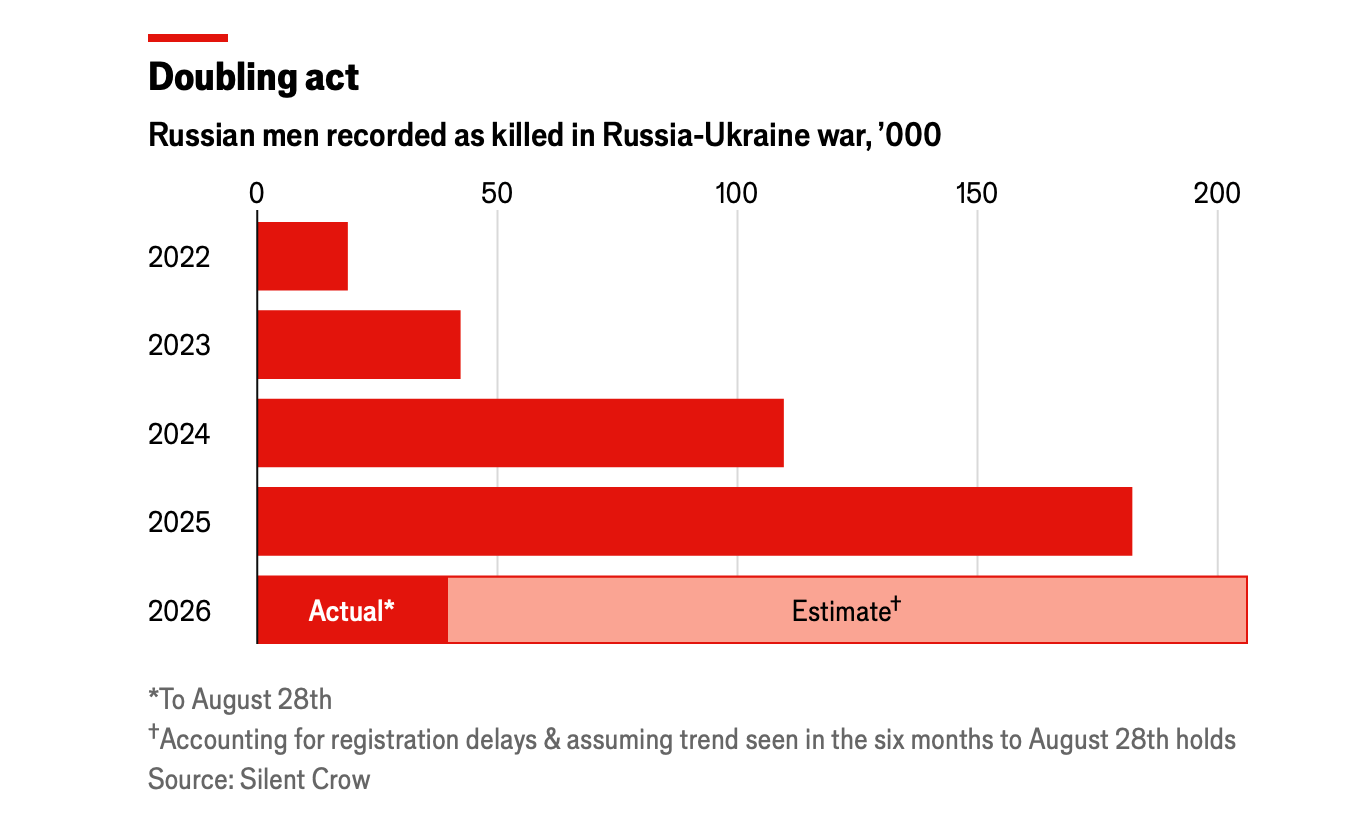
The NYT reports that the number is actually at least 700,000.
What this highlights to me is how contingent our political outcomes are. In 2022, I would’ve never thought that either Russia or Ukraine would tolerate casualties this high. We just don’t see this happening anywhere else for nations at that level of development. In fact, we don’t see interstate wars this bloody anywhere. And Putin’s approval rating has remained high. It shot up from around 70% at the beginning of the war to the 80s, and now is in the high-70s, according to the Levada Center.
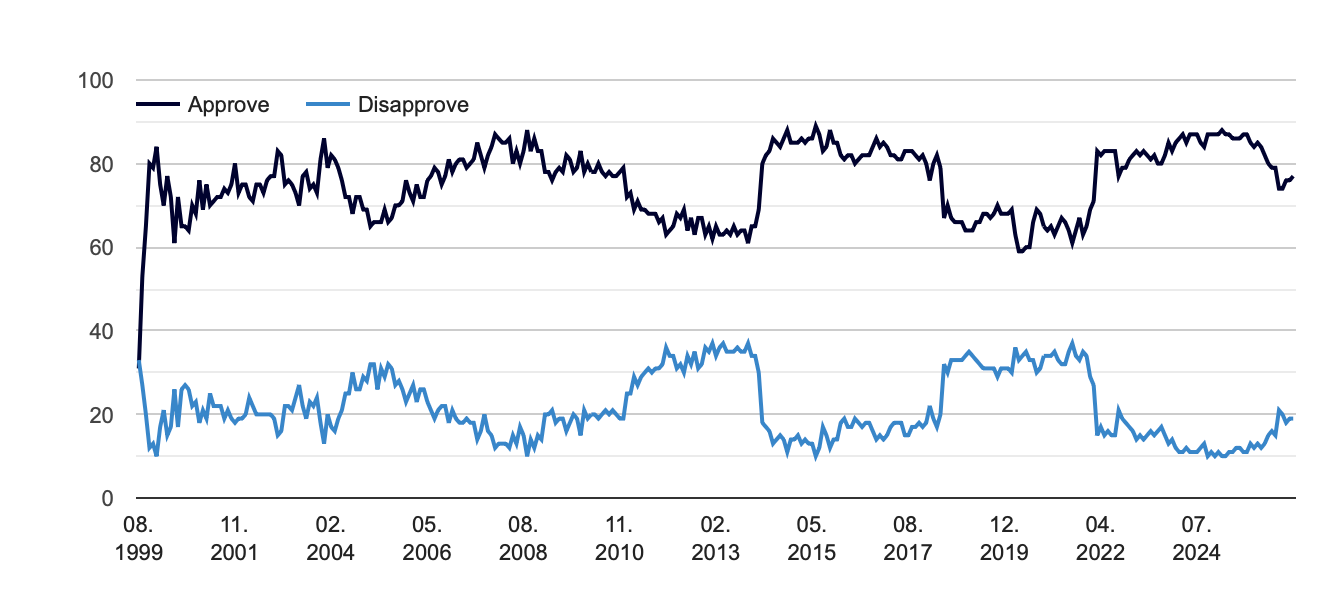
Yes, he’s a dictator and all that, but authoritarians have seen widespread unrest and resistance for much less than this. The Putinist system seems robust in ways that are difficult to explain by referring to the experience of other countries.
I have an explanation in Kakistocracy, and it’s rooted in the idea that Putin has in a sense stumbled upon a populist-authoritarian hybrid that is consistent with human nature.
The most successful dictatorships in the modern world—namely those of Singapore and the Gulf Arab states—can point to real accomplishments in maintaining social peace and high living standards. Leaders like Lee Kuan Yew and Mohamed bin Zayed have admirers even among more technocratically inclined observers in the West. But most authoritarian leaders achieve mediocre to poor results on objective measures people care about. Thus, they adopt populist rhetoric and policies in order to maintain legitimacy. This might seem like a contradiction, as above we noted that in the most advanced Western democracies, populism isn’t all that popular, with populist leaders and parties never achieving anywhere near majority support.
Yet this state of affairs exists in the context of societies where organic elites have power. At lower levels of societal development, those inclined to populism will make up a larger share of the population. We can think about it in the following way. Most humans are naturally inclined toward populist ideas, aesthetics, and ways of thinking. They are prone toward being nationalistic, conspiratorial, accepting of zero-sum thinking regarding economic issues, distrustful toward nonconformists and authority figures who tell them things they don’t want to hear, and partial to the traditional values of the society they belong to—in terms of stated attitudes and rhetoric at least, if not always personal behavior. At the same time, when societies are free, it allows for the emergence of organic elites who are less inclined toward such views and outlooks.
Therefore, in places where organic elites are oppressed, or have never had a chance to form institutions in the first place, dictators who adopt populist rhetoric and policies can maintain extremely high levels of support because those with power are pushing in the direction of human nature. Unable to rely on victories in free and fair elections to maintain legitimacy, they give the masses the kind of society they want in terms of rhetoric, strategies of moral suasion, and—to a much lesser extent, because the masses don’t pay much attention in this area—policy outcomes. In contrast, in democratic societies, organic elites emerge and push back against human nature, but they are not able to completely overcome it, so they maintain lower levels of support. Despite the fact that voters elect their leaders, the types of people who exercise the most power in such a system have emerged out of an elite bubble that is alienating to large swaths of the population. Thus, a spin dictator having sky-high levels of support is more common than a democratic leader achieving a similar level of popularity.
The fact that this level of support can be maintained in the midst of a conflict this senseless and bloody reinforces the theory. The support for authoritarian populists is not simply shallow and passive. People will make real sacrifices on behalf of the regime.
One thing that strikes me about clips from Russian TV is how much the personalities remind me of Fox News hosts like Hannity and Ingraham. This kind of chest-beating patriotic buffoonery has mass appeal. In America, however, we have organic elites to counteract it, and the stone-age cult of personality is limited to one side of the political spectrum, checked by the other. Russia is perhaps what the US would be if Fox News and online right-wing influencers who either worship Trump or criticize him only from the right were the only media allowed. In that situation, we could probably lose hundreds of thousands of Americans for some cause that looks objectively stupid and unjust to outsiders.
4. Pinker has finally released his magnum opus on AI risk. As expected, it’s brilliant and beautifully written. It seems like before he was devoting like 10% of his brain space to refuting doom arguments, but Scott Alexander finally prodded him into giving it his full focus, and the results don’t disappoint.
