
I recently read Frederick Douglass’ autobiography, and found it inspirational. When I expressed my enthusiasm on X, I got mocked by many for having just discovered this hip new writer.

When I think about why I didn’t read Frederick Douglass’ biography until now, part of the answer is that I basically never read anything in school, even what was assigned. Still, I’ve read a lot of books over the years, and I was never inspired to pick this one up. It’s kind of strange, though, since Douglass was the most prominent black intellectual of the nineteenth century, and I knew that he had been born a slave before escaping, so the story would obviously be of interest.
The true explanation of why it took so long is racism. It’s not that I ever supported slavery. But if you asked me to read a book on the topic, I would’ve said something like “Pstt!! Slavery was a long time ago, we emphasize it way too much. Today we have DEI and affirmative action and taxes that go to people of color. That’s kind of like slavery when you really think about it.” Only recently had I become enlightened enough to give Douglass a chance. So I apologize to this great man.
One of the more striking parts of the book to me was when the author went back and reunited with his old owner and the members of his family. In 1858, Douglass met with Amanda Auld Sears, who was the daughter of the family that had enslaved Douglass, after she had attended one of his lectures. Upon meeting with her some years later for a second time, he recounts the original reunion.
I was somewhat disconcerted when I was ushered into the large parlors occupied by about thirty ladies and gentlemen, to all of whom I was a perfect stranger. I saw the design to test my memory by making it difficult for me to guess who of the company was “Miss Amanda.” In her girlhood she was small and slender, and hence a thin and delicately-formed lady was seated in a rocking-chair near the center of the room with a little girl by her side. The device was good, but it did not succeed. Glancing around the room, I saw in an instant the lady who was a child twenty-five years before, and the wife and mother now. Satisfied of this, I said, “Mr. Sears, if you will allow me, I will select Miss Amanda from this company.” I started towards her, and she, seeing that I recognized her, bounded to me with joy in every feature, and expressed her great happiness at seeing me. All thought of slavery, color, or what might seem to belong to the dignity of her position vanished, and the meeting was as the meeting of friends long separated, yet still present in each other’s memory and affection.
Amanda made haste to tell me that she agreed with me about slavery, and that she had freed all her slaves as they had become of age. She brought her children to me, and I took them in my arms, with sensations which I could not if I would stop here to describe…
If any reader of this part of my life shall see in it the evidence of a want of manly resentment for wrongs inflicted by slavery upon myself and race, and by the ancestors of this lady, so it must be. No man can be stronger than nature, one touch of which, we are told, makes all the world akin. I esteem myself a good, persistent hater of injustice and oppression, but my resentment ceases when they cease, and I have no heart to visit upon children the sins of their fathers.
In 1877, Douglass went to see Amanda’s father, Thomas Auld, on the old man’s deathbed.
On reaching the house I was met by Mr. Wm. H. Bruff, a son-in-law of Capt. Auld, and Mrs. Louisa Bruff, his daughter, and was conducted by them immediately to the bed-room of Capt. Auld. We addressed each other simultaneously, he calling me “Marshal Douglass,” and I, as I had always called him, “Captain Auld.” Hearing myseld called by him “Marshal Douglass,” I instantly broke up the formal nature of the meeting by saying, “not Marshal, but Frederick to you as formerly.” We shook hands cordially, and in the act of doing so, he, having been long stricken with palsy, shed tears as men thus afflicted will do when excited by any deep emotion. The sight of him, the changes which time had wrought in him, his tremulous hands constantly in motion, and all the circumstances of his condition affected me deeply, and for a time choked my voice and made me speechless. We both, however, got the better of our feelings, and conversed freely about the past.
Though broken by age and palsy, the mind of Capt. Auld was remarkably clear and strong. After he had become composed I asked him what he thought of my conduct in running away and going to the north. He hesitated a moment as if to properly formulate his reply, and said: “Frederick, I always knew you were too smart to be a slave, and had I been in your place, I should have done as you did.” I said, “Capt. Auld, I am glad to hear you say this. I did not run away from you, but from slavery; it was not that I loved Caesar less, but Rome more.” I told him that I had made a mistake in my narrative, a copy of which I had sent him, in attributing to him ungrateful and cruel treatment of my grandmother; that I had done so on the supposition that in the division of the property of my old master, Mr. Aaron Anthony, my grandmother had fallen to him, and that he had left her in her old age, when she could be no longer of service to him, to pick up her living in solitude with none to help her, or, in other words, had turned her out to die like an old horse. “Ah!” he said, “that was a mistake, I never owned your grandmother; she in the division of the slaves was awarded to my brother-in-law, Andrew Anthony; but,” he added quickly, “I brought her down here and took care of her as long as she lived.” The fact is, that, after writing my narrative describing the condition of my grandmother, Capt. Auld’s attention being thus called to it, he rescued her from her destitution. I told him that this mistake of mine was corrected as soon as I discovered it, and that I had at no time any wish to do him injustice; that I regarded both of us as victims of a system. “Oh, I never liked slavery,” he said, “and I meant to emancipate all of my slaves when they reached the age of twenty-five years.” I told him I had always been curious to know how old I was and that it had been a serious trouble to me, not to know when was my birthday.
Nobody ever liked slavery after it was over! It’s touching that Douglass found it necessary to apologize for being unfair to his former enslaver when writing about his experiences.
In these meetings, we see a microcosm of what happened in the country as a whole in the years after emancipation. Before the Civil War, Southerners seceded from the Union on the grounds that black people were inferior and meant to be slaves. Texas’ declaration of secession said this outright.
We hold as undeniable truths that the governments of the various States, and of the confederacy itself, were established exclusively by the white race, for themselves and their posterity; that the African race had no agency in their establishment; that they were rightfully held and regarded as an inferior and dependent race, and in that condition only could their existence in this country be rendered beneficial or tolerable.
Alexander Stephens, the vice president of the Confederacy, was just as explicit in a March 1861 speech:
The prevailing ideas entertained by [Jefferson] and most of the leading statesmen at the time of the formation of the old constitution, were that the enslavement of the African was in violation of the laws of nature; that it was wrong in principle, socially, morally, and politically…
Those ideas, however, were fundamentally wrong. They rested upon the assumption of the equality of races. This was an error. It was a sandy foundation, and the government built upon it fell when the “storm came and the wind blew.”
Our new government is founded upon exactly the opposite idea; its foundations are laid, its corner-stone rests, upon the great truth that the negro is not equal to the white man; that slavery, subordination to the superior race, is his natural and normal condition. This, our new government, is the first, in the history of the world, based upon this great physical, philosophical, and moral truth.
Shocking that a belief in hereditary racial differences did not lead Stephens to embrace colorblind meritocracy. Someone needs to alert Cofnas.
Despite the clear historical record, once slavery was defeated, practically nobody argued that it should be brought back. In fact, the South retconned the entire Civil War to make the conflict about states’ rights, thus creating the “Lost Cause” narrative. In a sense it was, but that narrative begs the question of “the right of states to do what?” It was to own black people, which partisans of the South preferred to forget, despite what they said when they still hoped to gain independence. Moreover, when states’ rights conflicted with defending slavery, Southerners always decided to fight on behalf of the latter, as shown in debates over the Fugitive Slave Act and whether the practice could be excluded from federal territories. The downplaying of the role of slavery as the ultimate cause of the war continues to this day among rightists who complain about Confederate monuments being taken down.
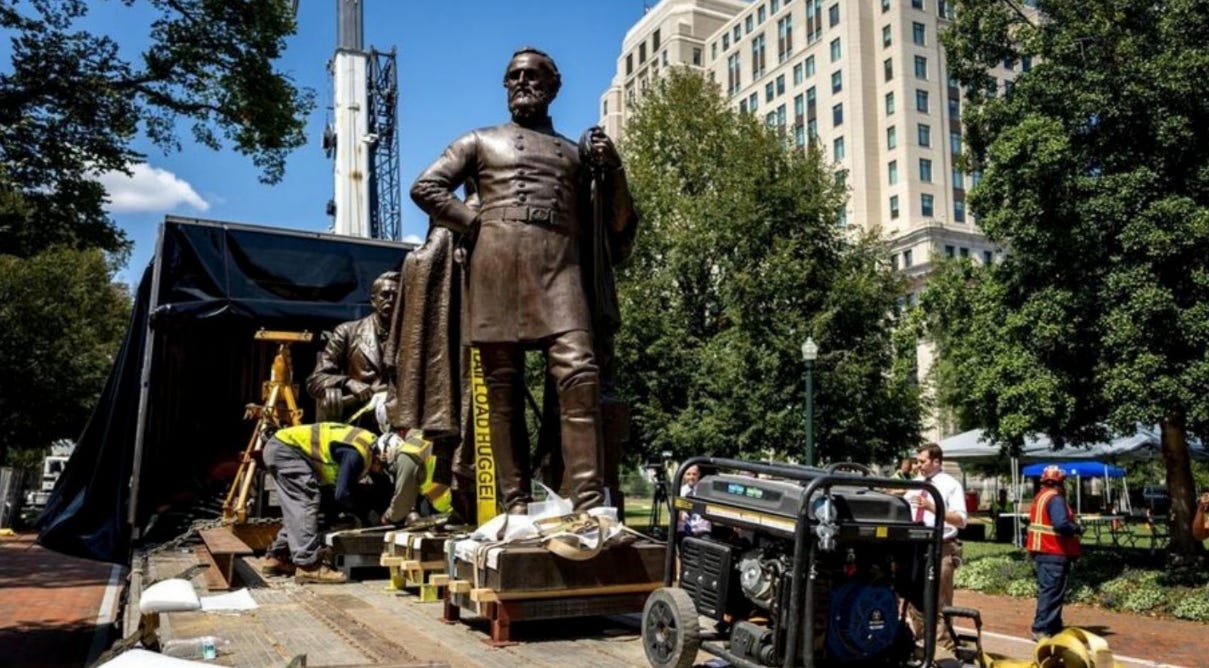
In 2018, Corey Stewart, the Republican nominee for Senate in Virginia, centered his campaign around preserving Confederate monuments. He was something of an outlier at the time, but the ideology of the Lost Cause would conquer the right. To take one example, Matt Walsh, enraged about a Robert E Lee statue being taken down in late 2025, lamented that the general was “a million times more honorable and courageous than all of the politicians applauding in this video.”
Recently, the Democrat-controlled legislature in Virginia voted to remove the last Confederate monuments from Capitol Square in Richmond. A writer at the Federalist calls this act part of “Leftists’ jihad against history.” The author goes on to say that “the activists who call for the removal of Confederate statues quickly move on to those of the founders once their demands are initially met. They’re hostile to all of American history, not just that of the Confederacy.”
Sure, some activists think like this. But Democratic legislatures are not going after the Founding Fathers. As for the far left, so what? If leftists didn’t distinguish Hitler from George Washington, does that mean we should all honor Hitler to spite them? The argument that men like Robert E Lee were brave is simply a non sequitur. A lot of enemies of America, and humanity itself, are brave. Hitler, Stalin, Mao, Saddam, and bin Laden all showed physical courage throughout their lives. We still don’t think that they’re worth honoring, based on what these men did and the causes they championed.
The Republican Party is now practically united on this issue. In the Virginia Senate, the bill to remove Confederate monuments passed on a party line vote, with all 19 Republicans in opposition. Just last May, South Carolina made it difficult to take down historical monuments without action by the state legislature. And the Trump administration has also gone to considerable lengths to restore the old names of nine Army bases that had originally honored Confederate officers. A federal law prohibits them doing this, so the Pentagon found a workaround by finding members of the military who had the same surnames as Confederates. Hence “Fort Lee,” originally honoring the military leader, is now named after Pvt Fitz Lee, a black soldier who won the Medal of Honor in the Spanish-American War.
The idea that the right is just blanketly in favor of “remembering history” is refuted by the reaction to the creation of Juneteenth. Jeremy Carl, the rare Trump nominee who couldn’t get past the Senate for being too explicit in his white identitarianism, acknowledged in 2021 that “if we could somehow strip away the dubious political context in which it was birthed, Juneteenth might indeed be worthy of national commemoration.” But because the motivation was ultimately the death of George Floyd and the energy coming from the Black Lives Matter movement, the purpose of Juneteenth must be understood as villainizing white Americans, which is its real “esoteric” meaning.
Of course, history itself will ultimately strip away the context of 2020, and the exoteric meaning of the holiday will remain. The right has come to the conclusion that any public recognition that slavery is wrong, that slaveholders were bad, and that emancipation was good is a victory for Marxists. All of this shows that “own the libs” is not simply something influencers do on Twitter, but has become the basis of right-wing intellectual theorizing. Matt Walsh might fulminate in Tweets and Carl may write long essays, but they share a basic emptiness in being unable to take a stand on even the easiest moral questions if doing so can be seen as a concession to political opponents.
None of these people, of course, want to bring back slavery. And I understand the underlying impulse here. In 2021, I would’ve agreed with Carl’s essay, and it’s possible I read it at the time and nodded along. But this is a classic case of hatred deforming the soul. When not even slavery can motivate an unequivocal denunciation from your movement anymore, you’ve got to stop and ask yourself what you’re doing.
This post is sponsored by Mechanize. They are hiring software engineers at a base salary of $300K-$400K/year, plus substantial bonuses. They also have openings for other positions, including Research Engineer ($500K base pay), Recruiter ($200K), Growth Manager ($250K), Interns ($150/hr), and legal counsel ($400K). You can even “build your own role.” Here is their website, and you can apply here. If you apply, make sure to use the links provided here so I can receive credit, and name me as a reference in the process.
In all the Old South, there is not one statue of James Longstreet, Robert E. Lee's "old warhorse" and right-hand man after the death of Stonewall Jackson, and also one of Ulysses Grant's West Point classmates and best friends, whom he and Lee surrendered to at Appomattox.
After the war, Longstreet was a fervent supporter of Grant, Reconstruction, and rights for freed slaves. He led mixed race militias against the Ku Klux Klan and other recalcitrant Southern whites in pitched battles.
This explains why no statues of Longstreet were erected with all of the other Confederates during Jim Crow, but begs the question of why no one else ever bothered to do so, except for the one on the Gettysburg battlefield.
Longstreet proves people really can change, and that makes many people, including those who see white supremacy behind every bush, uneasy. We should remember Longstreet at least as much as we remember Grant and Lee.
It is sad to see the right’s conflation of a focus on the evil of slavery with hate for America. When I read about these great figures like Douglass and Lincoln I feel more patriotic, not less.