
Conservatives report higher levels of mental health than liberals. Recently, Derek Thompson profiled a study by Schaffner et al. (2025) arguing that this might be due to liberals being more comfortable putting their problems in therapeutic terms. That paper begins by confirming earlier studies showing a mental health gap, which is reduced but still there when controlling for a wide variety of factors in a sample of 60,000 US adults. The authors then get a representative sample of a thousand, asking half of respondents about mood and half about mental health. The mental health difference is as expected, but there is no gap in reported mood at all. This implies that conservatives are more likely to say their mental health is fine even if they might not be any happier.
Lakshya Jain responded by publishing the results of a new survey for The Argument, finding that liberals tend to do worse on a “well-being score”, which largely avoided the language of mental health but asked about things like social relationships, anxiety, and whether individuals dislike themselves. Moreover, conservatives have described themselves as happier in the General Social Survey since 1972. Peltzman (2023) includes the following graph, with happiness scores rated on a scale of -100 to 100.
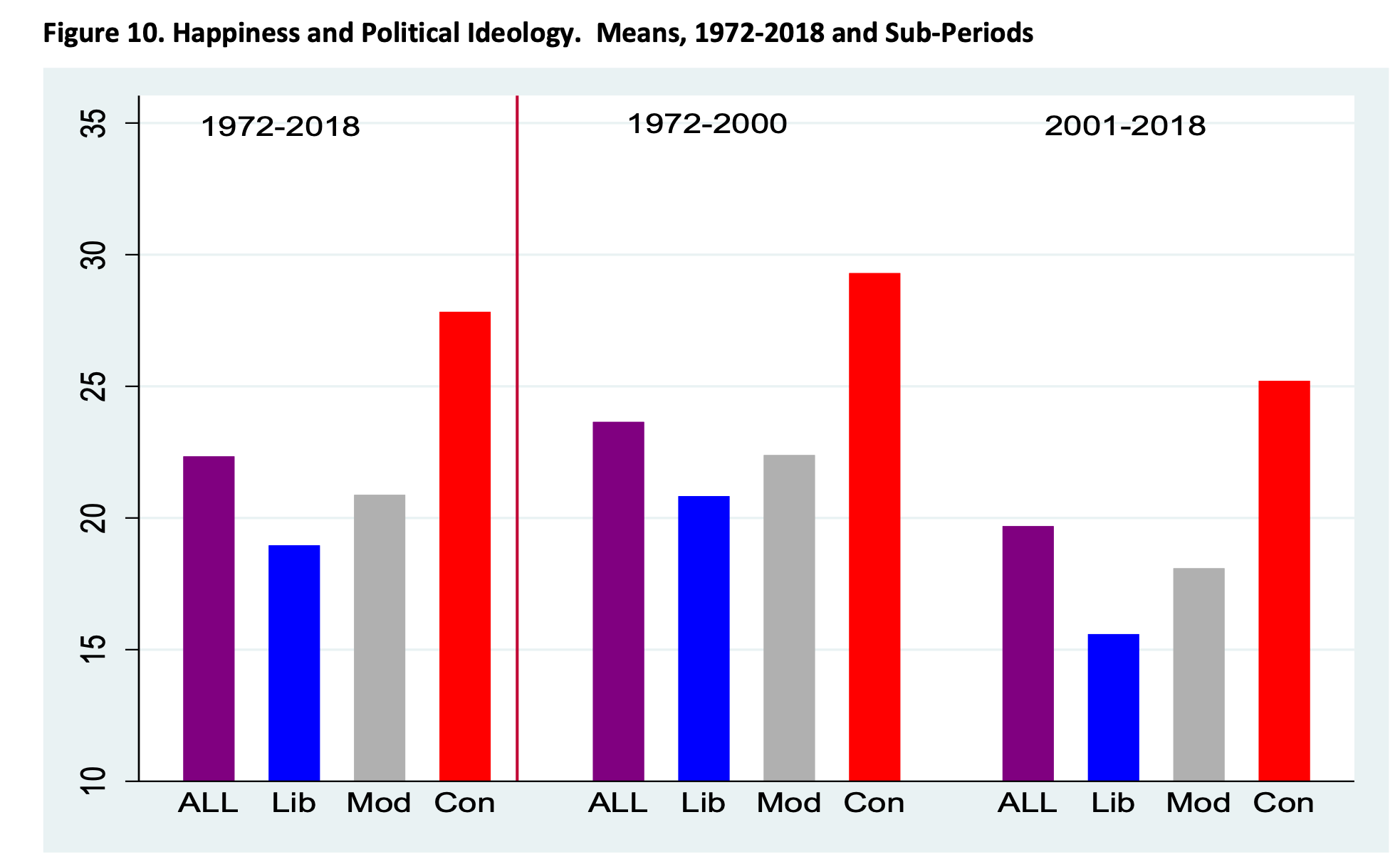
Overall, Schaffner et al. is not enough on its own to conclude that there is no mood or happiness gap based on ideology. Asking about mental health in particular may exaggerate underlying differences between conservatives and liberals, but they’re still there according to a wide body of research.
If, compared to liberals, conservatives are happier, have better mental health, or whatever else we want to call it, what might be the reason for this? There are three broad possibilities:
Liberalism causes poor psychological outcomes
Poor psychological states cause liberalism
There is some trait X that is correlated with liberalism and psychological outcomes
Note that in figuring out what X might be, we are usually not talking about normal demographic correlates like age and sex, since every competent scholar is going to control for such factors. There must be something going on that is a lot less obvious.
Theory: Liberals Accept Therapy Culture
I start with the intuition that one of the things most likely to cause mental health outcomes is beliefs about mental health. A similar view is put forward in Abigail Shrier’s Bad Therapy, which argues that it is the focus on mental health itself that is causing young people to become more anxious and miserable. The idea that priming can affect outcomes is so widely accepted that medical trials as a matter of course test treatments against placebos. If more purely physical health outcomes can be shaped by expectations, isn’t this even more likely for mental health?
We even have direct evidence that mental health interventions for young people make certain psychological problems worse. According to a 2023 review,
A growing body of quantitative research indicates that some school-based mental health interventions can cause iatrogenic harm (adverse effects from the treatment approach itself). Psychological interventions more generally can lead to a range of harms, but this research in schools specifically demonstrates an increase in internalising symptoms relative to control groups. A meta-analysis of anti-bullying interventions found that, in some studies, students who were taught cognitive–behavioural therapy (CBT) skills experienced an increase in internalising symptoms relative to control groups. A randomised control trial of another CBT-based school intervention also found an increase in internalising symptoms in the intervention group compared with those who had their usual lessons. These findings tell us there were instances when, on average, a participant was worse off receiving the intervention than not receiving it – i.e. this is evidence of iatrogenic harm.
It is also important to consider whether there are subgroups of adolescents who will experience harms from interventions, which may be masked when findings are averaged. For example, a recent trial assessing mindfulness lessons in secondary schools found that overall there was no change in depressive symptoms in the intervention (or control) group, but that adolescents with elevated levels of mental health symptoms at baseline experienced a small increase in depressive symptoms after the intervention, relative to those who had their usual social-emotional teaching. This should indicate to all researchers and clinicians that even if there is evidence that a school-based intervention is effective or ineffective on average, there may still be a minority of participants to whom it can actively cause harm.
My theory then, is that liberals accept more of what I call therapy culture, and therapy culture causes worse moods and mental health outcomes. I define therapy culture as a belief in the idea that normal human beings are psychologically fragile and need care from professionals in order to achieve happiness and mental stability. Therapy culture is also associated with the idea that society should devote more time, effort, and resources toward actively looking for ways to diagnose and solve psychological problems through clinical interventions.
If my theory is true, then it makes a few straightforward predictions
An acceptance of therapy culture is correlated with worse mental health/worse moods.
Such correlations hold when controlling for ideology.
The gaps in mental health and mood between conservatives and liberals shrink or disappear when acceptance of therapy culture is controlled for.
You can change people’s beliefs about therapy culture through messaging, and perhaps ultimately impact their mental well-being.
Survey Design
In order to test my theory, I put together a survey of respondents recruited through X, Substack, and Bluesky. This was an opt-in study, which means that it has some limitations. That said, the survey is not investigating something as straightforward as generalizable public opinion on issues, but trying to get at the effects of certain variables on others. This mitigates some of the issues with non-representativeness.
The survey began by asking basic demographic questions: age, sex, race, religion, and country. All these questions were randomized. Then I had people read one of three treatment conditions: a neutral text (50% of respondents), a short text making the case for therapy culture (25%), and a short text making a case against it (25%). See the codebook below for the actual text. Finally, the last page of the survey randomized questions and asked people the following.
Their daily mood on a scale of 1-5, from very bad to very good
Their mental health on a scale of 1-5, from very bad to very good
Which political party they identified with, if they were Americans
To describe themselves on a five-point scale from very liberal to very conservative in terms of social issues, economic issues, and overall
To say how much they agreed with the statement that religion was very important in their life, on a scale of 1-5
The degree to which they agree with the basics of therapy culture.
For (6), I created a therapy culture scale based on the sum of the following six questions, with respondents asked how much they agreed with each statement on a scale of 1 (strongly disagree) to 5 (strongly agree).
I think more people should go to therapy.
People who feel depressed or anxious should take more responsibility for their situation. (reverse coded)
All people have mental health issues that they need to work on with trained professionals.
Society should spend more money on helping those with mental health issues.
Many psychological problems would go away if people just stopped worrying about them. (reverse coded)
People can generally recover pretty easily from many events considered traumatic. (reverse coded)
Results
First, let’s look at the connection between belief in therapy culture, self-reported mood, self-reported mental health, and ideology. Note that all the results in the rest of this essay are for American respondents only.
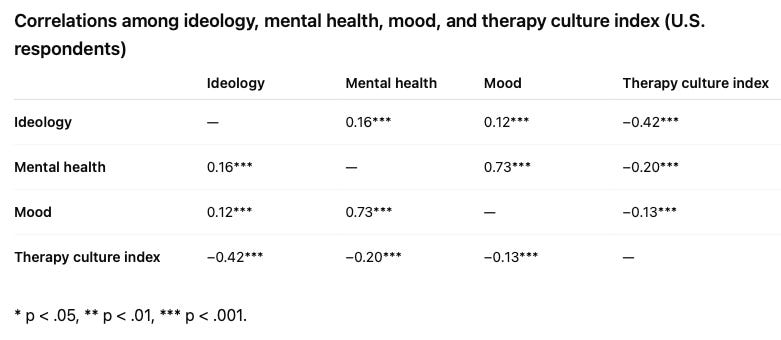
Quite strong. Therapy culture correlates at -0.42 with ideology, indicating that a supposed effect of ideology in studies might just reflect a belief in therapy culture. Mood and mental health correlate at 0.73, indicating that the two are closely related.
Here’s what happens as you go from very liberal to very conservative in terms of standardized values for therapy culture index, mental health, and mood.
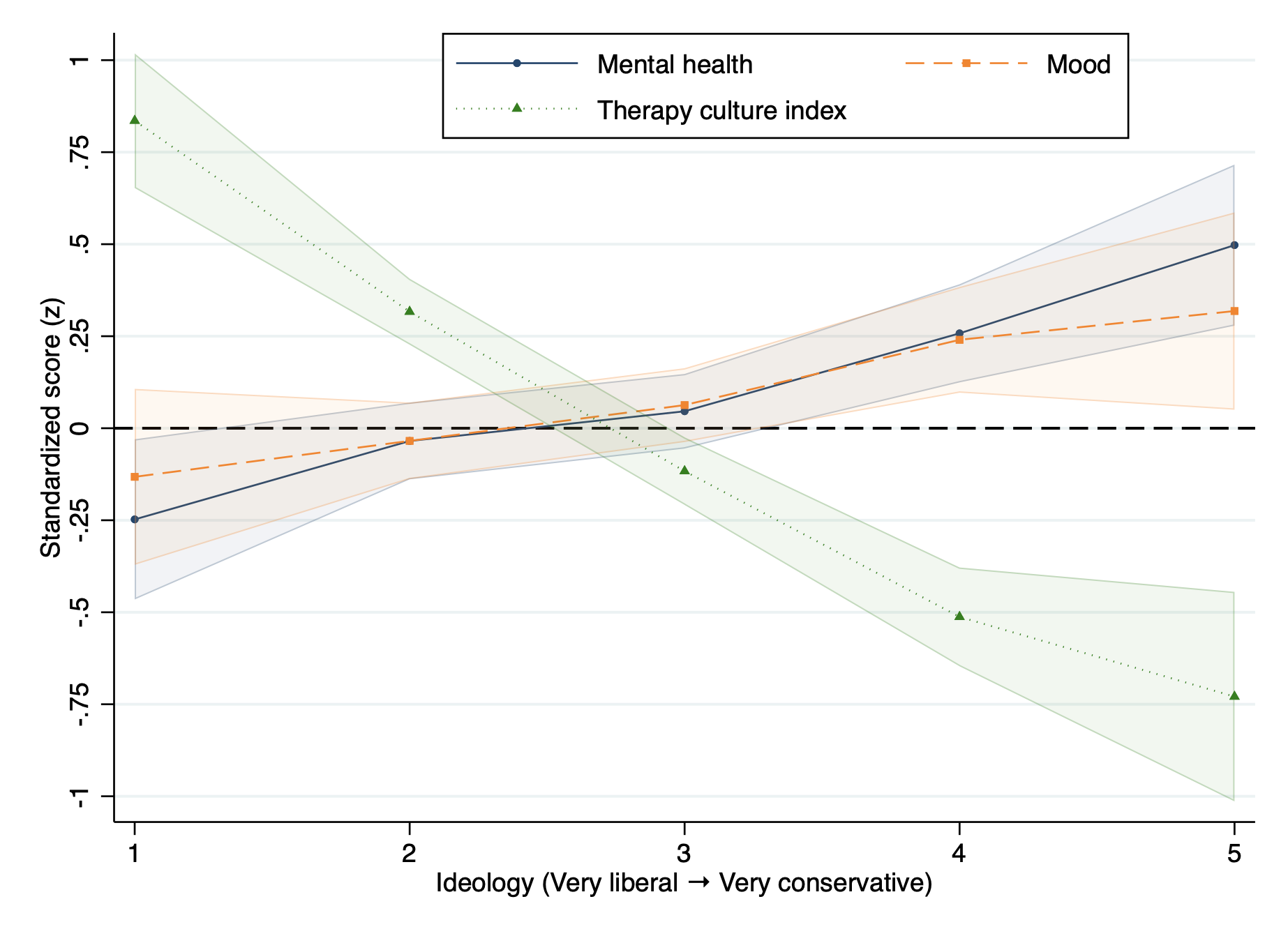
In terms of belief in therapy culture, there’s about a 1.6 standard deviation gap between those who are very liberal and very conservative! This is absolutely massive. The connection of ideology to mental health is weaker, and mood weaker still.
Finally, the table below is the ultimate test of my main theory, showing the results of four regressions. Model 1 has mental health as the dependent variable. The independent variables are sex (1 = female), race (1 = white), age, importance placed on religion, and overall ideology. Model 2 is the same as Model 1, but with the standardized therapy culture index added as a predictor. Model 3 and Model 4 do the same for mood rather than mental health. People who identified as neither male nor female are dropped. Those who listed their race as other and filled something in are included and coded as non-white.
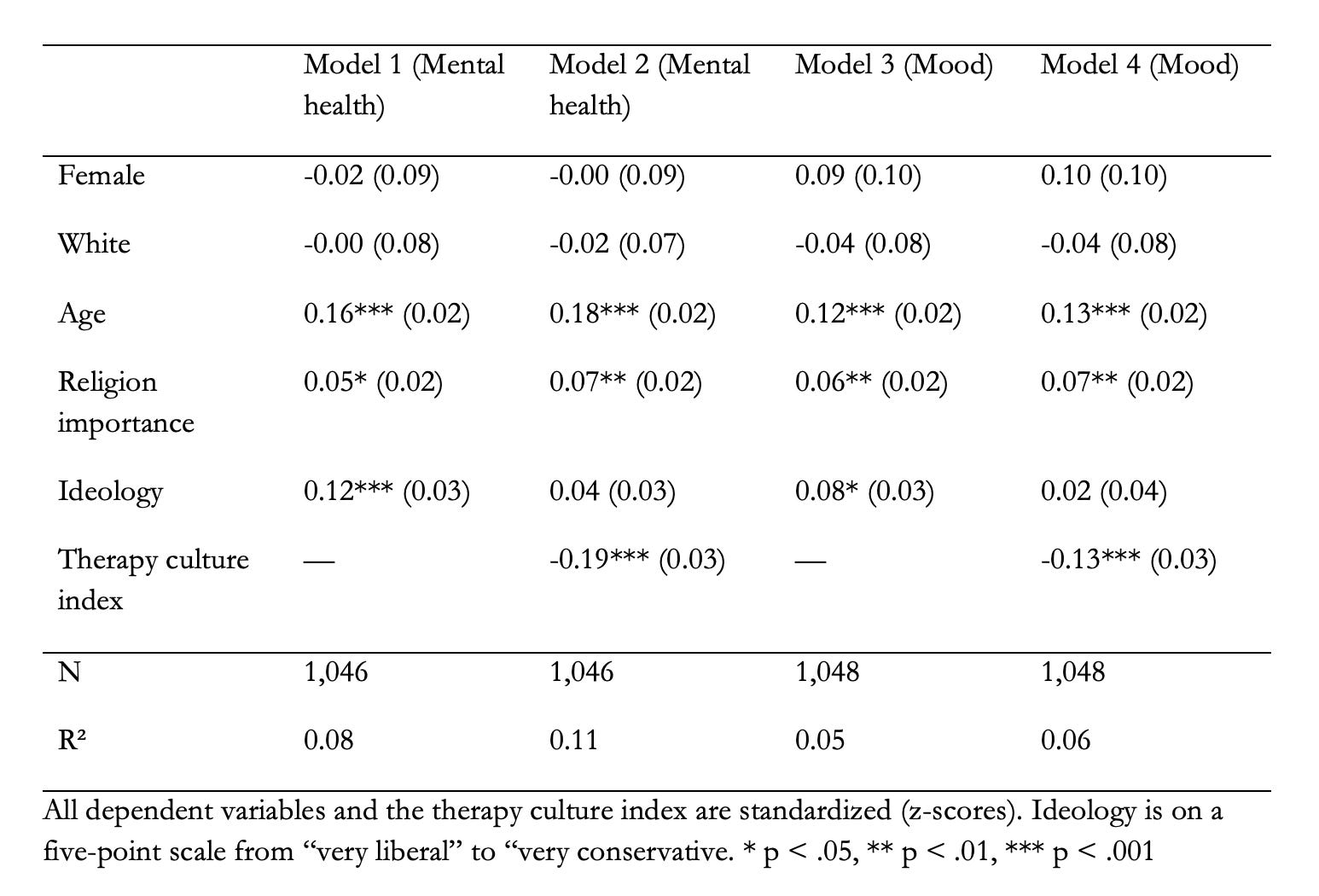
The prompts had no effect on mood or mental health, so I ignored them in the main models. When I add dummies for the two non-neutral prompts and run Models 1-4 again, the results don’t notably change, so I am going with the models that do not have dummies.
Above, we see that a one-point shift in ideology in the conservative direction is associated with 0.12 SD better mental health, and 0.08 SD better mood. But the effects of ideology disappear into insignificance once you add the therapy culture index, which is associated with a standardized effect of -.19 on mental health and -.13 on mood. These are very large effects.
Since some of you can’t read regression tables, here is the same info in visual form.
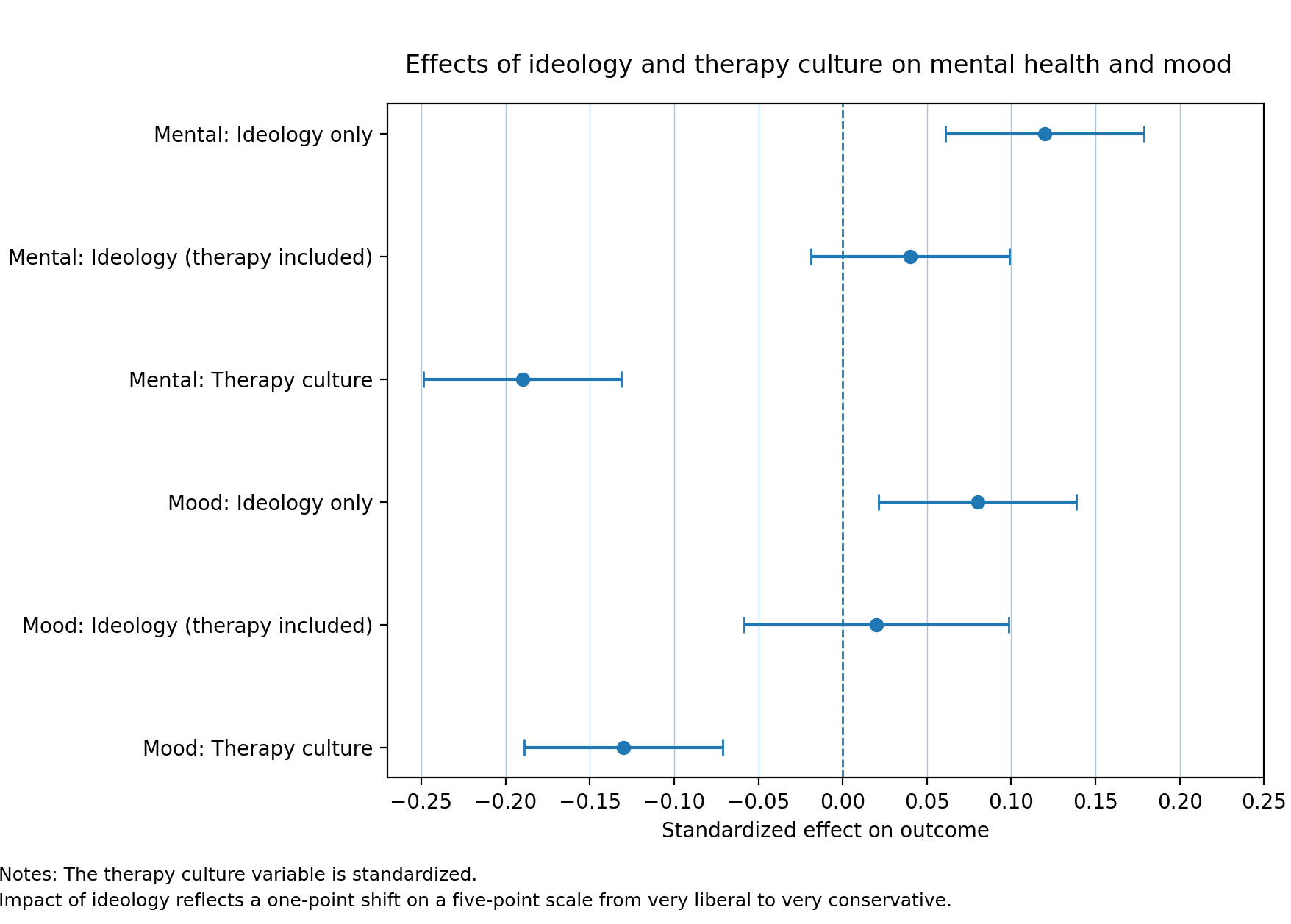
Regarding the prompts, the pro-therapy culture one did in fact move people toward accepting therapy culture (β = 0.12, p = 0.10) and the anti-therapy culture prompt pushed them in the opposite direction (β = -0.16, p = 0.03). That said, there was no detectable mediation effect in terms of shifting perceptions of mental health or mood through changing views on therapy culture. This makes sense, as changing people’s attitudes on therapy culture might not be expected to immediately change their views on their own recent psychological state. But given the apparently large effects of belief in therapy culture on mental health and mood, it seems likely that persistent messaging over time can shift people toward better or worse psychological states.
Limitations and Promise
Although I find the results very exciting, my small study is not on its own going to revolutionize the field of political psychology. The hope here is to inspire research with larger and more representative samples to get at exactly what the connections are between ideology, on the one hand, and mood and mental health, on the other.
I started with the intuition that mental health is likely to be most directly affected by attitudes towards mental health than most other ideological, political, or social views. This is for the same reason that a placebo given to someone to make their neck pain go away is more likely to affect feeling in their neck than other body parts. Two lines of evidence suggest that what I call therapy culture has a negative impact on mental health. First, in the US and among some other nations, mental health challenges appear to be increasing as therapy culture becomes more embedded in our medical systems, governments, and broader cultures. Second, certain randomized control trials find that mental health awareness and similar interventions can make people psychologically worse off.
People who write about politics are interested in the political angle of this issue. But individuals identify as conservatives or liberals for all kinds of reasons, and it is doubtful that say, views on the marginal tax rate have much of an inherent connection to mental health. Differences in religiosity seem to be part of the story. The findings here also indicate that an acceptance of therapy culture itself might explain a large part, if not all, of the connection between ideology and mental well-being.
Other causal pathways may explain the results presented here. Perhaps having mental health problems causes a belief in therapy culture, rather than the other way around. Randomized control trials that involve interventions changing people’s levels of happiness or belief in therapy culture over an extended period of time could help clarify the exact nature of the relationships between the variables of interest. It would be interesting if making people sadder causes them to embrace therapy culture, or embracing therapy culture impacts mental health or mood. I would guess causal arrows go in both directions, indicating that people for better or worse fall into self-reinforcing cycles, in which their beliefs about mental health affect their ideas, and those ideas in turn affect mental health.
This study is obviously not the final word on anything. I designed this survey on Friday, and have published it on Monday. But the results are highly suggestive. They indicate that there may be a direct and straightforward explanation of the mental well-being gap between conservatives and liberals. Even more importantly, if the main theory put forward here is correct, it would imply that society may need to completely rethink our approach to human psychology and how we conceptualize mental health.
Note: You can find the raw data below, along with the codebook. Statistical analysis was conducted through Stata. Reach out if you have any questions or are looking for more of the coding.

When I lost my Christian faith at the age of 15, therapy culture and far-left ideology swooped in to fill the void (Tumblr was the medium). I’m grateful for CBT techniques and the meditation practice I picked up along the way, and I’m still in therapy now (IFS). But I cringe when I witness fellow liberals treating therapy like it’s a metaphysical framework with which to interpret the world. Because that used to be me!
Advances in the field of mental health have been objectively great for many people suffering from psychological issues. The problem is when therapy masquerades as the transcendent, the alpha and the omega, the point of it all.
I see the cause as a confluence of our cultural woes: hyper-individualism, hyper-immanence, high expectations of consumerist comfort, and intellectualism winning out over the mysteries of the heart and body. And liberals fall prey to it more easily because 1) our focus is more national/global, outside our locus of control, which makes us feel helpless and small, and 2) our belief in immanence over the transcendent fails to relieve us of any spiritual burdens. So we seek comfort where we can find it.
For all my critiques about my Southern Baptist upbringing (and there are many), religion/spirituality is better than medicine/science in making sense of our souls and comforting us in our pain.
Jonathan Haidt has done a lot of thinking and writing about the mental health implications of differing political ideologies. In general he posits that ideologies foregrounding an external locus of control (i.e., victimhood) have much poorer mental health outcomes than ideologies centering an internal locus of control (ie self reliance and resilience.).
Traditionally progressives have ceded much more agency to social forces rather than individual action and look to society for solutions. This can coincide with or even encourage feelings of helplessness and resentment. Not good for mental health.
Conservatives are often associated with self reliance but I don’t think that really applies to MAGA which is much more focused on grievance politics. According to Haidt’s theory, MAGA conservatives should also be experiencing a decline in mental health.