
From the earliest days of the civil rights movement, a taboo on accepting inherent racial differences in intelligence was already deeply embedded in American intellectual life. An amusing demonstration of the power of the taboo is found in a pro-segregation 1961 book called Race and Reason, written by Carleton Putnam, who had been chairman of the board of Delta Air Lines. The argument presented was Cofnasesque – by refusing to emphasize biological differences between the races, Southerners were left defenseless against their enemies in debates over segregation. The problem was that white Southerners loved blacks too much to tell the truth about them.
White Southerners understood the Negro and in large measure loved him. They realized that the agitation rending the South originated with organized white minorities in conjunction with mixed-bloods well over on the white side of the spectrum. They deplored the deterioration this agitation was producing in existing race relations in the blacker South. Yet they could scarcely bring themselves to hurt their own. The South, after generations of experience, had developed customs and a way of life with the Negro that took his limitations into consideration with a minimum of friction and a maximum of kindness. It was entirely against these customs, these adaptations, openly to analyze and publicize the reasons for them.
Segregationists didn’t completely avoid race science arguments in all contexts. Putnam’s book itself became popular, and was even endorsed by Senators Strom Thurmond of South Carolina and Richard Russell of Georgia. Around this time, the governor of Alabama commissioned a study on race differences in intelligence to be used in desegregation cases, and the resulting work was a 1962 book called The Biology of the Race Problem, written by a UNC anatomist named Wesley Critz George.
That said, when making arguments to Northern audiences, as they did in the 1956 Southern Manifesto, segregationists generally avoided any discussion of heredity. Maybe this was because for every race scientist they could produce, liberals could cite many more egalitarians from even more prestigious universities.
What is interesting here is that Jim Crow lasted in the South, along with social segregation and the acceptance of racial inequality in the rest of the country, decades after the taboo on race and IQ was established. This poses quite the problem for the theories of Nathan Cofnas.
Before getting more into this, it’s worth noting that, for someone who told everyone to shut up about race and IQ, I’ve been talking a lot about the subject.
Not in a direct way, exactly. In contrast to the old stale debate, I feel like there’s still something to say about whether we should discuss the topic and in what contexts. In other words, talk of race and IQ is not very productive, but metaconversations about race and IQ still can be.
The Arday scandal has put Cofnas in the news, and we can say that Cofnasism is a simple four-step argument.
Blacks and whites differ in cognitive and behavioral traits for genetic reasons, a view that we can call race realism.
Mainstream intellectual life denies this fact.
The denial of race realism makes it logical to be a woke leftist.
Wokeness will never be defeated until people become race realists.
Cofnas’ defenders agree with him on each of these points, while his critics tend to be leftists who deny race realism. Yet people who accept that race realism is true but don’t agree with 3 and 4 are generally silent. They think it’s usually not worth it for an intellectual to come out as a hereditarian, so they have no reason to say “Cofnas is right on genetics and IQ, but wrong in his larger political and social analysis.”
That is a shame, because it is #3 and #4 where Cofnasism is weakest. I’ve argued this before, but the Arday debacle has inspired me to give it a more thorough treatment based on American history. The idea that a denial of race realism leads to wokeness is inconsistent with what we’ve seen happen since the first half of the twentieth century. The taboo on talking about race and intelligence significantly predates Critical Race Theory, affirmative action, and the Civil Rights Act by decades. No matter how you define “wokeness,” it took a long time for society to get there after the taboo was established. This at the very least poses a deep problem for Cofnasism, though, as will be seen, not one that is insurmountable.
Race Scientists Lost in the 1920s
Cofnasism predicts that you would rarely or never have a situation where a society both 1) denies hereditary cognitive differences between groups; and 2) is not left-wing or woke on racial issues.
Watching people debate the taboo on race and IQ on Twitter, I’ve seen some say that an intellectual hostility to race realism is something new.
These people don’t know what they’re talking about.
It is true that, in the first quarter of the twentieth century, eugenics and race science were completely mainstream at the most prestigious American institutions.
A. Lawrence Lowell, president of Harvard from 1909 to 1933, supported eugenics research, fought for quotas on Jewish students, and banned blacks from living in the freshman halls. In 1920, Harvard psychologist William McDougall published The Group Mind, in which he wrote that “the negro brain is decidedly smaller than that of the white and yellow races,” and credited blacks with naturally having a “happy-go-lucky disposition” and being disposed to “unrestrained emotional violence and responsiveness.” Elsewhere, he added that the “innate qualities, mental and physical” of blacks were so different from whites that it made it seem as if absorption into the American nation was impossible.
David Starr Jordan, the founding president of Stanford University until retiring in 1913, served as the inaugural chair of something called the Eugenics Committee of the American Breeders Association. Henry Fairfield Osborn was a Columbia zoology professor and president of the American Museum of Natural History. In 1921, the museum hosted the Second International Eugenics Congress, with Osborn as chair and Alexander Graham Bell as the honorary president. Among the attendees was Leonard Darwin, the son of the great scientist, who suggested encouraging larger families among the upper classes and using X-rays to sterilize criminals, imbeciles, and drunks.
One estimate counts 376 American college courses in eugenics as of the late 1920s. These ideas were also reflected in policy. Some thirty American states had involuntary sterilization laws, and race science motivated activists who fought in favor of the restrictionist 1924 Immigration Act. The congressional debate involved testimony from Harry Laughlin of the Eugenics Record Office, which was supported by the Carnegie Institution, with the witness arguing that recent migrants were disproportionately criminal and degrading the quality of the American population.
The triumph of race science did not last. In his classic book The Nature and Origins of Mass Opinion, the political scientist John Zaller documented how views on race and intelligence evolved toward current dogma over the 1920s. In 1923, Carl Brigham, a Princeton psychologist and leading authority on race, wrote that science had demonstrated that Nordics were naturally more intelligent than “Alpine, Mediterranean, and negro groups.” Only seven years later, Brigham said he had been mistaken, calling one of his own racial studies “pretentious” and “without foundation.”
Columbia professor Elazar Barkan notes that when Nazis came to power in 1933, scientists in the US generally saw their racial views as not worth taking seriously. In the US, hereditarians were “marginalized by institutional anthropology in the 1920s.” University of Michigan history professor Perrin Selcer writes that “by the start of the Second World War, the consensus among psychologists (although not yet among biologists, geneticists, and physical anthropologists) held that there was no discernible innate difference in intelligence between races — at least it did in the United States.”
In 1950, the dominant view among nearly all academic disciplines was formalized when the United Nations Educational, Scientific and Cultural Organization (UNESCO) published a statement on race that declared: “given similar degrees of cultural opportunity to realize their potentialities, the average achievement of the members of each ethnic group is about the same.”
There were certainly exceptions to the general rule. The physical anthropologist Carleton S Coon – yes, that was his actual name – spent time as a lecturer at Harvard before taking up a position at Penn in 1948. He remained a public figure into the 1960s, but his racialist theories increasingly placed him outside the mainstream. In 1969, Arthur Jensen’s famous Harvard Educational Review article on race differences in intelligence caused a nationwide controversy. The backlash at Berkeley included protests, flyers denouncing Jensen and his ideas, and threats that forced a class to change locations. He remained a well-respected scientist protected by tenure, but left few successors in academia.
Thus, if we trace the defeat of race realism among elites to 1930, it occurred around 34 years before the Civil Rights Act, and it would be a further half century before we got modern wokeness.
As has been common throughout history, mass opinion shifted after elite opinion did. In 1942, 42% of white Americans said they thought that blacks were just as intelligent as whites, meaning that they could “learn just as well if given the same education.” That number shot up over subsequent decades, and by 1956, 78% of whites believed that the races were inherently equal in intelligence, including a majority of white Southerners. It is perhaps unsurprising then that segregationists tended not to make hereditarian arguments while pushing back against the civil rights movement. Such views didn’t even have majority support in their own region of the country. In Eisenhower’s America, race realism was already a radical position.
Anti-Race Realism and Anti-Woke
Race realism continued being taboo. In 1994, only 12% of Americans said that black struggles were due to “less inborn ability to learn.” That same year, however, 59% of Americans agreed that blacks who couldn’t get ahead were mostly responsible for their own condition, compared to only 32% who said racial discrimination was the main reason. The first answer was still a majority position as of April 2024.
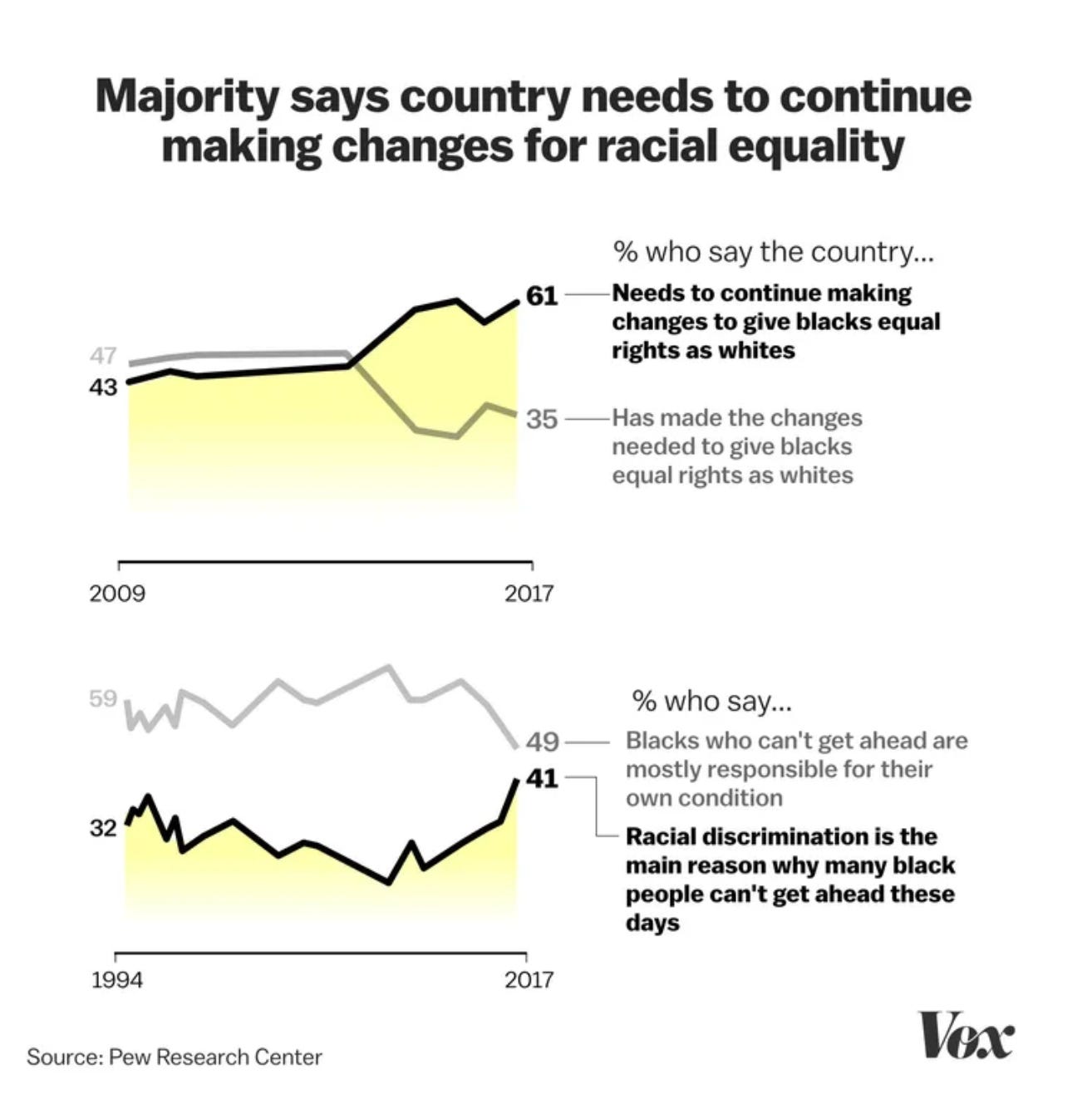
So we have an approximately 65-year period, from the mid-1940s to at least about 2010, in which most white Americans rejected both race realism and wokeness. That’s a very long time. The mainstream American position was “all races are born equal, but inequality exists because some groups have worse cultures or don’t try as hard.” Many clearly find Thomas Sowell more compelling than Ibram X Kendi.
It’s true that we’ve basically had some form of affirmative action almost as long as elites have rejected race realism. Yet it was a while before we got anything close to full-blown wokeness. In 1973, around 3% of American professors were black. This was about half a century after the defeat of race realism among elites. The nation obviously hadn’t descended into egalitarian madness by that point.
It’s true that by 2020, the share of black professors had increased to 5.7%. In 2017, 6.7% of tenure-track faculty hires at R1 universities were black. The percentage briefly shot up to a much higher number during Floyd, but by 2024 it was back down to 7.7%. So, assuming current trends continue, academia is going to stabilize over the next few decades with blacks at about 60% representation relative to their percentage of the population. Of course, this isn’t a question of pure numbers, because the harms of wokeness are more a matter of decreasing standards overall than special favors given to certain groups.
While affirmative action in some form has existed among elite institutions for a very long time, the point is that it was relatively contained until the 2010s, both as a cultural and policy matter.
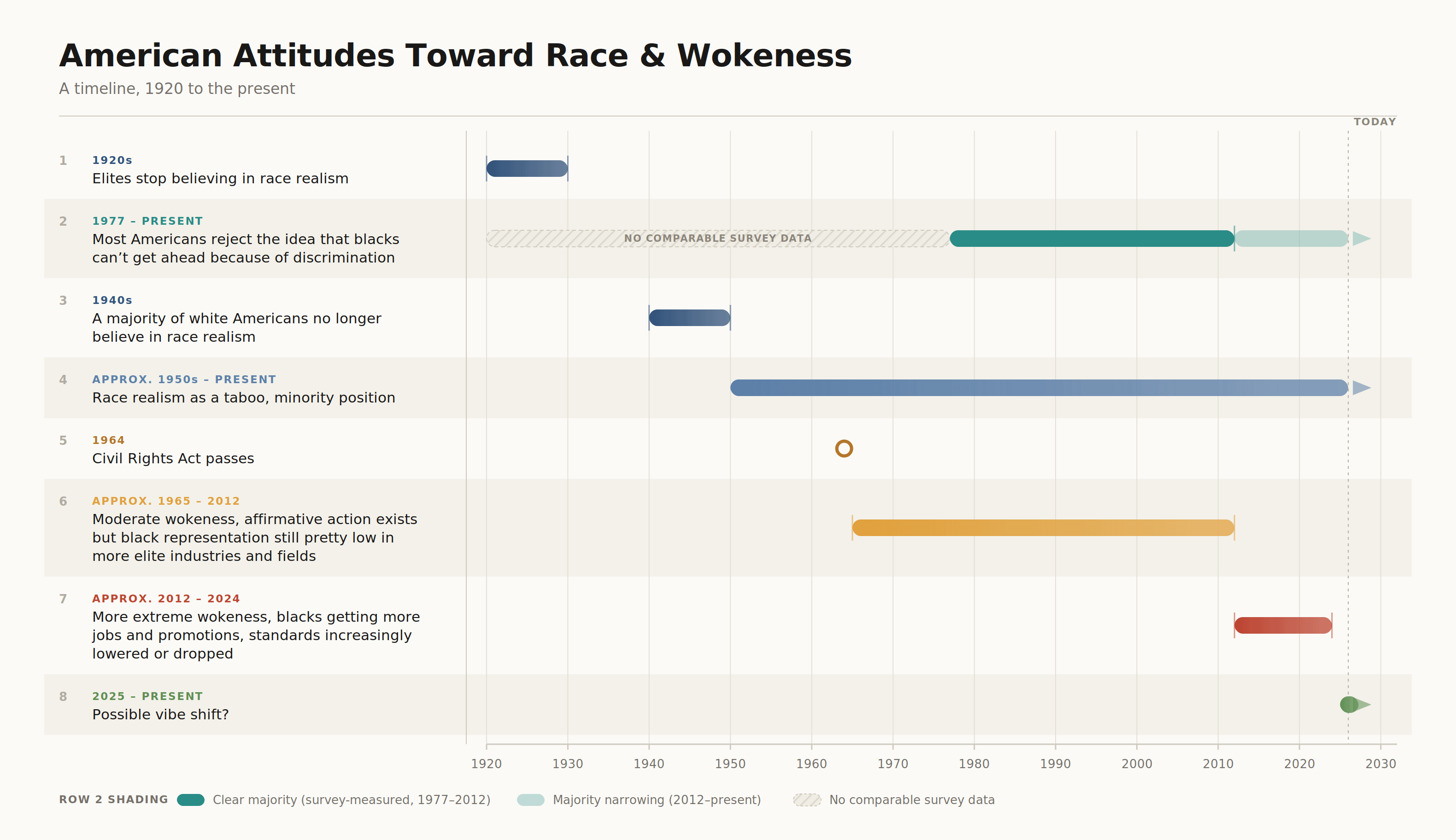
See the timeline below of American views on race and wokeness, which is generally inconsistent with Cofnas’ theories.
The Possibility of Gradual Change
I think there’s a way to save Cofnasism here, and it requires a delay between when an idea becomes accepted and when its full implications play out. For example, the demographer Jesús Fernández-Villaverde argues that the birth control pill can be seen as responsible for the recent fertility collapse through changing our values surrounding marriage, courtship, and sex. Given cultural inertia, it took a few generations for the larger shift to occur.
It’s not as if birth control becomes available, and then everyone instantly adopts new ideas about gender roles, women in the workplace, and premarital sex. Over time, technology exerts a subtle influence on values, which change across the next few generations. Similarly, societies that secularize usually don’t go straight to accepting homosexuality. Early Enlightenment thinkers who rejected the divinity of Christ still for the most part took Christian sexual morality for granted, but one can argue that in the long run it was inevitable that homosexuality would become increasingly tolerated.
So if we want to steelman Cofnasism, we can say that, through the process of a gradual shifting of values, there is a direct line between the eugenicists and race scientists being marginalized in the 1920s, and the Summer of Floyd almost a century later. Throughout American history, blacks were seen as less capable and separating the races was understood as natural and desirable. This meant that by the 1950s even white Southerners could at an intellectual level reject race science, yet still support segregation. Eisenhower himself pushed for legal equality, but said that his political views did not imply that a black man could “court my daughter.” Even in the 1990s, old prejudices were so strong that it was still extremely rare to see black-white couples in commercials, but perhaps with practically nobody willing to endorse race science principles, those days were destined to come to an end.
This argument is not crazy, and perhaps it saves Cofnasism. To me, when we’re talking about broad societal phenomena, a hundred-year delay between X and Y creates a strong burden of proof on the person claiming that X caused Y. I believe that the rise of Twitter led to the Great Awokening, because both of these things took off around the same time. But to blame the defeat of Harvard eugenicists in the 1920s for the Great Awokening is a lot more difficult.
There’s a risk of Cofnasism becoming unfalsifiable dogma. Let’s say in twenty years, America is a lot less woke than it is now. An advocate of Cofnasism can always go “you just wait, the pendulum is about to swing back.” So when we’re woke, that’s evidence for Cofnasism, and when woke has yet to arrive or is receding, we are to take that as a temporary state of affairs.
Personally, I see so much double-think, hypocrisy, and internal inconsistency in political movements, including among elites, that I am skeptical of most arguments about an intellectual commitment leading to its natural corollary. Liberals tell us that everyone is equal and we need to give the marginalized a voice, but also that the unwashed masses should trust the science and listen to elites on substantive issues. Conservatives tell us that they hate elites for their lies and corruption while they’re all worshipping Donald Trump.
I do think that a kind of reverse Cofnasism is true, which is that if society accepts race realism, then it is necessarily anti-woke. This is because rejecting race realism is more natural for liberal societies, and if we’ve overcome the impulse to say that everyone is equal in the name of a commitment to scientific truth, then we’re probably going to reject a lot of other things that individuals want to believe simply because they feel good.
From this perspective, race realism is a sufficient but not necessary condition for defeating wokeness. But that doesn’t mean you should reach for the sufficient condition, given the difficulties in getting people to accept it, and given that even if you succeed, there may be all kinds of unintended consequences.
It’s probably not a coincidence that race and IQ is the ultimate taboo in our society, that it is a taboo everywhere else, and the people who have been enthusiastic about discussing it have generally been those we mostly agree are awful. Wokeness is pretty bad, but to assume that it is the worst thing that can happen to a society shows a lack of imagination. And history indicates that a societal taboo on race realism is consistent with a wokeness that is contained and doesn’t go too far, which is what we had in America before the 2010s. The biggest current problem with our large black population in America isn’t the affirmative action, but the crime and urban disorder. We can tackle those issues directly, and make arguments about why doing so is good for people of all races, without throwing a grenade labeled “HBD” into the public square.
Cofnas as Scapegoat
Here’s another possibility: there’s a big difference between having a tiny minority of race scientists in the discourse and having none. Educated elites once knew that The Bell Curve had been published and that its authors were considered real scholars by most respected voices, and also vaguely understood that people like Arthur Jensen were out there. This was enough to create doubt about taking wokeness too far. In the 1980s and 1990s, almost all educated elites rejected inherent racial differences, but if they thought there was something like a 15% probability hereditarianism was true, that could have created enough doubt about egalitarian dogma to be immune to the appeals of Kendi-like grifters and not let left-wing radicals tear down institutions.
From that perspective, few intellectuals today are as important as Nathan Cofnas. He’s out there telling us race realism is true. Intellectual elites see that he’s able to do this and obtain positions in elite universities while being taken seriously by other respected thinkers. We can all see intellectuals stand in solidarity for Cofnas’ free speech rights, even if practically none of them are willing to endorse the ideas that make him so controversial.
We all understand that theoretically there’s a big difference between endorsing someone’s views and defending their right to hold those positions. But we all also know that people are much more likely to defend the free speech rights of controversial figures when they secretly agree with them than when they don’t. Most correctly assume that a large portion of the individuals standing up for Cofnas’ academic freedom think he’s right about race and IQ. That’s why his cause has been taken up by the Trump administration, which usually isn’t big into free speech as an abstract concept.


This means that by signing a letter defending Cofnas, you are in essence validating Cofnasism. It’s a way for hereditarian intellectuals to hint at their position without getting themselves in trouble.
In this way, Cofnas’ explicit endorsement of race realism can lead to hundreds of implicit endorsements among intellectuals, magnifying his influence.
So maybe this is the real Cofnasism. The point isn’t to defeat wokeness by winning over elites. Cofnasism matters simply because of the existence of Nathan Cofnas.
Wherever there is a bureaucrat thinking about eliminating a standardized test requirement; or a DOJ official considering going after a locality for arresting too many black youths; or a judge deciding whether to implement the disparate impact standard, Nathan Cofnas is there whispering in their ear: “Are you sure? Do you really want to risk the institution you’re responsible for based upon this belief? Why not take a second look at my IQ charts before you make that decision?” He’s not going to influence the true-believing leftists, but might shift the positions of everyone else.
There’s also a usefulness in moving the Overton Window. When hereditarians are given a voice, those presenting cultural explanations of group differences are much harder to cancel. Get rid of the hereditarians, and Thomas Sowell becomes the person with the most far-right position, and gets targeted by leftists. In my own experience as someone who used to make race realist arguments aimed at normies, when I talked about heredity, people would respond with cultural arguments for group differences. If you start with culture, a lot of those same people would begin talking about discrimination.
This theory of Esoteric Cofnasism lines up much better with the timeline discussed above than standard Cofnasism. Already by the 1930s, American elites rejected race realism. Yet until around 2000-2010, there were at least some mavericks in intellectual life arguing the hereditarian position. This limited the power of Marxists and committed egalitarians by sowing some doubt regarding whether their beliefs about equality were actually true. But academia became too restrictive to tolerate any more Jensens and Herrnsteins, and as soon as the last generation of hereditarians retired or died off, we got a period of Ibram X Kendi being treated as our greatest living intellectual.
Cofnas seems to believe that hereditarian and cultural explanations are substitutes, but in reality they’re complements. Their acceptability rises and falls together in the discourse. When The Bell Curve came out in 1994 and was getting respectful reviews in outlets like The New York Times, cultural theories explaining racial disparities were a lot more popular than they would be during the Great Awokening, when discrimination was the only acceptable explanation and talking about either genes or culture would get you in trouble on a university campus. I think Americans will forever be arguing about where on the genes-culture-discrimination spectrum the true explanation for group differences lies, and perhaps the genes position necessarily needs to be heard for culture to be widely accepted as a compromise.
Cofnas will never bring a majority of elites over to his views. But his power lies precisely in his role in the intellectual ecosystem. Cofnas serves as a lightning rod for public anger, a symbol that closet hereditarians can rally around, a guilty conscience for moderates tempted to take radical steps in the name of equality, and the figure staking out the most right-wing claims on the causes of group disparities, thereby making the mainstream conservative position look moderate.
If he actually ever won, it would probably mean that we were living under a fascist regime. But the existence of Cofnas in the context of democratic institutions that protect his right to speak might be all that it takes, if not to defeat wokeness, then to keep it in a box.
Elon Musk just tweeted a video of me talking about race differences. The Hereditarian Revolution is happening.
Cofnas might wind up saving affirmative action.
You'll notice that affirmative action is taking a whomping lately at the hands of the Trump Administration ,and there isn't, so far, much pushback. A little understood reason for this is that in 2026, few Americans recognize how big the IQ gap is between blacks and whites (and, especially, between blacks and Asians). It's been taboo to talk about the data for so long that almost nobody knows the real numbers anymore
Many Americans now assume that affirmative action in elite institutions is fairly marginal, that, say, 20% of the blacks at Harvard are there due to affirmative action.
So, they reason, we could get rid of affirmative action at Harvard and the percentage of black students might drop from 10% to 8%. So, what's the big deal! Now, all 8% of the blacks at Harvard know they got in legitimately based on their high IQs and strong work ethics! It's a win-win (except for the small number of blacks currently being let into Harvard on racial preferences).
Cofnas pointsout that Harvard's internal numbers suggest that if Steven Pinker's plan for Harvard to admit solely on academic merit, then only 0.7% of Harvard undergrads would be black. He extrapolates, reasonably, that that means under purely meritocratic hiring, Harvard's black share of its faculty would fall toward (but never quite get to) zero percent.
Cofnas haters hate this revelation more than anything else. They constantly cite this datapoint from Harvard's own deposition in the SFFA Supreme Court case as an obviously racist hallucination Cofnas dreamed up out of the blue because he hates blacks.
But, maybe, a few of the brightest onlookers will realize that Cofnas is just citing facts. At super-elite institutions like Harvard, the race gap in IQ is so big way out at the right tail of the bell curve that racial preferences are the only way to get even just a few percent blacks into Harvard's student body and, especially, faculty.
I've long joked that they should make a sequel to Nic Cage's "Book of Secrets." In that second National Treasure movie, Cage's treasure hunter steals the President's Book of Secrets which reveals who shot JFK, what happened at Roswell, etc.
It should be called "National Treasure: Ivy League Presidents' Book of Secrets." When Cage finally gets his hands on the Harvard president's padlocked book of secrets, it turns out to be a dog-eared first edition of "The Bell Curve."
It's clear that Ivy League presidents understand how big the race gap in test scores is and that nobody has a solution for it other than racial preferences for blacks. But, ironically enough, THEY CAN'T TELL ANYBODY. It's widely considered Nathan Cofnas-level racism to reveal that blacks need affirmative action to have even low single digit percentage representation in ultra-elite organizations.
For example, Ruth Bader Ginsburg believed in affirmative action for thee but not for me. She needed the smartest law clerks. So, only 1 of her 159 clerks, Paul Watford, was black.
But few know facts like that anymore because race realism has been so demonized. So, affirmative action is currently in really big trouble because it is considered racist to point out how much blacks need it.