
As you might have noticed, I’ve gotten sidetracked on my quantum mechanics series and have returned to normal programming. We have a midterm coming up obviously, and I’ve gone down the rabbit hole of learning about Brazil.
I still want to return to this eventually. One thing that I’ve realized is that I’ve got to go all the way back and rebuild my math foundations. I took a few years of calculus in college, but realized that I basically lost all of it that wasn’t related to statistics, and have to review basic trigonometry. A demonstration of how whatever you learn in school you’re going to lose anyway if you don’t use it, so education is mostly pointless. But for now the science is going on the back burner.
On Election Day, I plan to be streaming at various times. Pay attention to the Substack app and the X account to find out when.
1. Derek Thompson on You Can See Everything. He explains that of course Elizabeth Holmes understood why Fielder was playing the Abbott and Costello clip, and I’m convinced he’s right. In fact, I feel like an idiot for arguing the opposite position earlier. Perhaps I’m the type of person who would’ve lost my life savings to her.
2. Discouraged by Trump, Taiwan appears to be in no mood to fight off Chinese aggression or a charm offensive from Beijing. The Atlantic (via Apple News) on how there is a large constituency in the country in favor of a peaceful merger. Cheng Li-wun, the leader of the Nationalist Party, which, along with the Taiwan People’s Party, controls the parliament, has friendly relations with Xi Jinping and talks in inspired tones about the Chinese all being of one people. I’ve never thought that China would invade. But a sufficient wielding of soft power and threats could eventually get you something close to the same results. It’s a difficult situation, since those who want to be free of Chinese rule must win every political battle, while those in favor of unification just need to briefly get the upper hand, at which point Beijing will get what it wants.
This post is sponsored by Mechanize. Making sure AI goes right is perhaps the most important issue of our time, and if you’re interested in being part of that effort, Mechanize is hiring software engineers at a base salary of $300K-$400K/year, plus substantial bonuses. They also have openings for other positions, including Recruiter ($200K). Here is their website, and you can apply here. If you apply, make sure to use the links provided here so I can receive credit, and name me as a reference in the process.
3. Who believes in hereditarianism? A detailed analysis here. The correlations between believing in genetic origins of race differences in intelligence and conservatism are extremely weak. People tend not to have coherent political views. I learned from this piece that James Watson in 2016 was an enthusiastic Bernie Bro! For someone who doesn’t think about politics that often, the belief that blacks are less intelligent than whites can coexist alongside the view that we need transformative socialism, even if they won a Nobel Prize. Only intellectuals narrowly defined have a need for consistency. In fact, we’re obsessed with it, constantly calling one another out over logical flaws and hypocrisies embedded in our worldviews.
But even at a more intellectual level, hereditarianism is compatible with a lot of different views. The most surprising thing I learned from the article: “Across 20 countries in the 2014 European Social Survey, a median of 15% agreed that some races are born less intelligent than others, while a median of 41% agreed that some races are born less hardworking than others.” Wait, belief in racial differences in work ethic is more popular than for intelligence? I would’ve predicted the opposite, and that most people would find work ethic to be a lot more malleable by cultural factors. Maybe differences in work ethic are just a lot more salient. It’s easier to observe others grinding away than showing off gradations in IQ, and people might assume that large observable differences are more likely to have genetic causes. But this I think also shows that the hereditarian taboo isn’t completely about heredity. Intelligence being genetic is seen as more of a problem than work ethic.
It’s also interesting to think about how rare hereditarian intellectuals are.
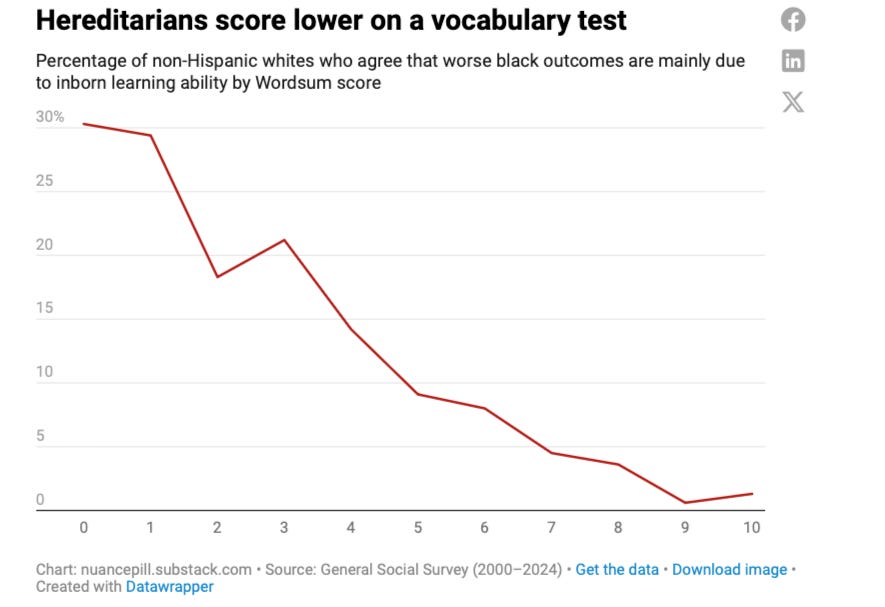
On a population wide level, really smart hereditarians don’t exist. But you can probably think of 5-10 prominent hereditarian intellectuals off the top of your head. In fact, it’s a pretty common view among centrist, libertarian, rationalist, and conservative writers – pretty much everyone except the standard left and socialists. Again, intellectuals are very unusual as a class. It was also news to me that Snyderman & Rothman (1987) has been replicated more recently:
