
There’s a new article in The Atlantic about how more and more students are identifying as “disabled” to receive extra time on exams.
The increase is driven by more young people getting diagnosed with conditions such as ADHD, anxiety, and depression, and by universities making the process of getting accommodations easier. The change has occurred disproportionately at the most prestigious and expensive institutions. At Brown and Harvard, more than 20 percent of undergraduates are registered as disabled. At Amherst, that figure is 34 percent. Not all of those students receive accommodations, but researchers told me that most do. The schools that enroll the most academically successful students, in other words, also have the largest share of students with a disability that could prevent them from succeeding academically.
“You hear ‘students with disabilities’ and it’s not kids in wheelchairs,” one professor at a selective university, who requested anonymity because he doesn’t have tenure, told me. “It’s just not. It’s rich kids getting extra time on tests.” Even as poor students with disabilities still struggle to get necessary provisions, elite universities have entered an age of accommodation. Instead of leveling the playing field, the system has put the entire idea of fairness at risk…
According to Weis’s research, only 3 to 4 percent of students at public two-year colleges receive accommodations, a proportion that has stayed relatively stable over the past 10 to 15 years. He and his co-authors found that students with learning disabilities who request accommodations at community colleges “tend to have histories of academic problems beginning in childhood” and evidence of ongoing impairment. At four-year institutions, by contrast, about half of these students “have no record of a diagnosis or disability classification prior to beginning college.”
Something similar has happened with standardized tests. Between 2012-2013 and 2016-2017, the number of approved accommodation requests to take the Law School Admission Test (LSAT) jumped from 729 to 3,000. By 2022-2023, the number was over 15,000. About 98% of accommodation requests were approved, meaning the process was basically automatic.
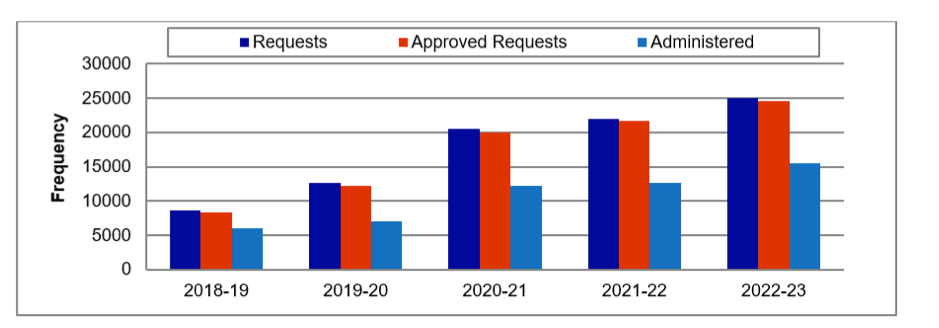
This comes out to about 11% of tests being administered under the condition of some kind of accommodation, up from less than 1% a decade before. When I went to law school, the beauty of the LSAT was that everyone was on equal footing, but a high score appears to be a much weaker predictor of ability than it used to be.
As I was finishing up my book on civil rights law, I started to do some research on the Americans with Disabilities Act (ADA). I incorporated some of what I found into The Origins of Woke, but ended up kind of regretting not making it more of a focus since it was clear that this law had some very negative downstream effects. In fact, there’s an entire book that could be written on the harms of the ADA. Along with the Civil Rights Act itself, it provides a case study of how poorly thought out government policies can end up massively distorting institutions and even the wider culture.
Under the ADA, signed in 1990, employers had to provide “reasonable accommodations” to workers who were disabled. Public universities (under Title II) and private universities (under Title III) were both required to provide “appropriate auxiliary aids and services” to covered students.
The Civil Rights Act banned discrimination on account of protected categories like race and sex, but never defined exactly what that meant, creating opportunities for all kinds of mischief. The ADA has the following definition of disability:
(A) a physical or mental impairment that substantially limits one or more of the major life activities of such individual;
(B) a record of such an impairment; or
(C) being regarded as having such an impairment.
In subsequent years, what this meant would be fought out in court. Unlike what happened in the aftermath of the Civil Rights Act, however, the judicial branch behaved somewhat reasonably. The case of Sutton v. United Air Lines, Inc. was decided by the Supreme Court in 1999. A pair of twin sisters both applied to be pilots, but were told that they did not meet the standard of having uncorrected 20/100 vision or better. They sued, saying that they were being discriminated against. The Supreme Court ruled that the sisters were not actually disabled, because they had a condition that could be corrected – in this case by using glasses or contact lenses.
Crucially for its decision, the Court pointed to a Congressional finding included in the ADA that approximately 43 million Americans suffered from a disability. If the justices adopted the definition of disability urged by the plaintiffs in Sutton, it would include, among others, everyone who needed glasses. That would mean that over 160 million Americans were disabled. The original Congressional finding, however, arguably put a much smaller numerical limit on how many people were protected under the ADA.
Toyota Motor Manufacturing, Kentucky, Inc. v. Williams (2002) dealt with a separate but related question. Ella Williams was an employee at a Toyota plant who was fired for poor attendance. She claimed that she had been discriminated against under the ADA, because she had carpal tunnel syndrome and other impairments that prevented her from doing the job. The Supreme Court unanimously ruled that the lower court erred in failing to ask whether Williams’ impairment interfered with central parts of her life. Not being able to do manual labor with one’s hands alone did not count.
The absurdity of this area of law can be seen in the fact pattern involved in Miners v. Cargill Communications (8th Cir. 1997), where a woman argued that her employer couldn’t fire her over alcoholism, and that the firm’s claim that it caught her drinking and driving was just a pretext for discrimination, as other employees were treated differently. Since she was 250 pounds and was consuming food while drinking alcohol, the woman argued she wasn’t even drunk. The Eighth Circuit reversed the summary judgment in favor of Cargill and sent the case back to the district court.
My favorite court decision from this era is PGA Tour, Inc. v. Martin (2001), in which a golfer who had a condition making it difficult to walk between holes demanded to be able to ride around in a cart during the qualification tournament for the professional tour. The Supreme Court ruled on behalf of the plaintiff this time, holding that it would not alter the fundamentals of the game to grant his request.
Scalia responded with one of the best dissents in the history of the Supreme Court.
Before considering the Court’s answer to the first question, it is worth pointing out that the assumption which underlies that question is false. Nowhere is it writ that PGA TOUR golf must be classic “essential” golf. Why cannot the PGA TOUR, if it wishes, promote a new game, with distinctive rules (much as the American League promotes a game of baseball in which the pitcher’s turn at the plate can be taken by a “designated hitter”)? If members of the public do not like the new rules — if they feel that these rules do not truly test the individual’s skill at “real golf” (or the team’s skill at “real baseball”) they can withdraw their patronage. But the rules are the rules. They are (as in all games) entirely arbitrary, and there is no basis on which anyone – not even the Supreme Court of the United States — can pronounce one or another of them to be “nonessential” if the rulemaker (here the PGA TOUR) deems it to be essential.
If one assumes, however, that the PGA TOUR has some legal obligation to play classic, Platonic golf — and if one assumes the correctness of all the other wrong turns the Court has made to get to this point — then we Justices must confront what is indeed an awesome responsibility. It has been rendered the solemn duty of the Supreme Court of the United States, laid upon it by Congress in pursuance of the Federal Government’s power “[t]o regulate Commerce with foreign Nations, and among the several States,” U.S. Const., Art. I, §8, cl. 3, to decide What Is Golf. I am sure that the Framers of the Constitution, aware of the 1457 edict of King James II of Scotland prohibiting golf because it interfered with the practice of archery, fully expected that sooner or later the paths of golf and government, the law and the links, would once again cross, and that the judges of this august Court would some day have to wrestle with that age-old jurisprudential question, for which their years of study in the law have so well prepared them: Is someone riding around a golf course from shot to shot really a golfer? The answer, we learn, is yes. The Court ultimately concludes, and it will henceforth be the Law of the Land, that walking is not a “fundamental” aspect of golf.
Either out of humility or out of self-respect (one or the other) the Court should decline to answer this incredibly difficult and incredibly silly question
He also foresaw where this was all going.
Which means that future cases of this sort will be numerous, and a rich source of lucrative litigation. One can envision the parents of a Little League player with attention deficit disorder trying to convince a judge that their son’s disability makes it at least 25% more difficult to hit a pitched ball. (If they are successful, the only thing that could prevent a court order giving the kid four strikes would be a judicial determination that, in baseball, three strikes are metaphysically necessary, which is quite absurd.)
Scalia was only wrong because he thought Americans might ruin sports on account of the Americans with Disabilities Act. But it turns out we take sports too seriously for that. We ruined academics instead.
In signing statements and press conferences, politicians have often appeared with people in wheelchairs, but never with alcoholics who drink and drive on the job. It’s kind of like how Jim Crow is used to justify civil rights, but in practice the law ends up going after employers for using standardized tests. For its part, on the alcohol question the Supreme Court eventually ruled that although drug addiction could be considered a disability, you can still fire someone for conduct caused by their disorder. It explicitly rejected a disparate impact standard for determining discrimination under the ADA.
By the mid-2000s, the damage that the ADA could do had been at least somewhat contained by the Supreme Court, despite PGA Tour. Unfortunately, Congress did not like the decisions in Sutton and Toyota, and overrode them in The Americans with Disabilities Act Amendments Act of 2008. In determining who is disabled, the law now says institutions cannot consider mitigating measures that one might take. So this counts not only people who are in wheelchairs, but also alcoholics, sufferers of just about any recognized mental condition, and yes, those who need glasses. Congress even struck from the record the finding of 43 million Americans being disabled in 1990, on the grounds that it was too limiting. No numerical benchmark was set, which meant that Congress was implicitly endorsing the Supreme Court’s counterfactual in Sutton in which a majority of the country might be considered disabled.
The ADA Amendments Act further added to the definition of disabilities, clarifying that “major life activities include, but are not limited to, caring for oneself, performing manual tasks, seeing, hearing, eating, sleeping, walking, standing, lifting, bending, speaking, breathing, learning, reading, concentrating, thinking, communicating, and working.” Anything that substantially harms the ability to engage in “sleeping,” “learning,” “reading,” “thinking,” or “working” counts! It is genuinely hard under this definition to imagine a person who doesn’t have at least an arguable case for being disabled.
On the merits, this sounds completely insane. If businesses, universities, and other institutions need to provide accommodations for those who are disabled, don’t we need to place some limits on how many people fall into that category? Congress explicitly said no. Only seventeen members of the House voted against the ADA Amendments Act, and it passed by voice vote in the Senate. There was practically no controversy over this at the time. It is difficult to see how there could be virtual unanimity over a bill that was so clearly irrational. The only explanation is that disability activists had halos over their heads, and the media and politicians of both parties were rushing to give them whatever they demanded.
There’s a direct comparison to be made to the expansion of the Civil Rights Act to cover more and more conduct. A key difference is in that case, it was courts and the bureaucracy that were pushing in a more expansive direction. With regards to the ADA, the Supreme Court tried to place some limits, but was overruled by Congress. The ADA Amendments Act even included a provision telling courts and bureaucrats to go as far as possible, declaring that the definition of disability “shall be construed in favor of broad coverage of individuals under this Act, to the maximum extent permitted by the terms of this Act.”
Eventually, college kids and their parents who wanted to game the system were able to make the greatest use of this. Under the plain reading of the ADA Amendments Act, things like ADHD and anxiety count as disabilities and must be reasonably accommodated. Say a school wants to claim that a student isn’t disabled because they don’t seem to have a major impairment that affects their day-to-day life, or that they could take steps to overcome their problems. This would be fine if Sutton and Toyota were still the law of the land, but such considerations are now explicitly prohibited.
Of course, there’s still a lot of wiggle room here, and if there emerged a widespread consensus that things have gone too far, bureaucrats and courts could surely find ways to push back on what is happening. But the plain text of the law has opened the door to exactly this type of abuse. An honest judge or bureaucrat, looking at what Congress did in 2008, would have to acknowledge that every aspect of the ADA Amendments Act calls for a more maximalist interpretation of who counts as disabled.
There’s a lesson here about moral panics. Recently, certain writers have asked why some people would “die on the hill” of saying Epstein is not a pedophile. But this is exactly how mass hysterias end up taking over society. My book discusses this dynamic in the context of civil rights law, in which few wanted to push back on each incremental step taken to fight racism or sexism. Something similar has happened with the concept of disability.
I find it completely amazing in retrospect that the ADA Amendments Act generated no substantial opposition in 2008. When the Supreme Court looked closely at the issues involved, both conservative and liberal justices came to reasonable conclusions and limited the scope of the original ADA. The idea that the law would actually say that the majority of Americans were disabled was too ridiculous to codify. But then disability activists raised a fuss, and nobody wanted to be “that guy” who says that society is going too far in helping those with physical and mental ailments. Unlike on the questions of race and sex, where conservatives have long recognized liberal activists have a tendency to push too far, when it came to the disabled as a protected class, society had no antibodies in 2008.
People tend to have a model of the world where problems are caused by either bad actors, or those who are operating under false ideological assumptions. While this often happens, it is underrated the extent to which society makes terrible decisions because something sounds good and social pressure stops anyone from standing against the consensus view, or even looking too closely at the issues raised by a public policy question.
I was working in disability law in 2008, and the pre-2008 law really was too narrow. IIRC, it essentially meant: if you could be accommodated, you weren’t disabled; if you couldn’t be accommodated, you could be discriminated against.
The problem isn’t that we expanded the definition of “disabled” - it’s that we got too loose on what counts as a “reasonable” accommodation.
Pre-2008, Little League could have legally banned eyeglasses because needing them wasn’t a disability. To most people, that’s absurd and defeats the purpose of the 1990 ADA. On the other hand, suing for an extra strike in baseball shouldn’t have been allowed under any version, because it fundamentally changes the game and isn’t reasonable. Similarly, extra time on tests isn’t truly reasonable as it materially alters what the test measures.
The issue arises from (a) courts being too willing to deem accommodations “reasonable” and (b) schools wanting to avoid the fights. As a result, people receive clearly unreasonable accommodations. This is especially problematic with testing time: it costs schools almost nothing, so they don’t resist, but it’s unfair to other students judged against those who get extra time.
I went to a private Jewish high school where basically everyone I knew had at least one doctor in their family, which meant getting "academic accomodations" for a "learning disability" was widespread. I would guess roughly 25-35% of my classmates got extra time on tests, some of whom were quite a bit smarter than I was and very clearly did not have any learning problems. One friend of mine would openly brag about gaming the system. Was extremely frustrating at the time and was obviously unfair to people who didn't get this fake disability status. Thank you for speaking up about this.