
My politics are anti-populist, which kind of sounds like I’m against the average citizen. But that is not necessarily true. I see the vast majority of the public as relatively passive and uninterested in politics. This makes them mostly harmless, and this is why democracy is fine, since, depending on what elites are doing, they can be led in a positive or negative direction.
Imagine four quadrants. People can be smart or dumb, and they can be interested or uninterested in politics. When I say smart, I’m not referring just to IQ, but some combination of intelligence and a lack of intellectual laziness. Elon Musk is an extreme case here: obviously smart when it comes to engineering and business, but about as stupid as human beings get when it comes to politics. Of course, both intelligence and interest in politics exist on a spectrum, so keep that in mind, as this is a simplified model of the world.
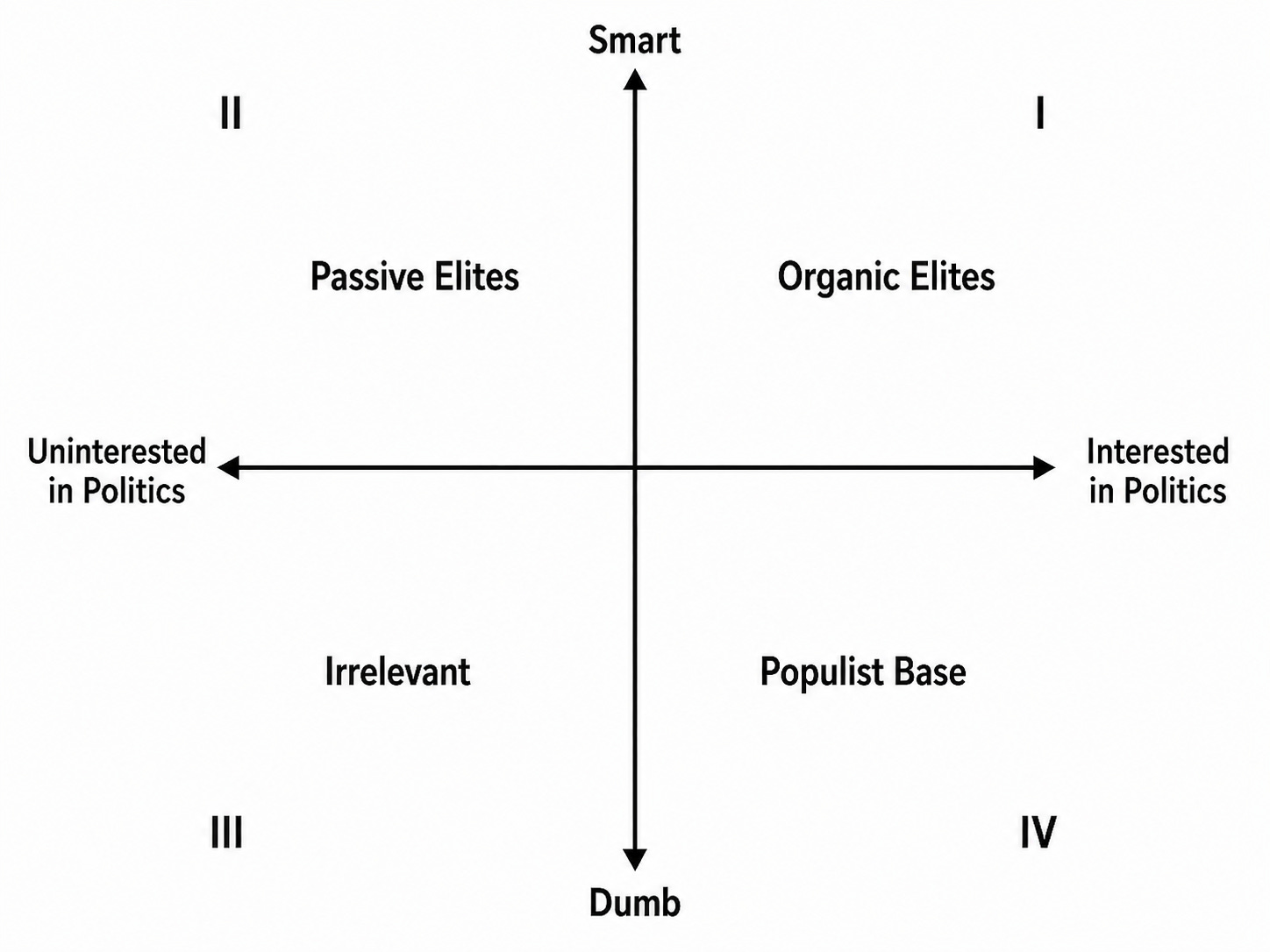
The degree of populism in a political community is based on the balance between Quadrant I and Quadrant IV. Society doesn’t really change all that much in intelligence, but the degree to which smart or dumb people are interested in public affairs varies greatly.
One of the biggest changes in American politics from the 1990s to today is the rise in Quadrant IV. If you wanted to consume political material in 1995, your choices were basically limited to stuff like reading The New York Times, watching 60 Minutes, picking up a book from a mainstream publisher, turning on C-SPAN, or finding an intellectual magazine such as National Review or The New Republic. If your intelligence is so low that the only narrative you can find compelling is one that blames foreigners or transsexuals for all that has gone wrong in the world, there weren’t a lot of options. Today, however, you are drowning in them.
This article is part of a series discussing topics covered in more detail in my forthcoming book Kakistocracy: Why Populism Ends in Disaster. If you find the ideas expressed in this article interesting, please consider preordering here. The release date is July 7, and you don’t get charged until the book is shipped or you receive the digital version. Preorders are very important in determining how much attention a book receives, so by getting yours in you can help ensure that its arguments reach a wide audience.
Imagine if, before the streaming era, the only kind of music available to purchase was classical. Some dumb people might get into Mozart, but for the most part the left end of the bell curve would just buy less music overall.
Quadrant IV has grown mainly due to technological developments, namely the rise of the internet and social media. Yet this does not mean that nothing else matters for determining the balance between Quadrants I and IV. Specific leaders can have a major influence. Trump swelled the ranks of Quadrant IV, as he made politics as interesting as a reality show, so a lot of people who would be into reality shows are now more active participants in the political process. He also concentrated them into one party, increasing their influence. So in 2012, anti-vaxxers and the people who believed in globalist plots to make everyone gay were on opposite sides of the political spectrum. Today, because of Trump’s unique appeal to the stupid, they all march under the same banner, and so have an entire political party that caters to them. Trump was responsible for Operation Warp Speed and tried to defend its legacy, but anti-vaxxers still like him better than other politicians because he is the kind of leader that the less intelligent naturally look to.
I used to see Trump occasionally be less anti-vaxx and anti-immigration than his followers, and thought that meant that he was keeping the right from going even more insane. I’ve changed my mind on this, and now believe that the effect is dominated by the degree to which he animates and consolidates Quadrant IV. Even if Trump sometimes has the salutary effect of checking the worst impulses of his fans, many of them wouldn’t be as interested in politics in the first place if he were still a reality TV host. If Ted Cruz or JD Vance were leading the Republican Party, many would find the show too boring to continue paying attention to.
Some political figures, like Obama and Macron, expand Quadrant I. The French president has been paradoxically referred to as an “anti-populist populist.” Such figures usually project youth and competence, and make more educated people feel better about the system they live under. They also appeal to the better angels of human nature, since they draw into the political process more of those who are happy with their lives and fewer who have failed and are looking for someone to blame.
Institutions also matter. Open primaries have moved us in the direction of more populist figures being elected. If we still had stronger political parties exercising the kind of control they had in the mid-twentieth century, Trump would never have survived the 2016 primaries. And in this cycle alone, we would have been spared Ken Paxton and Graham Platner, each party’s most ethically compromised Senate nominee.
Even technology itself is not immune to policy decisions. We decided to give social media companies Section 230 protections, which meant that they could not be sued for things posted on their websites in the same way that newspapers can when their journalists and writers make false claims. When you think about it, this creates an asymmetry, in which actual publications have to be a lot more careful about the kinds of claims they make, putting them at a market disadvantage. In theory, you can sue individual social media users for what they post, but since most of the time your targets don’t really have deep pockets or much to lose, and the defamatory contribution of each individual spreading a lie is so small, in practice this is rarely worth doing. In contrast, I think AI is probably going to be anti-populist in its effects, so this is another reason to encourage its development and deployment.
People will often argue that economic grievances put people into Quadrant IV. I can think of few ideas in politics more straightforwardly refuted by data. As Western societies have gotten wealthier, policy programs of major parties have focused more on cultural issues and less on economics. If you’re actually worried about your economic situation, the most rational thing to do is not waste time on politics at all, since you’re not going to change much on your own. People who pay the most attention to politics treat it as a form of entertainment and an escape from their jobs, not as part of a diversified portfolio in which they seek economic advancement by combining work with activism.
Stupid people will explicitly tell you what they’re angry about: vaccines, having to see brown people, women not knowing their place, gender non-conformity, pedophile conspiracies, etc. Populist-leaning intellectuals like to pretend that these are just excuses and the true source of pain is always material. Ironically, how populists explain populism is itself an example of the poor epistemological standards of populism. Anger at the rich seems to be more of a phenomenon of the relatively poor intellectual and artistic class, rather than the most disadvantaged. Think of the anti-monopoly movement, which is a bunch of law professors and professional activists trying to find a broad base of support, in contrast to conspiratorial, anti-immigration, anti-trans, and anti-vaxx sentiments on the right, which are genuinely grassroots phenomena that conservative elites resisted for a while.
You can’t defeat populism by turning back the technological clock. But you can think about what the impacts of laws we pass and communications strategies we embrace are going to be on the balance between Quadrants I and IV. I see my war on Low Human Capital as part of this effort. I want smart people not to consider dumb people who happen to agree with them in the moment for tribal or accidental reasons their true allies. And I’d like to see the dumb people themselves either be demoralized and leave politics, or perhaps otherwise find me so entertaining that they outsource their thinking to me rather than James Fishback.
From a public relations perspective, one does not have to think about fighting Quadrant IV as going to war with the masses. Most of the public is in Quadrants II and III, at least if we set the bar for interestedness in politics high enough. That means they are passive, and, to the extent that they have opinions, they will shape them in response to what is going on in Quadrants I and IV. To pull up an arbitrary number, I’d estimate that the stupid-interested demographic makes up maybe 20% of the population.
William F Buckley famously quipped that he would rather be ruled by the first 2,000 people in the Boston phonebook than the faculty of Harvard. That was never the choice, as we’ve clearly learned in recent years. The alternative to organic elites isn’t a random sample of the population, but the guest list of the Joe Rogan podcast and MAGA influencers. The case against populism has therefore become much stronger.
As discussed in the case of the anti-monopoly movement above, one major group that doesn’t cleanly fit into the schema presented is highly ideological left-wing elites. Someone who writes books preaching Critical Race Theory may be bad at thinking, but it would be wrong to say that they lack intelligence or are in a true sense intellectually lazy. Nonetheless, I still want to see these people defeated.
On an optimistic note, I would argue that there is something deeply artificial about this class, with its dependence on government subsidies through the university system and civil rights law creating a demand for DEI bureaucrats in addition to other kinds of regulators. The free market will give you The New York Times, The Atlantic, Tucker Carlson, and Joe Rogan, catering to either smart or dumb people. But it will not give you the Journal of Black Queer Disabled Studies. Note that the most successful media outlets in the country are practically all either liberal-establishment or right-wing populist slop. Wokeness has a strong top-down component, and this is why I’ve always stressed the importance of taking apart its legal and bureaucratic underpinnings. The true threat to American living standards and the maintenance of a free country coming from the left is the more masculine form of socialism represented by Platner, because it has a much stronger base of support throughout all four quadrants.
Woke did have something of a populist moment in the early 2010s. As described in Ben Smith’s Traffic, people who were running websites at the time have discussed how identity-focused articles and blog posts would draw the most eyeballs. But this seems to me to have been the product of a unique historical era, in which we were reeling from the shock of the initial rise in social media. It only took a little over a decade for our politics to go back to centering on socialism and racism (the classical kind, not the woke version), two of the main pillars of human nature when it sets its sights on the political arena. We’re returning to the pre-2010 norm, in which crazy academic theories about race and human sexuality are mostly sequestered in universities and certain activist communities and, although generally aligned with the political left, by no means its dominant force.
Woke is not only wrong on the merits, but it also provides steroids for Quadrant IV (unlike economic grievances). The trans issue in particular riles up idiots like practically nothing else, and I say this as someone in no way sympathetic to gender theory. I’ve always said that Democrats could probably reduce the strength of Trumpism by perhaps 10% through simply accepting that God is a cisgender male and sports should be segregated by biological sex. Doing these things is not enough to defeat the right on its own, but there’s nothing else where you can get so far by giving up so little in material terms. Regarding gender-affirming care for minors, here leftists might feel that the stakes are too high to simply surrender, but the pronoun talk certainly hasn’t helped on that front either.
In my forthcoming book, Kakistocracy (again, preorder here), I explain my own disillusionment with right-wing politics as it got taken over by idiots, to the point that even intelligent people I knew surrendered their brains to the chuds.
My own alienation from the right had two major catalysts in vaccine denial and narratives that the 2020 presidential election was stolen. I had taken it for granted that conservatives and liberals often engage in motivated reasoning. But I thought that there was nearly always an ideological basis for disagreements, and that motivated reasoning almost always had at least some nexus in truth. Conservatives might believe, for example, in lower taxes and less government spending, and be more inclined to trust economic analysts who tell them that Reaganomics is the best way to achieve prosperity. Liberals might be inclined to accept a flawed study that told them that law enforcement was racist. This is the normal stuff of politics, and no longer shocking, particularly in a highly polarized era.
What was mostly outside my field of imagination was the idea that a movement could come to believe in lies with little to no grounding in ideology, or even fact. I watched in shock as both right-leaning friends and the conservative movement more generally became less and less connected to reality. They believed in propositions for no other reason than that Trump said them, in the case of election denial, or the effects were bottom-up, as when the misinformed and uneducated right-wing mobs on social media became enraged about the Covid vaccines.
What made me different from others on the right? While I had an identity as a conservative, I also had an identity as someone who believes that truth actually matters. There was sometimes a psychological pull toward agreeing with my tribe, but an even stronger sense that I am an honest person who deals in the realm of facts and has the courage to stand up to the mob.
People often discuss the need for a politics of meaning. Usually, I am not that big of a fan of such talk, since meaning is subjective and what we should be focusing on most of the time is policy outcomes. But there comes a point when the overwhelming stupidity and corruption of politics begins to insult one’s sense of dignity. For me, that limit has been reached. I don’t think that, in the long run, rule by podcasts and algorithms is the best way to achieve prosperity and advance the interests of humanity. But it would be too soulless to let that settle things alone. Standing in opposition to populism is a core part of my personal identity, as it should be for everyone involved in politics who values individuality, courage, and truth.
Quadrant III isn't irrelevant though. A huge chunk of them do vote, and when they do, they're running a crude but genuinely functional evaluation: is the economy doing well, does the person in charge seem competent, is the world on fire. That's where Wlezien's "thermostatic" model of public opinion comes from. When policy moves too far left, the public drifts right. When it moves too far right, they drift back. The low-information voter is the main carrier of that signal.
This actually strengthens your case for democracy in a way you're underselling. You say democracy is "fine" because the masses are passive and elites steer them, but that's a pretty fragile version of the argument. The stronger version is that Quadrant III is responsive in broadly sensible ways. They don't know what's in the infrastructure bill. They don't care about ideological fights. They just register whether things feel like they're going well or badly, and shift accordingly. And that works precisely because they don't have developed political views and don't follow the daily content war.
Which also clarifies why Quadrant IV is actually destructive rather than just annoying. The problem isn't that dumb people started participating. Dumb people were always participating, as Quadrant III voters, and that was fine. The problem is they switched from the thermostatic mode (judge by outcomes, punish apparent incompetence, and don't vote much) to the ideological-entertainment mode (judge by tribal loyalty, consume politics as content, vote more often). They moved from a system where their lack of information didn't matter because the heuristics were more outcome-tracking, into one where the heuristics are identity-tracking.
I am a big misanthrope and am absolutely here for arguments that large chunks of the population are too dumb to be involved in the political process. The problem I have with this argument, though, is that there's clearly a pretty substantial chunk of crazy elites as well. Contained within the conservative movement, and staffing the Trump administration now, are a large number of absolutely radicalized rightwing pseudo-intellectuals, people who think Curtis Yarvin is deep, etc. (In fact, Hanania has written about their pathologies at length!) I view them as much more dangerous than the large mass of clearly dumb people on the street- they're organized, more competent, clearly have the levers of power at the moment, etc. Social movements are always composed of a small number of radicalized intellectuals, never the proletariat.
Antivax is a great example of this- yes, there was always a small minority of dumb antivaxxers. But conservative elites & influencers pushing this stuff in the last 6 years has greatly increased antivax sentiment among the large population of Average Conservative-Leaning Guy On The Street. The antivax crowd has grown dramatically specifically due to crazy elites, not the other way around.
I find this a much more difficult problem to solve