
Note: I’ll be livestreaming throughout the day tomorrow, as is becoming my Election Day tradition. Check the Substack app or Notes to stay up to date. For those interested, here is my California ballot. The most important things for Californians are to vote Ben Allen for insurance commissioner, no on Prop 40, and yes on Prop 41 and Prop 42. Nationwide, I recommend voting Democrat for the House and Senate except in highly unusual cases. For state and local races, make your best judgment based on who is more pro-market, less populist, and less conspiratorial, with bonus points for not wanting to cooperate with ICE.
Polling seems like a mundane profession, but its day-to-day practice is useful for understanding some of the most fundamental ideas in statistics.
In an election with two candidates, how accurate can you expect a poll that samples a tiny fraction of the population to be? Assume for a minute that you can actually sample voters randomly and that nobody changes their mind between the time of the poll and the election.
There’s a mathematical formula for that, and it looks like this.
Let’s make it concrete, and say that 52% of Texas voters support James Talarico, and 48% support Ken Paxton. If you repeatedly seek out a random sample of 800 voters, here’s the distribution you would get for Talarico’s share.
This means that, with perfectly random sampling and an underlying support of 52% for Talarico, in polls you will get 52% of voters supporting him on average, and 95% of your polls will find him between 48.5% and 55.5%. Notice what the equation doesn’t depend on: the number of voters in Texas. In the last Senate election in that state, held in 2024, there were over 11 million votes cast. The formula above would’ve given you the same results if the number was 30,000 or 8 billion.
When I learned this in graduate school, I found it extremely counterintuitive. I would've assumed that it would be much more difficult to accurately poll a larger population. Under perfect random sampling, however, the size of the electorate makes virtually no difference to polling accuracy, as long as it is much larger than the sample. In practice, a culturally homogeneous population of a billion people might actually be easier to poll accurately than a heterogeneous population of tens of thousands, since differences in factors like turnout rates and willingness to respond to surveys can make it harder to obtain a representative sample.
Of course, in the real world, we have no way of proving before an election that pollsters accurately sampled the population. Those who conduct the surveys must make certain guesses about who is going to show up to vote, and which demographics might be more or less inclined to talk to them. But each election provides feedback that pollsters can try to correct for. If you find, for example, that in a series of elections white people are sampled too heavily, then you might weight them less the next time around. Pollsters are making an educated guess, but there’s no guarantee they’re going to be right, and of course there will probably be new biases in the polling introduced after any adjustment. Some of those biases will cancel out, while others won’t.
How do pollsters do in practice? The website PollingForecast.com looked at polling performance across Senate and governors’ races between 2000 and 2024 in the last month of each campaign. The average size of a miss relative to the average of the polls in each race was 4.56 points, with the person leading having won 93% of the time. Here are the results by cycle.
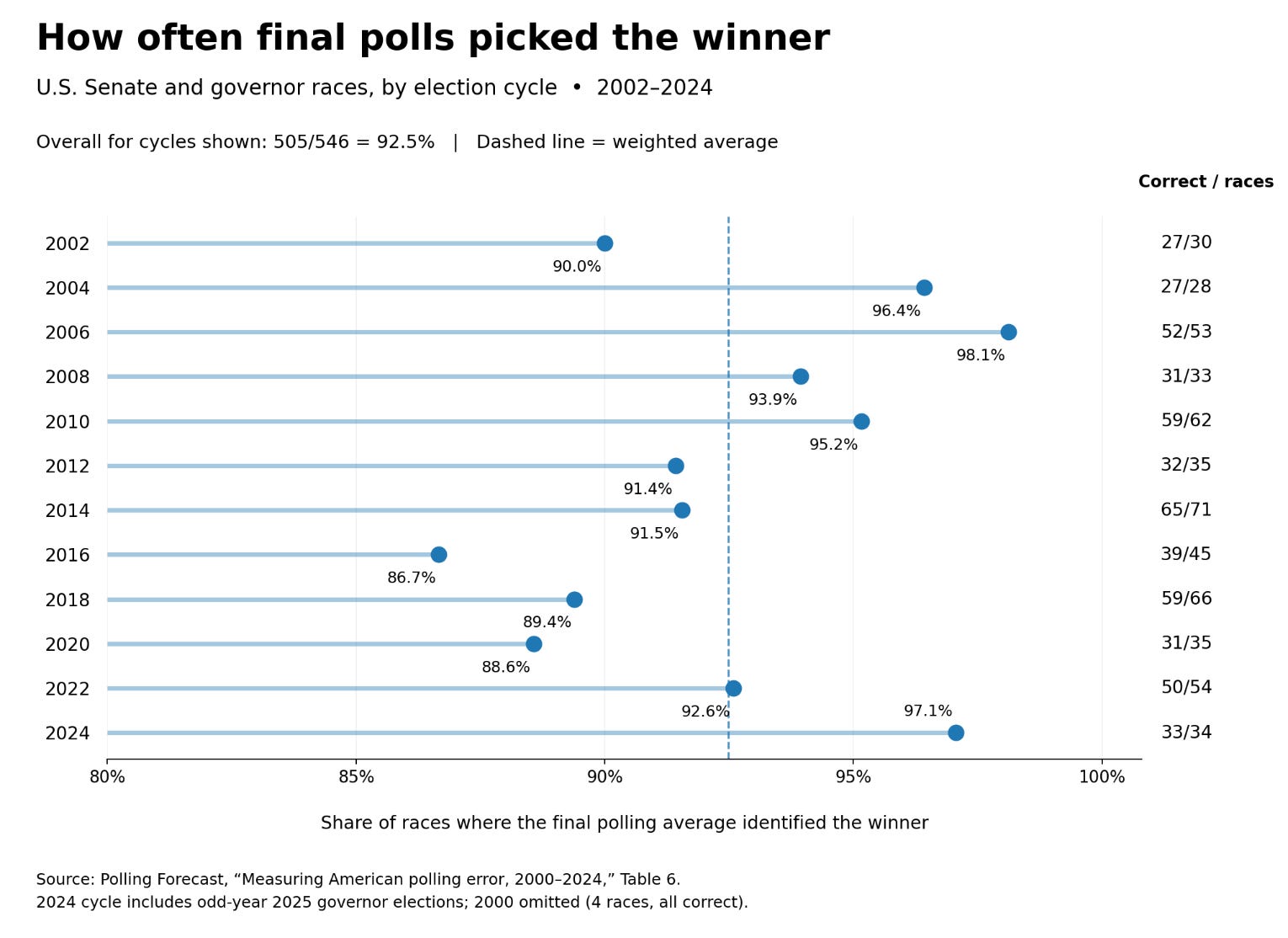
At first glance, this looks impressive. But if you’re a cynic, you might say that many races are easy to predict and not particularly close. I can forecast that Democrats will win this year’s gubernatorial race in New York, for example, without looking at polls. If I listen to the polls regarding who is going to win each governor’s or Senate race, I’ll be correct 93% of the time. But what if I just predicted the winner in each race based on how that state voted in the last presidential election?
Pew Research reports that between 2012 and 2024, in 91% of Senate races the winner was from the same party that won that state’s vote in the most recent presidential election. We can’t compare this to the Polling Forecast data, since the latter analysis selects for races that people were interested in enough to poll.
Downloading polling data from the FiveThirtyEight GitHub page, I compared how well polls taken in the last 21 days before an election and a state’s most recent presidential vote predicted gubernatorial and Senate races since 1998. For 2024, I used 270toWin instead of FiveThirtyEight.
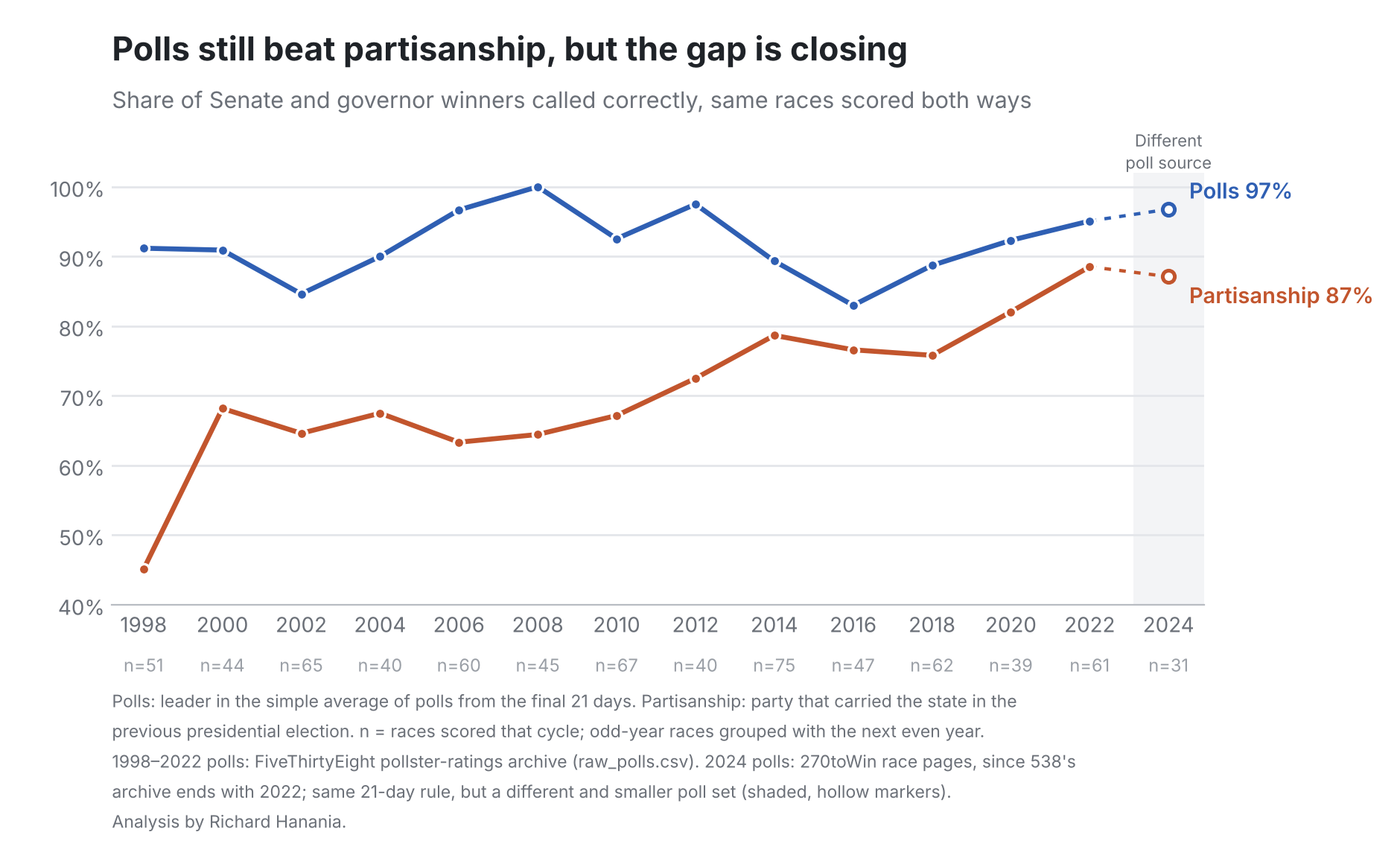
A different way to do the analysis: when polls and partisan lean disagree, which should you trust? Here is a chart answering this question for governors’ and Senate races by year.
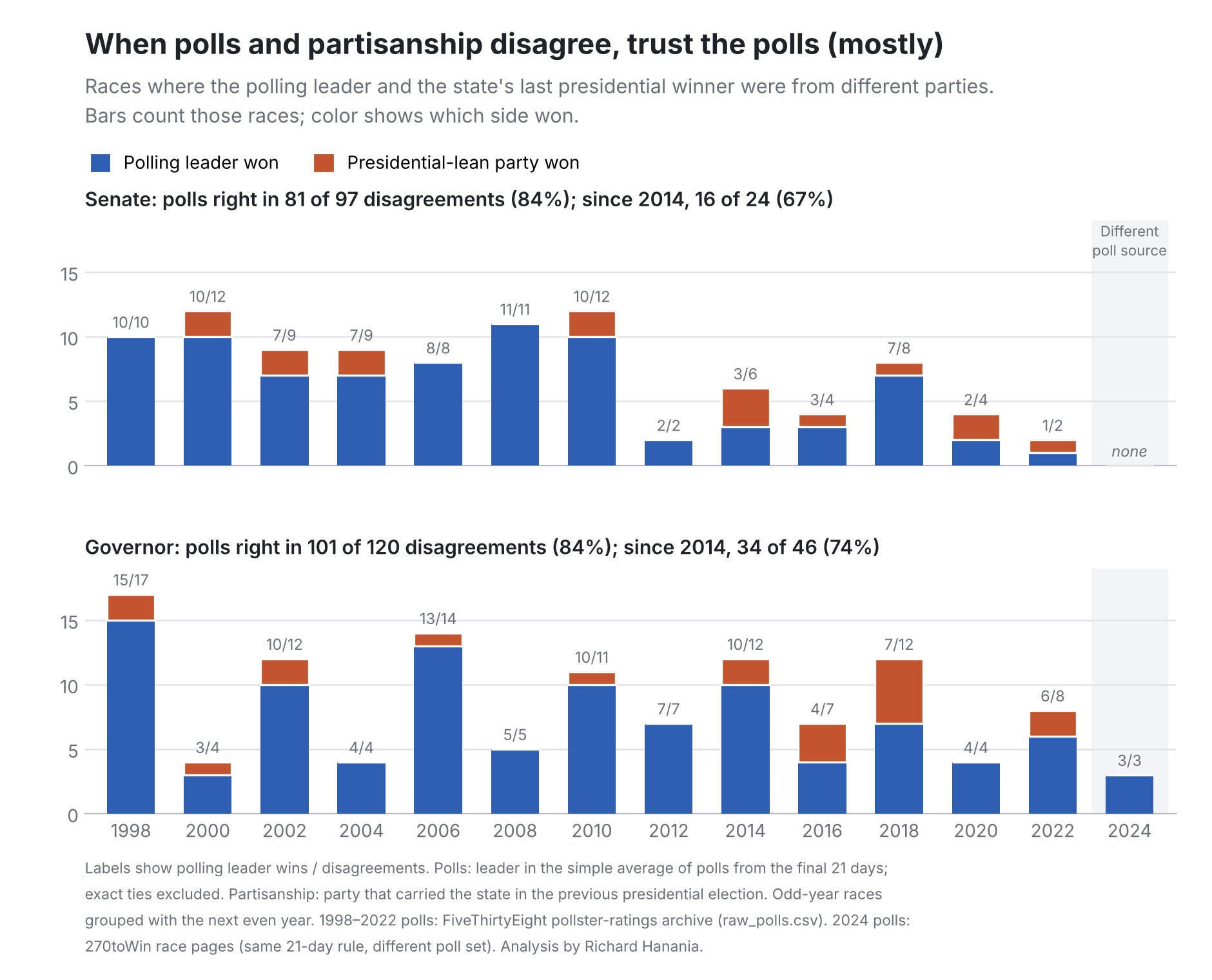
Since 1998, when polls and the partisan lean of a state disagree, polls have been correct 84% of the time.
To me, this seems pretty good. You could imagine a world in which polling was completely useless given that pollsters can’t force people to talk to them, which means samples can be biased. The world may change so much every few years that adjustments based on previous data don’t help all that much. Nonetheless, the results come out pretty well.
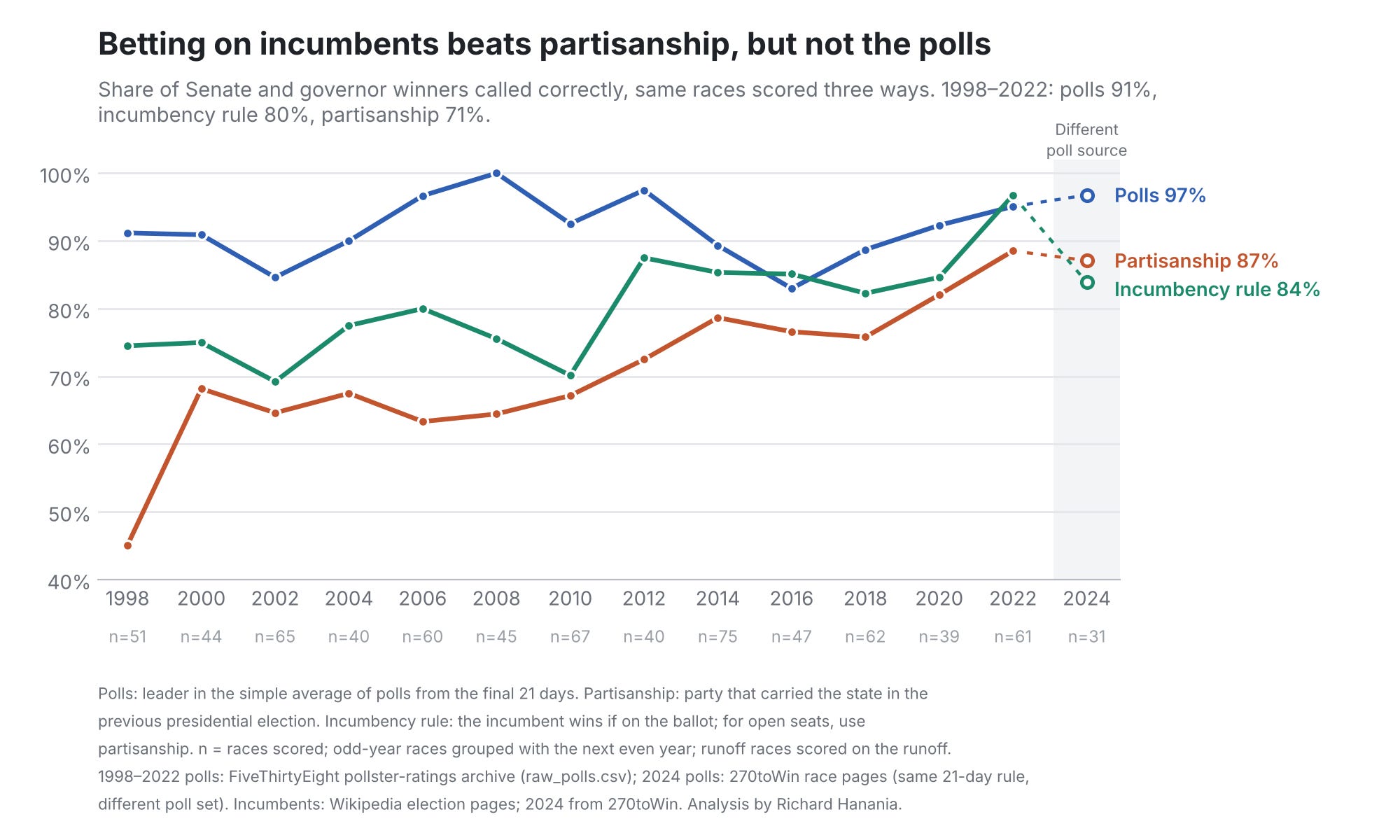
Let’s try another rule to see if we can do better than polling by using a simple heuristic. What if you went back to every race and applied the following rule: Pick the incumbent, and where there is no incumbent, default to partisanship. That turns out to actually be better than relying on partisanship alone, but polling still wins. Using the incumbency rule plus partisanship eliminates half the gap between polls and partisanship alone. Accuracy for polls since 1998 in predicting the winner of Senate and governors’ races has been 91%, compared to 71% for partisanship, and 80% for incumbency plus partisanship.
Are polls getting worse over time?
Let’s take a more granular look at recent elections. Here’s a table from Eli McKown-Dawson and Nate Silver showing polling bias since 1998 in races for president, Senate, the House, and governors.
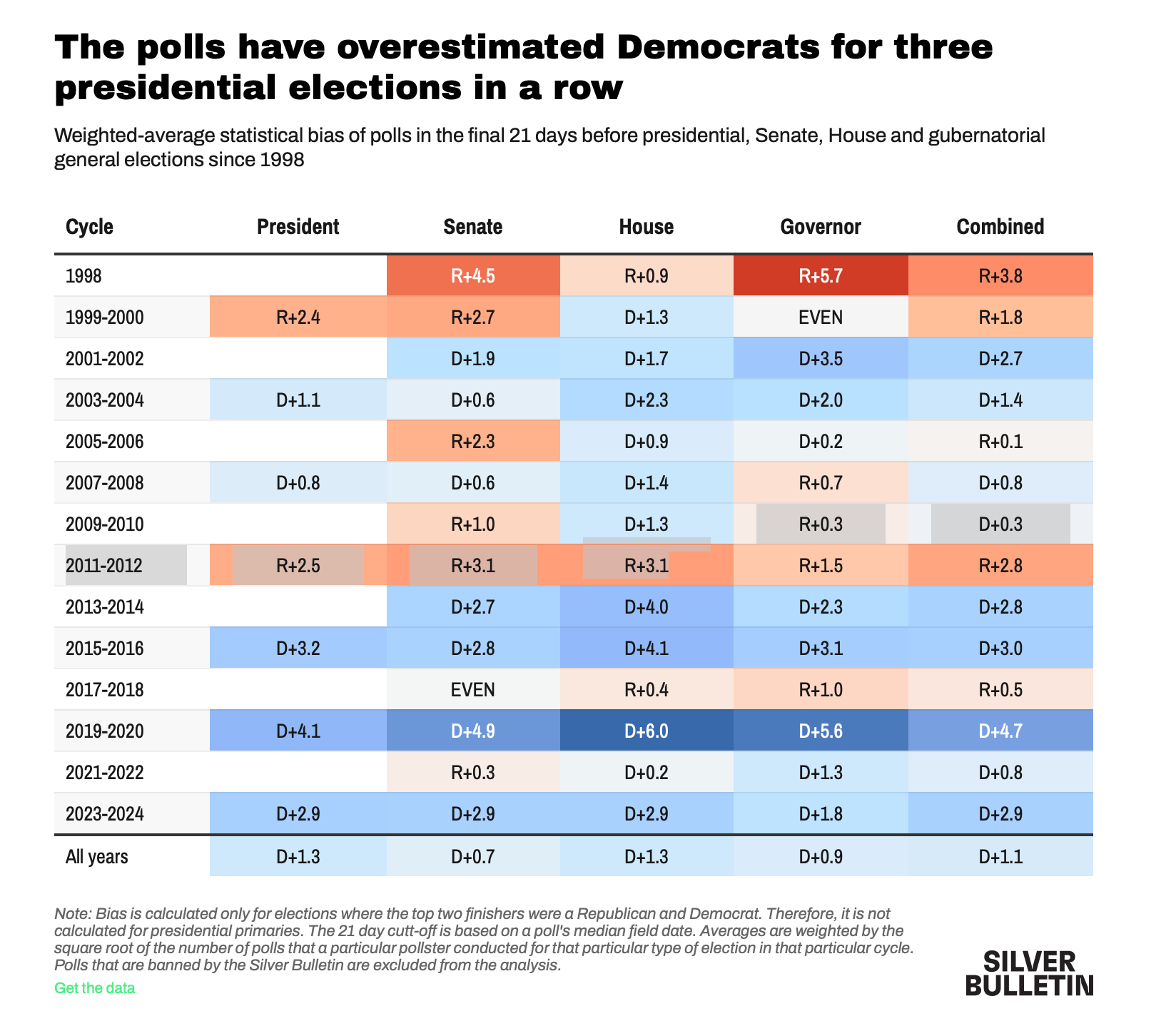
Starting in 2016, polls have been regularly underestimating Republicans by 2–6 points in presidential years. This is remarkable, given that pollsters try to correct for past mistakes. Yet both times they tried to make adjustments when Trump was on the ballot, it didn’t work, and they failed three straight times in the exact same direction.
In the two midterms without Trump, however, the bias has been 1.3 points or less in each type of race. Trump is obviously not on the ballot this time, so we will see if the pattern holds. But right now, it just looks like Trump is special, and in non-Trump elections, polls are at least as good as they’ve always been. I’d argue that a lot of things that seem broken in society are just the result of Trump breaking things, and polling supports that view. For their part, the NYT is openly saying that they’re going out of their way this year not to make the same mistakes of the recent past; if they used the same methodology as in previous elections for their last Senate polls, Democrats would mostly be even further ahead.
I have no special insights into what will happen in this election beyond what the polls and prediction markets tell us. Wisdom is knowing when to outsource your thinking to markets or the consensus of experts, which in the case of elections usually converge. But I think this exercise is useful because it proves that social science can work. Sometimes you’ll hear people disparage the polls or imply that social phenomena are too complicated to forecast. Yet every two years, we get a nationwide experiment, in which analysts try to figure out how elections with over a hundred million individuals participating in them will turn out. Statistical theory and regular validation against election results end up producing accurate predictions.
Not many people find polling inspiring. Call me a nerd, but I do. People have strong views about politics. Accurate pollsters are a mark of a civilization being able to apply the scientific method. Of course, because they often tell people what they don’t want to hear, partisans commonly discount the polls, cherrypick instances when they were wrong, and invent conspiracy theories to explain inevitable misses. But a fair analysis has to give the pollsters credit for their overall performance. The lesson here is to not trust the conspiracy theorists, or those who believe mainstream institutions are too hopelessly biased to deliver accurate information on hot-button political questions.
This post is sponsored by Mechanize. Making sure AI goes right is perhaps the most important issue of our time, and if you’re interested in being part of that effort, Mechanize is hiring software engineers at a base salary of $300K-$400K/year, plus substantial bonuses. They also have openings for other positions, including Recruiter ($200K). Here is their website, and you can apply here. If you apply, make sure to use the links provided here so I can receive credit, and name me as a reference in the process.
The existence of (fairly accurate) pollsters as an indication of overall societal/institutional health is a perspective I've never thought of. That's very interesting, as polling combines social science, statistics, and the scientific method. Great observation!
Hanania gives institutional confidence far too much credit. Pollsters are no different than weathermen, and they are susceptible to substantial pressure if they don't tilt left. They call it "professional conformity." When the weatherman tells you to take sunscreen, and you need your umbrella, he loses credibility. When the pollsters tell you the left will win in a landslide, and you stay home, you lose the republic. Voters convinced the outcome is settled may surrender their opportunity to change it. Conservatives cannot afford that passivity. A pollster can explain his miss after the election. You don’t get to cast your missing ballot afterward. Get out and vote.