
I used to be a big believer in the potential of prediction markets to radically transform the world. But over time, I have become less inclined to see them as something that could revolutionize the search for truth or as a phenomenon that might potentially end up only a few steps below discoveries like free speech and capitalism in importance.
People like to share opinions on politics. In theory, we should be able to settle major disputes through prediction markets. Do you think Democrats or Republicans are better for economic growth? Which approach to foreign policy is more likely to deliver global peace? All we need is to bet on GDP growth or global combat deaths conditional on each side winning an election. Do this enough times and, if the markets turn out to be well-calibrated, we might learn something new.
Pundits run their mouths and professors come up with theories, but if such figures started making actual bets and we could track their predictions over time, maybe we’d be better able to decide who to listen to. The best ways to fight crime, make societies wealthier, and avoid war could start to have scientifically precise answers.
I still believe that prediction markets are pretty well-calibrated. When, for example, I hear about an up-and-coming politician and want to see whether he has a chance in an election, I will check the prediction markets first. That is the single best source of information for many questions one might ask. I’m glad they’re de facto legal now, and support them continuing to be allowed on the grounds of both libertarian principles and the idea that knowledge is good.
One positive impact can be seen in the fact that there used to be more of a culture of pundits making off-the-wall predictions and getting attention for them. I’ve seen less of that in recent years, because we can always reply “if you believe that, why not bet on it?” And even though journalists can say it would be a conflict of interest to do so, the theoretical possibility still has an impact. We may accept that journalists don’t place bets, but nonetheless dismiss the wild speculator on the grounds that he hasn’t done a good job of convincing others of his views, because if he had, the market would have moved more. CNN will now point to prediction markets in discussing the likely outcome of an election, and that is clearly a superior method of covering the news relative to having talking heads spout evidence-free opinions, often based on what they hope is true.
Despite those clear benefits, I no longer think that prediction markets are going to come anywhere close to revolutionizing the search for knowledge or introducing a new system of government, or taking us toward a futarchic utopia, unless there is a real effort to merge financial incentives with prestige incentives.
Usually, when I change my mind on something, the effect is gradual. In this case, however, I can trace the shift in my thinking to one specific article. This was a May 2024 essay, “Why Prediction Markets Aren’t Popular,” by Nick Whitaker and J Zachary Mazlish. It was written before Trump won reelection and we got de facto legalization. The two authors argued that, while prediction market enthusiasts thought that the law was the main thing holding them back, there were more fundamental problems that they were ignoring.
There is one important reason that prediction markets are not used by savers, and probably never will be. Prediction markets, unlike most asset markets, are zero-sum – in fact they are negative-sum, once you factor in platform fees. And if your money is in a prediction market, it can’t be invested in equities, or be earning interest in the bank, either. Every winner of a prediction market necessitates an equal and opposite loser. Securities investors with diversified portfolios can expect positive returns in the long term, because they are giving up their money for others to use to create output and wealth, in exchange for a share of what they create. That’s why responsible people have their pensions in stocks and bonds, rather than a diversified portfolio of sportsbooks. Positive-sum savings vehicles are far, far superior to zero-sum ones, for the simple reason that they will grow your savings in the long run.
Since that time, we have gotten a new administration that has basically let the prediction market sites run wild, which has disproved the main thesis of the article – prediction markets have in fact become popular. But the essay was wrong in a way that proved some of its larger points correct. Whitaker and Mazlish wrote that gamblers wouldn’t want to participate because it would take too long to resolve bets and the topics were too esoteric, and that sophisticated players as a result wouldn’t want to be involved because there wouldn’t be that much money to be made. And, as the passage above indicates, savers also would always stay away for the reason that prediction markets are zero-sum.
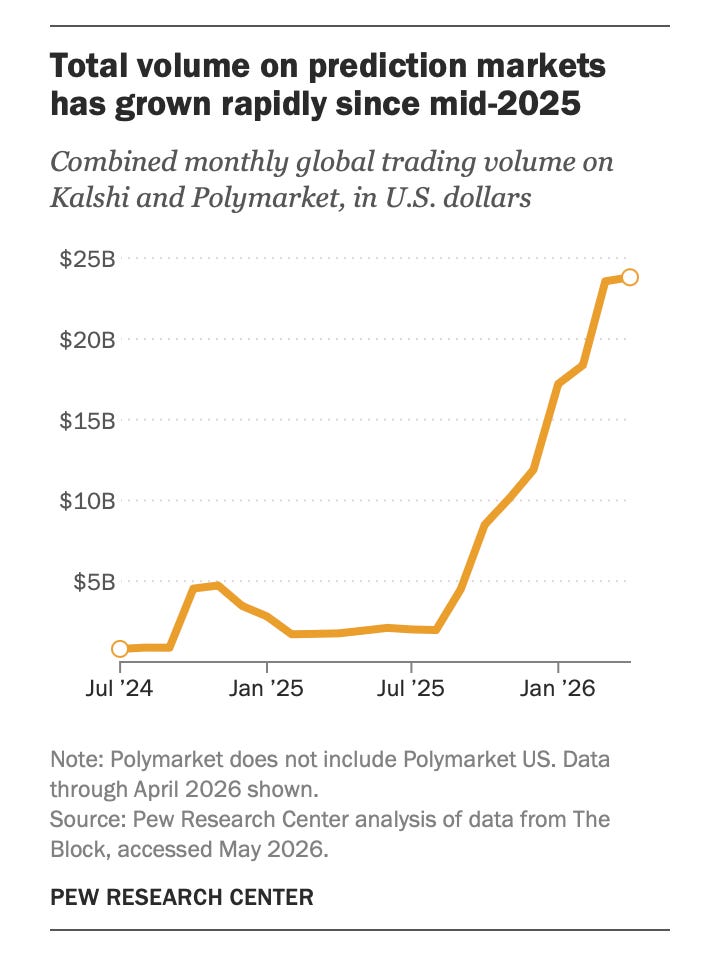
But, as it turns out, you could have an endless number of prediction markets on topics that resolve quickly. We’ve also learned that a lot of people are interested in gambling on random, non-sports related content. Prediction market trade volume has exploded since mid-2025, coinciding with de facto legalization.1
Yet these markets aren’t exactly the places where you would expect intellectuals and pundits to prove themselves. Instead, we have winner-take-all systems composed of a lot of suckers and a few large winners, and little betting on fundamental questions that might tell us something important about the world that we didn’t know before.
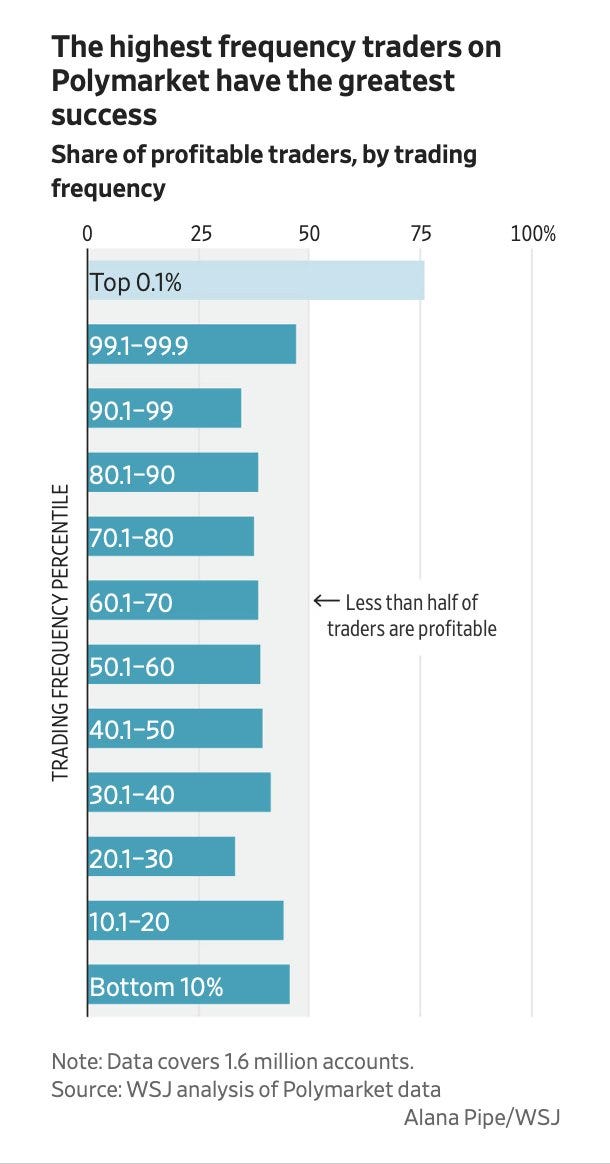
A May analysis from the Wall Street Journal shows that the top 0.1% of traders on Polymarket make 67% of the profits. And if you sort traders by trade frequency, only the top 0.1% make money on average. Those at the top are not smart pundits using their forecasting skills to improve their reputations, but largely bots that have been trained to take advantage of everyone else. You also have a lot of insider trading going on, meaning prediction markets are largely moving money from outsiders to insiders.
Knowing that their business model depends on stupid people losing money, Polymarket has found it advantageous to sponsor influencers who have large, unsophisticated audiences, primarily on the political right. I’ll note here that Polymarket has also reached out to me to discuss sponsorships, but it never ended up working out, and I suspect it’s because they understand that my readers aren’t the types to go out and bet their life savings on it being revealed that Michelle Obama is actually a man. Contrast this with a company like Mechanize, which wants to reach productive and talented individuals in order to engage in positive-sum economic activity.
Speaking of which…
This post is brought to you by Mechanize. They are hiring software engineers at a base salary of $300K-$400K/year, plus substantial bonuses. They also have openings for other positions, including Research Engineer ($500K base pay), Recruiter ($200K), Growth Manager ($250K), Interns ($150/hr), and legal counsel ($400K). You can even “build your own role.” Here is their website, and you can apply here. If you apply, make sure to use the links provided here so I can receive credit, and name me as a reference in the process.
While it has been teaming up with trash influencers, Polymarket has engaged in fraudulent practices when it comes to making ads, staging fake instances of people making money and sharing them as real videos. Prediction markets have just become another right-wing scam in the MAGA era. Again, I’m fine with brushing this off by saying fools and their money are soon parted, we must preserve individual liberty, etc. Being allowed to blow all your savings because of some fake news you saw on social media is one of your God-given rights in my mind, and we cannot take away that right from someone without robbing them of their dignity. But I don’t have to praise the people who benefit from the scam if they make taking advantage of the weaknesses of others a key part of their business model.
As for more esoteric topics we might care about like “what kind of economic system is good for growth,” Whitaker and Mazlish remain on point. Only smart people care about these things, and they have better things to do with their money than play a zero-sum game against others who also know what they’re doing, often having to wait a long time to get any payoff. If markets don’t have a lot of liquidity, they can more easily be moved by large or motivated bets, and may lack the ability to incorporate the wide sources of independent knowledge that make prediction markets work. Less liquid markets aren’t necessarily always less well-calibrated, but prediction markets that are volatile and have few people betting on them are unlikely to convince people that they’re doing anything useful, any more than Metaculus predictions do.
There are already other ways to get at many of the same questions that prediction markets deal with through the stock market or other financial indicators. I think Milei’s policies are good for Argentina because of the way markets react to rises and falls in his political fortunes, and people who aren’t convinced by that argument aren’t going to be convinced to become capitalists because of what prediction markets say. Once again, this isn’t necessarily a problem with prediction markets, but it does raise the question of what exactly their added value is.
The fact that stock markets already exist, and, again, they’re not zero sum, is an issue for the theory that prediction markets are going to give us insights on important questions we don’t already have. That’s true even if the latter are superior to normal punditry on questions like who will win an election or even when a war will end.
This is a problem with the culture of forecasting more generally. People act as if the top performers on Metaculus are the world’s greatest forecasters. It’s kind of like assuming that the best player in a recreational softball league is one of the world’s greatest athletes, or that chess grandmasters are the world’s smartest individuals. The best athletes in the world are doing things that are more rewarding, like playing in the NBA or winning Olympic gold medals. Similarly, we have every reason to believe that the best forecasters in the world are running successful hedge funds instead of spending all their time trying to prove how smart they are to strangers on the internet.
Not that there’s necessarily anything wrong with that. So many people spend time being wrong on the internet and having a careless disregard for what is true that we might say it’s a good thing that individuals can gain status by making accurate forecasts. That is, unless the opportunity costs of doing so are too high, in which case they perhaps should devote their talents to something else.
Did the cause of prediction markets have to end this way? Imagine an alternative world where, instead of recruiting MAGA influencers in order to squeeze as much money as possible out of their fans, Polymarket had found a way to team up with a serious journalistic institution or credible nonprofit. They maybe could’ve funded Robin Hanson or Phil Tetlock starting a Center for Forecasting at a major university to explicitly test the predictive power of various ideologies. While prediction markets won’t deliver convincing answers to deep questions we care about through market incentives alone, the story might be different if we use a combination of market and prestige incentives. Imagine Metaculus but with real money on the line – though the effort would probably need to be heavily subsidized. If Polymarket wants to do this now with all the money they make off simple-minded MAGAs, it would go a long way toward redeeming the negative impact they’ve had on our political culture.
I’m not saying that this would be certain to produce new forms of human knowledge, but it would at least be worth trying. And going down the path of trying to win over elites would also ensure the long-term viability of prediction markets. Right now, they’re basically begging to be shut down the next time a Democratic administration comes into office.
I remain appreciative of the spirit behind prediction market enthusiasm. Until this year, when going would have conflicted with the promotion of my book, I had attended every Manifest event since the conference began and enjoyed my time there. Support for prediction markets was always motivated by the search for truth, and in my case in particular, frustration with how much stupidity there was in the discourse. That makes it a particularly bitter irony that Polymarket has been making it even dumber by providing support for awful influencers with large social media followings.
When the questions you are interested in are straightforward, go ahead and use prediction markets as a good first approximation of what you can expect to happen in the world. Unfortunately, experience has so far exposed the limits of what they can tell us through using financial incentives alone.
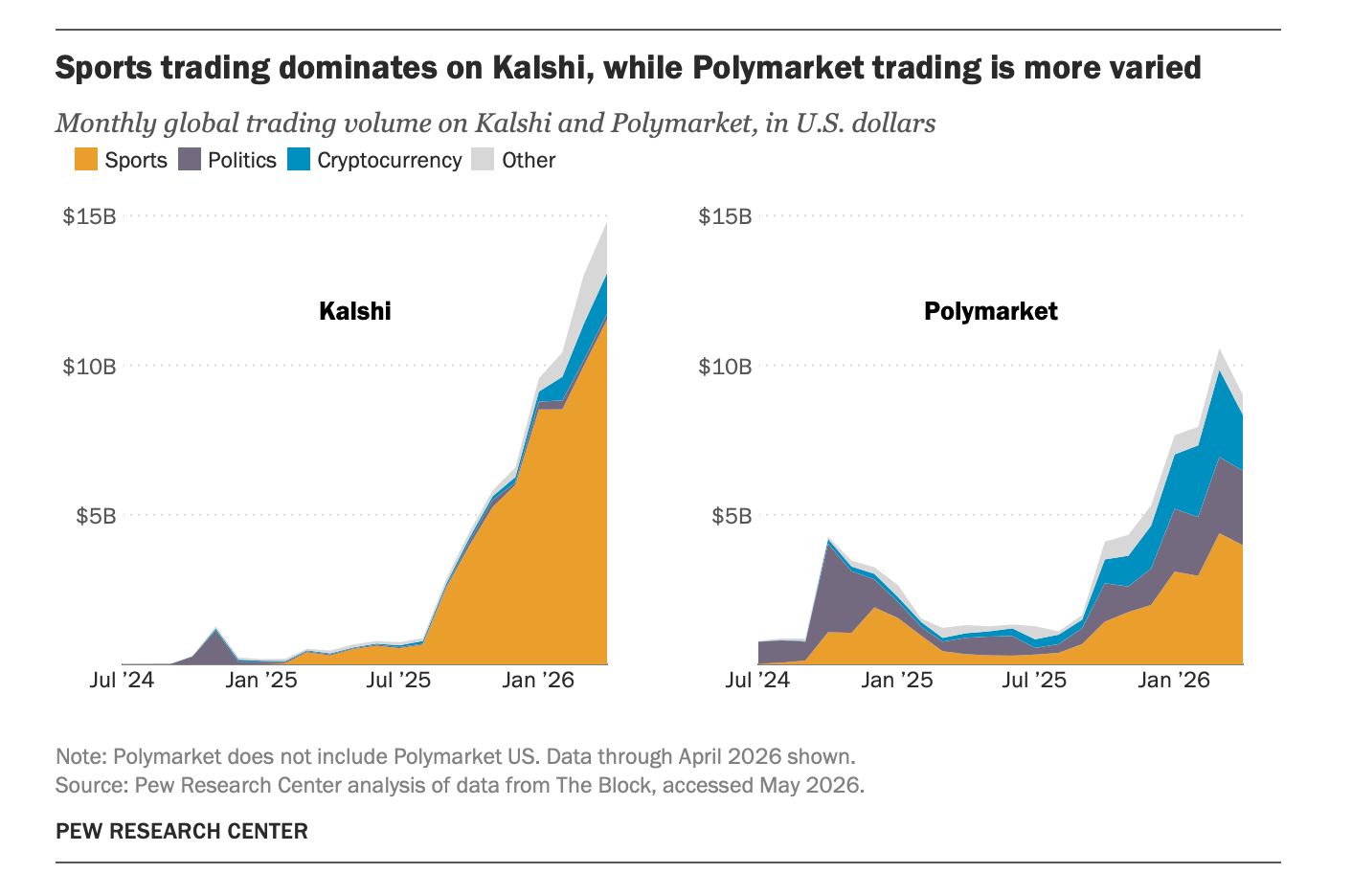
Kalshi is actually majority sports gambling, while it is around 40% of volume on Polymarket. Thus, while the chart captures an increase in sports gambling too, it also indicates a large rise in non-sports related content, as shown in the chart below. I thank Charles Fain Lehman for pointing this out to me.
I think your article is full of non-sequiturs. For example, top profiting accounts being bots on sports and crypto markets seems irrelevant to me, you should just be filtering those out because those are not what prediction markets are really about.
I make the falsifiable claim that if you are actually very good at forecasting, you will make a lot of money on prediction markets. Millions of dollars. Why pundits don't do this is a great question, you should let us know since you are one yourself! My answer is that it's because forecasting is actually very hard and the skill required to be a popular pundit is not highly correlated with good forecasting.
Interesting article, but it contains a couple of factual errors.
First, Kalshi (and Polymarket sometimes) pay interest or yield on funds tied up in eligible positions. That does not get rid of the opportunity cost of holding a long-term contract, but it makes the problem considerably less severe.
Second, bots do not dominate overall P&L. The methodology behind the report cited here is highly questionable: frequent trading is not the same thing as bot trading, and profitability among high-frequency accounts does not prove that bots capture most of the profits. Look through the actual P&L leaderboards; many of the largest winners are discretionary traders.
Bots clearly have an advantage in highly mathematical markets, particularly short-term crypto-price contracts. But extrapolating from those markets to claim that prediction-market profits are generally dominated by bots is not supported by the evidence.