
In 1958, Carl Jung published Flying Saucers: A Modern Myth of Things Seen in the Skies. He noted at the time that there were a lot of firsthand accounts of individuals seeing alleged alien spacecraft. Yet strangely, testimony was the only evidence we had. Jung wondered: “Considering the notorious camera-mindedness of Americans, it is surprising how few ‘authentic’ photos of UFOs seem to exist.”
That was 68 years ago. Jung was looking around and saying, “Gee, there are so many cameras in the world! Americans really love taking pictures. And not a single good one of a UFO? Really?”
If he could only see us today! In the decades since, billions of people have gotten access to smartphones in their pockets, ready to snap a picture or take a video of anything in the sky that looks anomalous at a moment’s notice. They bring these devices with them when they’re going to work, shopping, and flying on airplanes. The abilities of governments and private entities to monitor the sky have also grown exponentially, in terms of everything from military and civilian radar networks to weather satellites, commercial Earth-observation satellites, astronomical telescopes, air-traffic-control systems, and the sensors and tracking equipment carried by modern aircraft themselves.
And yet, remarkably, the evidence for UFOs remains… almost exactly what it was in the 1950s. Firsthand testimony, with very little else. The number of cameras in the world and their quality are constantly increasing, and yet the quality of UFO documentation remains the same. Elon Musk had it right in 2021.


To say there are reasons to believe in aliens based on what people have claimed they have seen would also force one to accept credible evidence for mind reading and ghosts.
You’ll often hear that UAPs – to use the modern terminology – have been identified by radar or other forms of detection technology. There’s less here than meets the eye. Sometimes, a sensor will pick up an object, but it will be found to have behaved unremarkably, refuting the claims of witnesses. In other cases, there are explanations for what happened in terms of equipment malfunctioning. I asked ChatGPT and Claude: “Is there a single confirmed case of a UAP defying the known laws of physics that is supported by detection technology like radar and does not ultimately rely on eyewitness testimony?” Both said no.
Despite all this, smart people now take the aliens hypothesis seriously. Ross Douthat, Robin Hanson, and Tyler Cowen are at least UAP-curious, while Ezra Klein says he feels that “there is something interesting here.” This makes the UAP issue different from most topics that excite listeners of the Joe Rogan Experience like vaccine denial and lost civilizations, in that some intelligent observers think that claims of alien visitors have credibility. They’re wrong; believers in alien aircraft have not presented enough evidence for us to even be at the point where one could say “we should be having this conversation.” We’re still at the level where we can simply dismiss UAP activism as a form of pseudoscience.
Sure, not every UAP sighting can easily be explained away. But think about what we’re talking about here. The sky is vast. It’s filled with planes, birds, balloons, helicopters, stars, space debris, the moon, other planets, and now drones. The sky is where you find the sun – an object famous for creating optical illusions. The UAP sightings that get the most attention come from individuals traveling through the air at unnaturally high speeds. With so many people peering out over such vast distances, often moving rapidly through the air, and with so many objects flying or floating around, it would be shocking if we didn’t hear reports of phenomena that appear bizarre.
There are perhaps 430 billion wild birds in the world. Each day across the planet, 100,000 airplane flights take off and land, and 1,800 weather balloons are launched. In the United States, there are close to 3 million registered drones, and there are tens of thousands of man-made objects orbiting the Earth. Are we really supposed to be surprised when the military reports a few hundred times a year that service members see objects that can’t be identified? Wouldn’t you expect that, in the glare of the sun and in unusual atmospheric conditions, a few birds or satellites would occasionally appear to be behaving strangely when you’re looking at them from far away? How would this not be the case?
As Adam Kirsch writes in We Want to Believe: How Aliens Went Mainstream and Why It Matters, the UFO debate goes through recurring cycles. The media reports anecdotal accounts of strange objects in the air. Attention being drawn to the topic increases the number of sightings. The government investigates what is going on, and finds that there is no evidence for anything unnatural or extraterrestrial life. The alien-believing community continues sharing stories with each other and never producing any real evidence to back up their claims, until the whole process begins again.
In 1966, the Air Force commissioned a team of scientists at the University of Colorado to conduct an independent study of the UFO phenomenon. The resulting Condon Report, published in 1969, concluded that “nothing has come from the study of UFOs in the past twenty-one years that has added to scientific knowledge.” Later that year, the Air Force shut down Project Blue Book, which over its history had collected 12,618 reported sightings, 701 of which remained unidentified.
The current UFO craze began in December 2017, when The New York Times published a story on the Pentagon having had a $22 million program for studying UAPs from 2007 to 2012. The article was given additional credibility by the release of two videos from US military jets that appeared to show unknown objects behaving strangely in the air.
Ordered by the Senate Select Committee on Intelligence in response to the 2017 revelations, a 2021 preliminary intelligence assessment reviewed 144 UAP reports, mostly from military aviators. Investigators were able to resolve only one case with high confidence, identifying it as a deflating balloon; the other 143 remained unexplained because the available information was insufficient: “The limited amount of high-quality reporting on unidentified aerial phenomena (UAP) hampers our ability to draw firm conclusions about the nature or intent of UAP.” The report goes on to say that “In a limited number of incidents, UAP reportedly appeared to exhibit unusual flight characteristics. These observations could be the result of sensor errors, spoofing, or observer misperception and require additional rigorous analysis.” It then suggested that resolved cases were likely to fall into categories such as balloons and other airborne clutter, atmospheric effects, American or foreign technology, or an unspecified “other” category.
Nothing in the report established extraterrestrial technology, or even the idea that the kinds of events showing apparent violations of the known laws of physics are anything but extremely rare. The authors note that sensors on US military platforms are designed for specific missions related to combat; they are not designed to pick up whatever UAPs are – or accurately perceive the movements of birds and weather balloons at great distances – so could naturally work imperfectly or malfunction when not used for their stated purposes.
While getting a tiny fraction of the attention of UFO-enthusiasts, a video game designer named Mick West has been doing the work of debunking individual stories. In one widely publicized 2014 case, a Chilean Navy helicopter recorded an apparently strange object emitting what looked like a plume. Later, West and colleagues used flight and radar data to identify it as Iberia flight 6830, with infrared glare from its engines obscuring the airplane’s normal shape and its contrails producing the apparent plume. West has proposed similar conventional explanations for the famous Navy videos covered in the NYT. For example, he shows that the 2004 “Tic Tac” footage may simply show a distant object whose apparent rapid movement is the result of the camera losing track of it and changing zoom.
The All-domain Anomaly Resolution Office (AARO) of the Department of War keeps a running dashboard of resolved UAP sightings. As of this writing, this entity has settled 941 cases from January 1, 1996 to August 15, 2026. Eighty-six percent were either satellites or balloons.
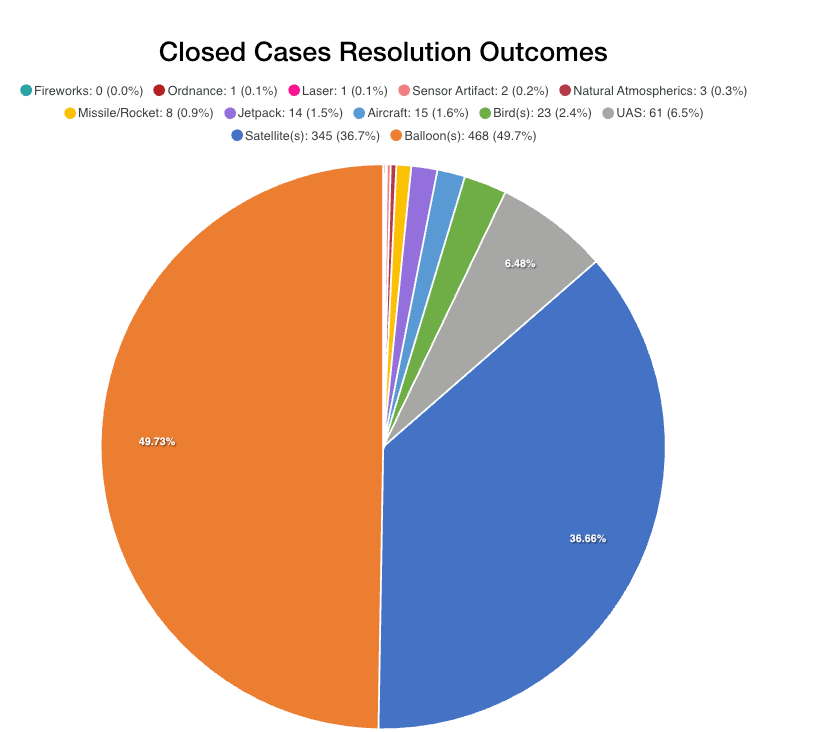
AARO doesn’t give a cumulative number of still open cases, or those with insufficient data to determine what was seen. But we do know that the government reports no positive evidence for alien aircraft or technology that violates the known laws of physics, and it’s simply absurd to jump to the conclusion that, because some sightings remain unexplained, this must mean aliens have visited us.
Imagine if we did this in other areas of life. I walk around keeping track of all noises I’ve ever heard that can’t be explained, and then decide it is a serious scientific hypothesis to suggest that they were all demons trying to make contact with me. Sure, I can’t rule that out in every single case, but this would be a ridiculous conclusion to draw. Of course, it might be a reasonable hypothesis if the noises clearly sounded like a voice saying “I am a demon watching you.” But the UAP sightings are never that unambiguous. The truly remarkable claims – think accounts of alien abduction or the government dissecting extraterrestrials – come from the least credible people, while individuals who are more credible generally report things like “I saw this blurry thing that was shaped like a tic tac and appeared to go really fast.” This is exactly what you would expect if the whole phenomenon were fake and we weren’t actually being visited by aliens.
I noticed something similar while watching the documentary The Age of Disclosure, on Tyler’s recommendation. The film was given credibility by its producer landing interviews with prominent figures like James Clapper, Marco Rubio, and Kirsten Gillibrand. But the more famous individuals were always cautious, stressing what we didn’t know and expressing concerns about national security. The people making the truly jaw-dropping claims were individuals who were long-time advocates for the idea that aliens have visited us, and who blame conspiracies for them not being able to get at and reveal the truth about what the government knows. They complain that their superiors don’t take them seriously, concluding they must be hiding something, instead of stopping to consider that maybe top government officials understand that no convincing evidence has been found for extraterrestrial life having visited earth, and to behave otherwise is to pointlessly squander government resources.
To give you an idea of how out of their minds the most famous UAP advocates are, at about forty minutes in, the documentary has them speculating that perhaps unknown life forms are not coming from outer space but the bottom of the ocean. At that point I stopped watching.
Each year AARO puts out a new report, and every year the same result is confirmed. A lot of new sightings, conclusive evidence that many of them are natural phenomena, some that are left unexplained, and basically nothing to suggest aliens.
As for the secret Pentagon program to investigate UAPs reported on in the NYT, its existence can be credited to a network of cranks who were able to funnel money to the company of one alien-obsessed businessman named Robert Bigelow, who is also interested in paranormal phenomena and had ties to Senate Majority Leader Harry Reid. Whenever more serious people in the government have looked into their claims, they have found nothing there, and when they’ve been put under oath, the UFO-believers suddenly become a lot more careful about what they’ve seen or heard.
One of the more amusing portions of Kirsch’s book is when he recounts what happened when the crank network went before Congress in 2023.
For all the attention the witnesses received, they didn’t present any evidence that met the Sagan standard. They, too, were simply telling stories—and not always their own stories. When Grusch was asked about his claims that the US government is hiding the bodies of extraterrestrials, he demurred, “That is something I have not witnessed myself.” Graves testified that in 2003, Boeing contractors at Vandenberg Air Force Base in California saw a very large red square “approach the base from the ocean and hover at low altitude over one of the launch facilities.” But when Representative Alexandria Ocasio-Cortez of New York asked him to expand on the incident, Graves replied, “The information about the contractors themselves were provided by a witness and I have no particular detail in that relationship.”
The committee members seemed more prepared to believe the witnesses’ claims that the US government, or people working inside it, were conspiring to conceal the truth about UAPs. Representative Anna Paulina Luna of Florida thanked Grusch for “coming forward in fear of his life.” Grusch suggested that he had evidence to back up his claims about secret government programs and was aware of planned reprisals against himself and others, but was legally prohibited from discussing classified details publicly. “I can provide more details in a closed environment,” he offered, and Representative Nancy Mace of South Carolina suggested that “maybe we get into a SCIF at the next hearing that we have.” A SCIF is a “Sensitive Compartmented Information Facility,” a military term for a room cleared of recording and transmitting devices, where secrets can be safely shared—provided, of course, that Grusch did possess such secrets.
This is all very familiar to anyone who pays attention to conspiracy theorist podcasters: large, sweeping claims that fall apart when you press for details, alongside hints that the person spreading the conspiracy theory is bravely risking his life by publicly defying shadowy forces. As with the Dominion lawsuit and the career of Kash Patel, conspiracy theorists tend to be a lot less measured on podcasts and social media than they are when speaking in forums with actual consequences for lying, like legal proceedings and congressional hearings.
Before coming into office, Vance promised low-information Trump voters that the new administration would get to the bottom of the UAP issue. It took power, and the serious bureaucrats in government kept releasing the same types of reports showing that there is no reason to think that aliens have visited earth. The administration has released new documents, but they haven’t made a splash because they haven’t revealed anything that interesting. Vance now tells podcasters that he’s “working on it” and simply hasn’t had time to get to the aliens question. It seems to me that this would be one of the first things you would look into once you got into office if you were interested in the topic, and strangely the vice president still has had the bandwidth to regularly record podcasts and write a book on his religious journey.
Obama – unlike Vance, a decent man who has not built a career out of flattering the lowest scum of the earth by becoming one with their hivemind – has consistently said that there’s nothing too exciting going on beyond what has been made public. The former president has stated that “the chances we've been visited by aliens is low, and I saw no evidence during my presidency that extraterrestrials have made contact with us.” UFO-believers ignore statements like this coming from prominent individuals, and instead focus on those who are more conspiratorially-minded.
As Kirsch notes, in the last decades, the respectability of UFO discourse has increased despite no compelling evidence having emerged suggesting that we are being visited by aliens. In fact, with camera phones and better technology to monitor the skies, we can go one step further and say that the case for UFOs has never been weaker.
Imagine if there was a forest that had never been explored, and some people were saying that it was full of elves. We go in, start examining the territory, begin monitoring movements within it, and don’t find any such creatures. We wouldn’t at that point simply say there is still no new evidence for elves. We’d say that the hypothesis has been tested, and it has been falsified – at least to the degree that we can prove a negative in a situation like this.
In the midst of a discussion in Robin Hanson’s comments, I asked Claude for the 12 most compelling UAP cases in the US. The incidents spanned the range of 1947 to 2004. ChatGPT gives 1952 to 2014/2015, with only three since the year 2000 and none in the last decade. It’s quite curious how, for real phenomena in the sky, as our technology and monitoring capabilities have improved, the number of observations has increased. But, somehow, compelling UAP cases have become no more common over the last few decades. Maybe the aliens stopped coming when they knew they would be reliably seen, but there is obviously a more likely explanation here.
While the UAP discourse has no scientific value pertaining to aliens, it is interesting as a political phenomenon. This is a textbook case of how populism makes us stupider. For the better part of a century now, there have been people who have said that they’ve had firsthand experience with UFOs or extraterrestrial beings. Experts and serious scientific voices have responded that these reports weren’t credible, and had no real evidence to support them. The experts were right and the outsiders and self-styled mavericks were wrong, and now conspiracy theorists have gained ground because they have more access to large platforms than ever.
It was perhaps a reasonable hypothesis that unidentified objects in the sky might be aliens in the 1950s and 1960s. Nobody ever found any convincing evidence in support of this idea, at which point we should have considered the question settled barring any new findings. As we got exponentially more and higher-quality cameras and improved capabilities for monitoring the sky, the idea that extraterrestrials are here got less credible each day.
It’s also an interesting question why smart people have fallen for this. I think it is a good example of how living in a populist era means that even the best minds are going to occasionally be convinced by nonsense. A sophisticated observer might see a NYT report and a congressional hearing, and think that these are signs that a narrative has credibility, without updating to take into account the fact that Congress now includes figures like Nancy Mace and Anna Paulina Luna, who are no more trustworthy than the worst social media scammers. We’re also all constantly picking up lower-quality data like chatter from social media and fragments from podcast interviews, adding to the general sense that there must be something going on here. It’s hard to stay smart in an era that is so stupid!
In times like this, it’s important to stick to the basics. David Hume and Carl Sagan were right. Extraordinary claims require extraordinary evidence, and eyewitness testimony tends to be the kind of evidence that humans are most likely to overrate. This is probably because we evolved to form bonds with other people, and that sometimes involves taking what they say seriously, even if there aren’t good objective reasons to believe that what they are saying is true. Moreover, before science existed, there really wasn’t any alternative to getting information from other human beings. This reminds me of the Fatima debate I participated in, where the fundamental flaw of the pro-miracle side was that they put way too much stock in the recollections of illiterate peasants.
I’m passionate about exposing the weaknesses behind claims of miracles and aliens not just because I enjoy debunking things and feeling superior, but also because arguments that there is real evidence for these things are an insult to actual science and truth-seeking. Questions like why, if the universe is so vast, we see no signs of alien life, as formulated by scientists like Frank Drake and Enrico Fermi, deserve serious attention, and the fact that we talking apes can extract any information at all from objects billions of light-years away – even that we have the concept of a light-year! – should fill us with awe and wonder. It should offend one’s sense of rationality to still see people, in the year 2026, act as if “trust me bro” counts as real evidence, in contradiction to everything we have learned about how to increase human knowledge. That’s good enough for those in the podcaster scene who, if we value honesty and intellectual integrity at all, we should regard with contempt.
The aliens are not here. Or at the very least, if they are, they’ve yet to give any hints of their existence that a rational observer should consider compelling. To figure out why that is should be one of the great projects of our species.
This post is sponsored by Mechanize. They are hiring software engineers at a base salary of $300K-$400K/year, plus substantial bonuses. They also have openings for other positions, including Research Engineer ($500K base pay), Recruiter ($200K), Growth Manager ($250K), Interns ($150/hr), and legal counsel ($400K). You can even “build your own role.” Here is their website, and you can apply here. If you apply, make sure to use the links provided here so I can receive credit, and name me as a reference in the process.
I work on astronomy data pipelines, including groups of scientists that are literally searching for evidence of aliens. One thing that people really underrate is just how many unusual sensor readings you get when you collect a huge amount of data and filter out to look at the one-in-a-million most unusual things.
For example, the "wow signal". https://en.wikipedia.org/wiki/Wow!_signal . If you read the wikipedia page you might think, oh there's some debate about what this is, maybe it's aliens. No, nowadays radio astronomers see similar things all the time. Literally millions of them. A big spike that never repeats again and so you have no idea what it is. Well, there are many ways that instruments can malfunction or something briefly interferes with a sensor and you get a reading that doesn't map to anything physically. With modern data collection volumes there are so many anomalies like this, you just have to throw them out.
So the idea of, what's the explanation for these things. For every video of a weird thing there must be an explanation. No, there just isn't an explanation. The sensor acted weirdly and you'll never know why because that's how massive data collection projects work.
I do support looking for UFOs, because it seems like a reasonable thing to investigate, but it doesn't make sense to take this extremely low-quality data and pore over it expecting it to lead to anything. Instead, the people who actually do have a very high-quality data source should spend a little bit of time checking for stuff they don't recognize. For example one obvious entity to do this is SpaceX since there are so many Starlink satellites and they are going to need a lot of high quality data collection to make sure Starlinks don't run into random space garbage. If they notice any space garbage moving unnaturally, that would be interesting to escalate to human analysis.
People understand now that the vast size of the universe across time and space makes it almost a certainty that we are one of many intelligent civilizations in our universe. What people miss is that same grand scale makes it vanishingly unlikely we will ever meet one. In 3.5 billion years of life on earth, we have had a civilization that could use radio waves only for the last 150. A similar civilization on a planet near enough that we could plausibly even detect them could have achieved radio transmission 3 million years ago and died out 1 million years ago, or may not arise for another 3 million. The odds that two intelligent space traveling civilizations will arise in geographical and temporal proximity such that they can be aware of each other are probably extremely small.