
When police killings of black men were in the headlines during the 2010s and early 2020s, we would often hear about “the talk” that black parents had to have with their sons. Law enforcement was supposedly so racist, violent, and out of control that the average black male needed to go through life worrying about being shot by the police.
This of course was always ridiculous. An unarmed man of any race being killed by police is one of those things that is so rare that the rational thing to do is to never think about it at all. If you were going to list all the dangers in the world from most to least threatening, suffering abuse at the hands of the police should be way down the list, unless you are a criminal. When there is more societal concern about this topic, it should be understood to be a manifestation of a neurotic spirit.
I thought about this after watching this clip about the differences in life experiences between “Boomers” and “Zoomers.” (The very framing itself is a sign of victimhood culture.)


According to this AI slop cartoon – which is exaggerated for comedic effect while still intending to make a sincere point – previous generations of American men were offered jobs, cars, houses, and submissive wives simply for existing. Today, they are gatekept out of corporate offices by fat tattooed lesbians, can only meet women who do porn, and are kicked out of their dingy apartments by BlackRock to make room for muscular Somali refugees in tracksuits. This self-pitying trash has two million views on X, with hundreds of replies and retweets talking about how much it hits home.
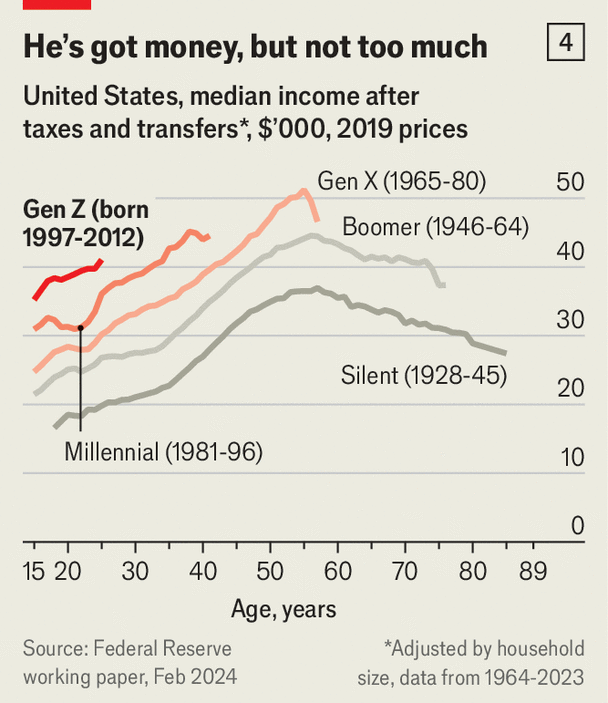
As with police shootings, none of this is consistent with reality. Young people today are wealthier than ever. You may think that life is hard in some absolute cosmic sense, but you cannot say that it is objectively difficult compared to what previous generations had to go through. Whether it feels harder is a different matter.
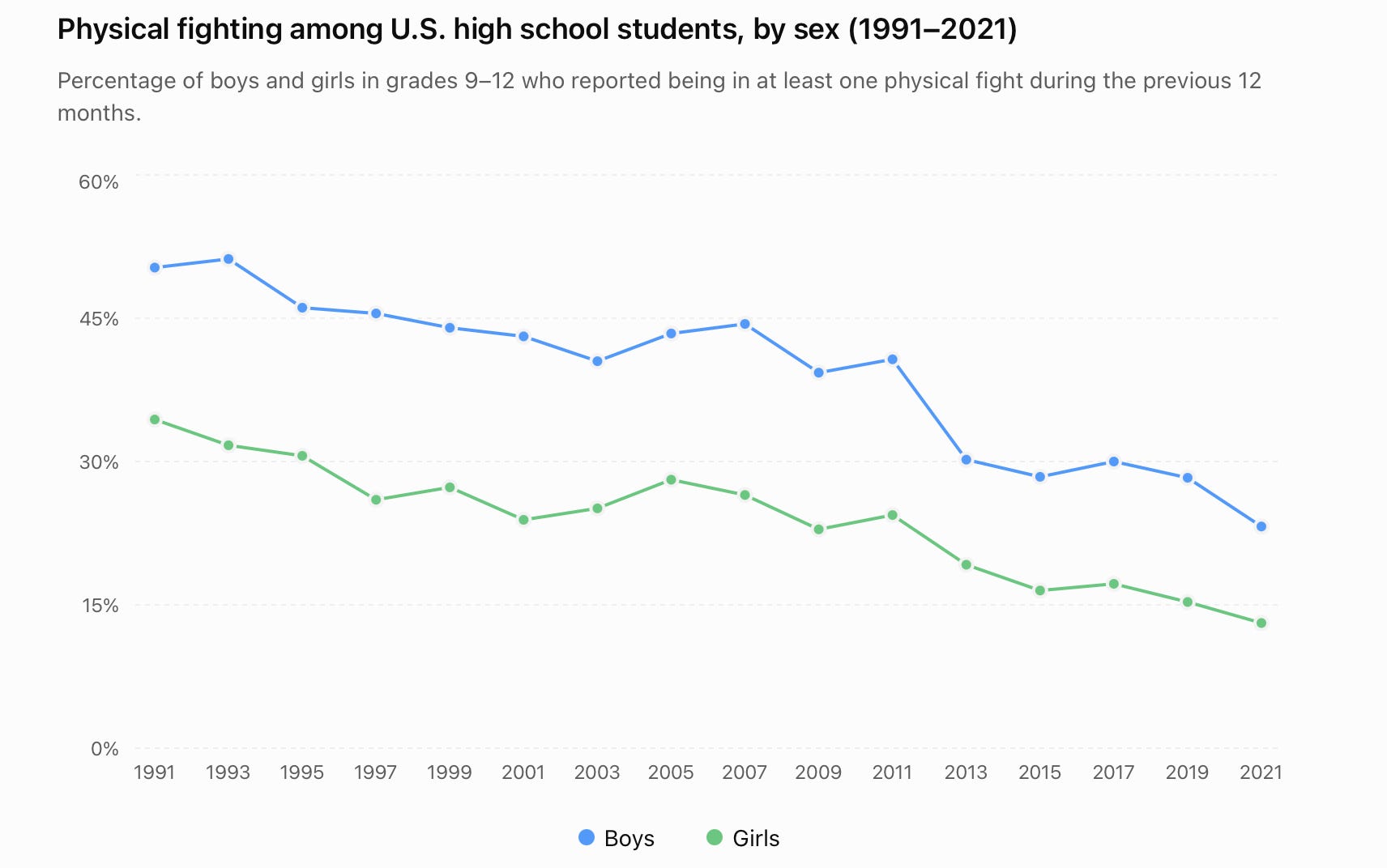
Economic indicators are not the only form of evidence showing that life has gotten easier. Violent crime in particular has plummeted, and I’m not just talking about murder. Watch movies or TV shows up until the 1980s and 1990s, and you’ll see parents encouraging their sons to physically stand up to bullies. Getting into fights was, until recently, seen as a rite of passage for boys growing up. I think parents handling bullying like that today would be seen as abusive. One could argue that it is good for a male to be involved in a few physical fights in his life, and it’s best to do it as a kid because children are weak and they’re highly unlikely to do permanent damage to one another. No matter how we feel about this trend, it is certainly a case of life getting easier for men. In 1993, 51% of male high school students had been in a fight in the previous twelve months. By 2021, it was down to 23%.
Whenever I say that men should overcome fear and try to hit on women, I’m told that this is impossible because today a girl might call the police or complain about you on TikTok. It's certainly possible that you might get arrested for asking a girl out for coffee, just like it’s possible that if a young black man asks a police officer for directions, he could end up in the morgue. But these are extremely rare occurrences! If you’re actually going through life worrying about either of these things, it says more about your level of neuroticism than the objective dangers you face in the real world.
Something has clearly gone terribly wrong in the culture. I remember the horror of finding out about the incel community for the first time several years ago. In the early days of the internet, if a young man went online and looked for advice on meeting women, he would find pickup artists encouraging him to develop confidence and mental resilience. You could criticize this community for encouraging unhealthy attitudes toward women, but it treated male failure as a problem that it was feasible to overcome.
By the late 2010s, young men were gathering on message boards to talk about how members of their community were genetic trash destined to die alone if they were not 6’5” with a chiseled jaw. Physical appearance has always mattered, and this is certainly truer in the era of dating apps. But if you go outside once in a while, you’ll see goofy-looking men with above-average women at their side all the time.
Similarly, throughout my life there have always been people complaining that they can’t get ahead because foreigners took their jobs. As incomes have gone up, thanks in large part to globalization and immigration, such voices have become louder and more numerous, and they are much more likely to be pandered to by politicians. JD Vance says that you have to express empathy for young people who complain about the price of burritos. Are Americans spending a larger portion of their income on food? Are they less able to eat out? No and no.
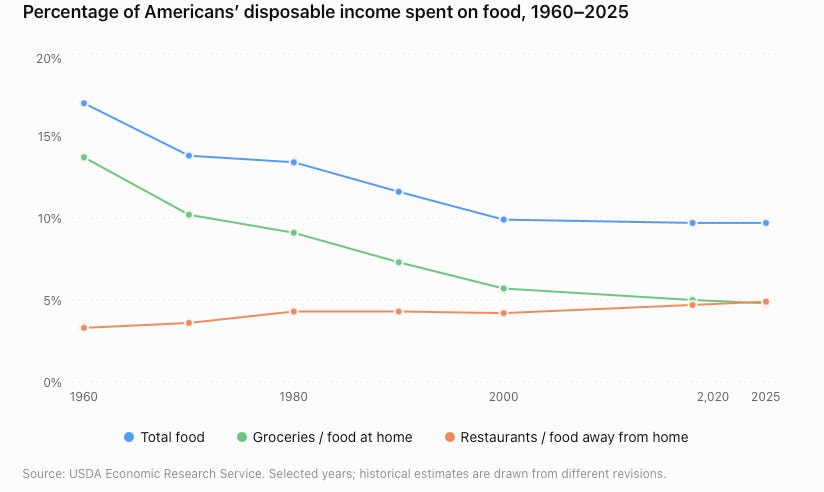
People are spending less on groceries, more on restaurants, and less on food overall, thus trading some of their higher disposable income for greater convenience. You shouldn’t need data to see this. Just take a look when you drive by shopping centers anywhere in the country, and you’ll see a noticeable improvement in the quality, abundance, and diversity of dining options every few years.
I’m not saying people should be Pollyannaish about policy. It’s fine to talk about ways in which life could be better. We should be complaining even more about housing, where the young are really getting screwed, and which eats up at least some of the rise in income, leading to more young people living at home. But if you’re starting from the position that people today have it harder than they did in the past, you’re simply not seeing the world accurately.
Am I falling into the same trap? Here I am complaining about people complaining. You might say that I am contributing to the very trend that I am denouncing. But the difference is that, when I say Americans have gotten sadder and more neurotic, my arguments are actually correct, and based on real data. Saying true things about the ways in which the world is getting worse is not being irrationally pessimistic. It’s called having insights. Those complaining about material conditions getting more difficult, in contrast, have their facts wrong.
In the future, all additional gains that we make are going to continue to feel hollow unless we confront head-on the degree to which the culture has become more negative. Smartphones are often pointed to as the obvious culprit here, but increasing misery is far from universal.
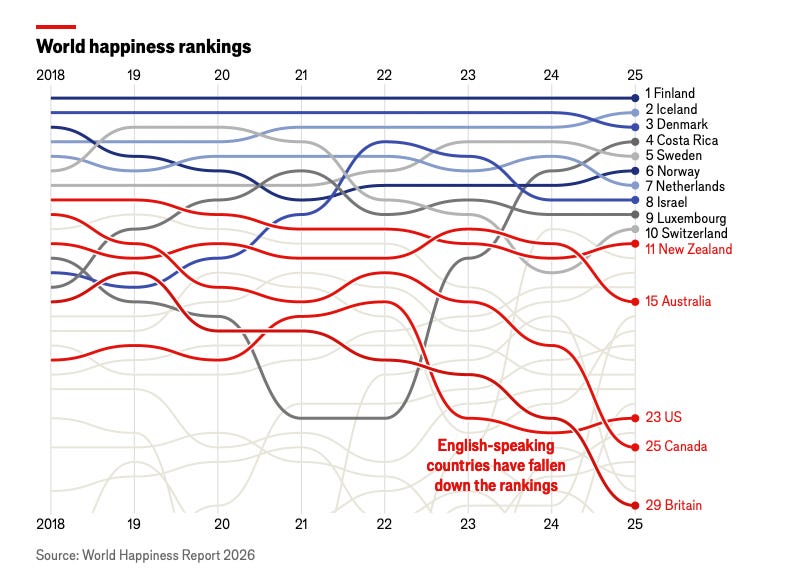
According to The Economist, between 2011 and 2025, twice as many countries got happier than sadder. This is simply inconsistent with a theory in which smartphones naturally make people hate life. Yet in the developed world, the Anglosphere stands out in terms of plummeting happiness. Smartphones aren’t inherently toxic devices, but they probably explain why the United States and other English-speaking countries cluster together, since they share overlapping news sources and algorithms. Try to come up with an economic reason why these nations in particular should have become more negative over the last two decades, and you will fall short.
Cultures change in mysterious ways, and it’s extremely difficult to establish causation when it comes to questions like this. Here, we might appeal to the Trump theory of everything, and hypothesize that this one particularly toxic individual made our politics miserable, which had a downstream effect on the rest of the culture. But the rise of Trump came on the heels of the Great Awokening, which likewise should be seen as both a symptom and a cause of increasing pessimism. The backlash to woke, when it exaggerates the oppression faced by white males, falls into the same pattern. Yet it’s not a simple matter of wokeness causing Trump, since if Trump hadn’t decided to run in 2016, then the Republican nominee for president would’ve been someone like Ted Cruz or Marco Rubio, and such a figure wouldn’t have inflamed the culture wars to anywhere near the same extent. And Trump’s political imitators on the right have found it much easier to copy his crudeness, bigotry, and negativity than his humor and charm, giving us a worst-of-all-worlds cultural shift within American conservatism.
Even if we can’t pin down the ultimate causes of rising self-pity, it doesn’t mean that we are helpless in the face of this problem. What we need to ultimately do is raise the status of optimistic intellectuals, politicians, and cultural figures, and decrease the status of the pessimists. I’m trying to do my part; my personal crusade against JD Vance should be understood in this context.
Part of the solution also has to be a return to stigmatizing neuroticism. It used to be less acceptable to go around feeling sorry for yourself. Unhappy people now denigrate self-help advice as “Boomer,” dismissing the possibility that those of a happier generation might have had a healthier outlook on life. The culture war is usually seen as pitting climate hysterics, trans extremists, radical feminists, and wokes against MAGAs and nativists. Wisdom today is understanding that all of these things are manifestations of the same repulsive spirit. Fighting back against it is the culture war we need.
This post is sponsored by Mechanize. AI alignment is perhaps the most important issue of our time, and if you’re interested in being part of that effort, Mechanize is hiring software engineers at a base salary of $300K-$400K/year, plus substantial bonuses. They also have openings for other positions, including Recruiter ($200K). Here is their website, and you can apply here. If you apply, make sure to use the links provided here so I can receive credit, and name me as a reference in the process.
Maybe I’m sheltered or I just have deeply idiosyncratic experiences and preferences, but seeing two technologies (GLP1s and gen AI) that solved two of the biggest problems in my life (obesity and research stamina) arrive within 3 years of each other makes pessimism a hard sell for me.
My first foray into social media was Reddit, which is filled with pessimists as far as I can see. I’ve noticed this especially on the topic of natalism. A lot of people’s reaction to why people are having fewer children is because it’s so terrible and hard to raise children these days.
Additionally, this pessimism has been there for several years now. I haven’t seen it get worse in recent years. It keeps taking different shapes. Before it was “as a disabled bipoc queer, my life is so so hard” and now it’s ostensibly about the price of housing, but it seems like it’s people who keep wanting to wallow in misery.
Maybe it’s social media making them feel worse off compared to others they wouldn’t ordinarily see. Maybe they are disappointed with how their own lives turned out. But there are a lot of disappointed bitter people who are really unaware of the conditions in this country today.