To Win Elites Over to Markets, Ditch the Chuds
Educated voters are not always economic collectivists
In the United States today, Democrats are the party of elites, while Republicans are with the “common man.” Since Democrats are on most issues the more anti-market party, this makes it seem like elites are more in favor of economic statism.
Yet there is a near universal pattern in the opposite direction, as shown in a new paper by John Nye and his co-authors called “Education and Market Liberal Preferences.” Looking at World Values Survey data over the time period 1990 to 2023, they find that higher education predicts pro-market values in 95% of cases, with 77% of the country-years showing a statistically significant relationship in that direction.
Pro-market values are determined using three World Values Survey questions asking respondents to place themselves on scales concerning a) whether incomes should be made more equal; b) whether private ownership of business and industry should be increased; and c) whether competition is good because it stimulates people to work hard and develop new ideas. The authors combine the three into an index, coding each so that higher scores represent more pro-market views.
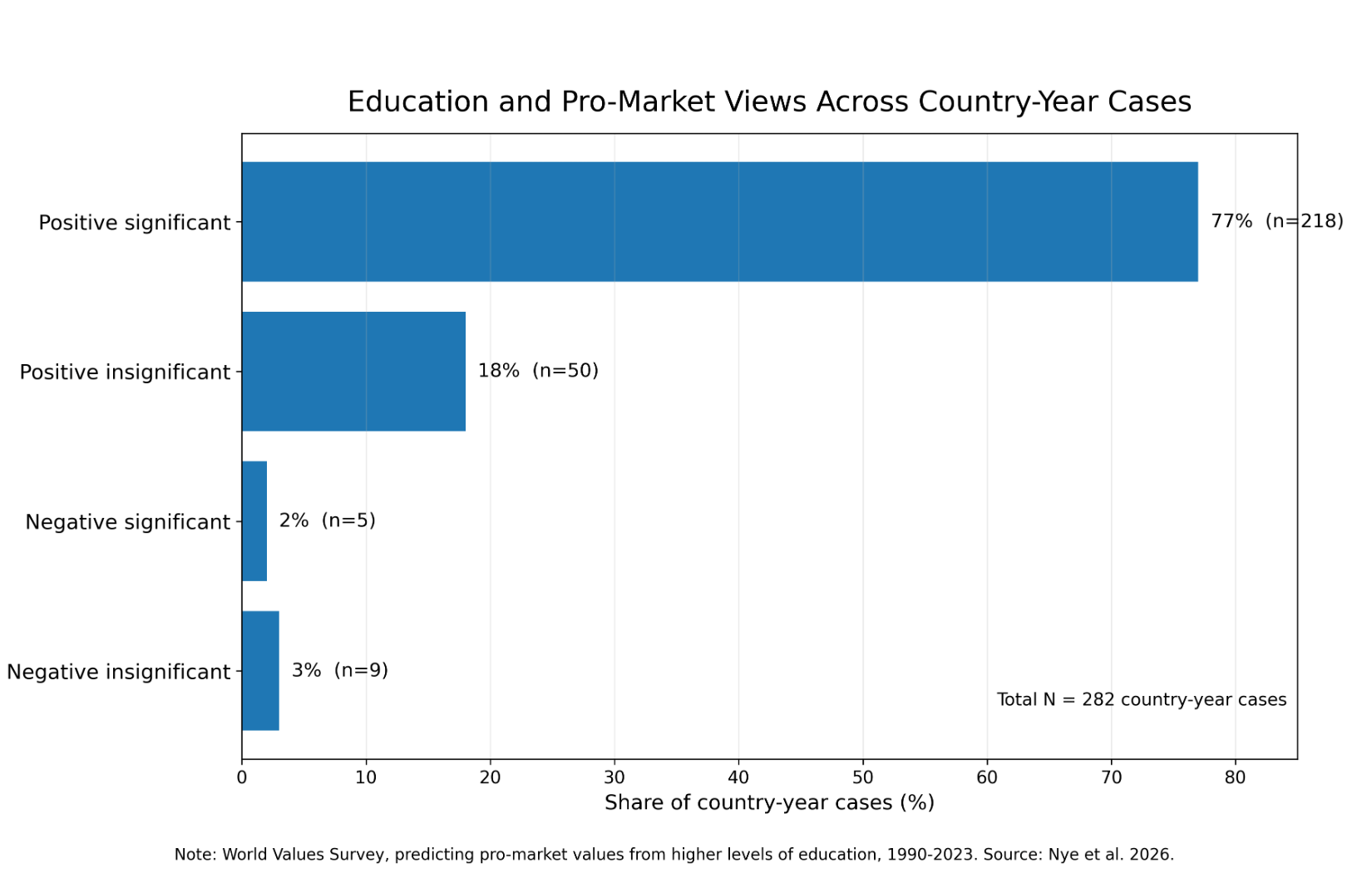
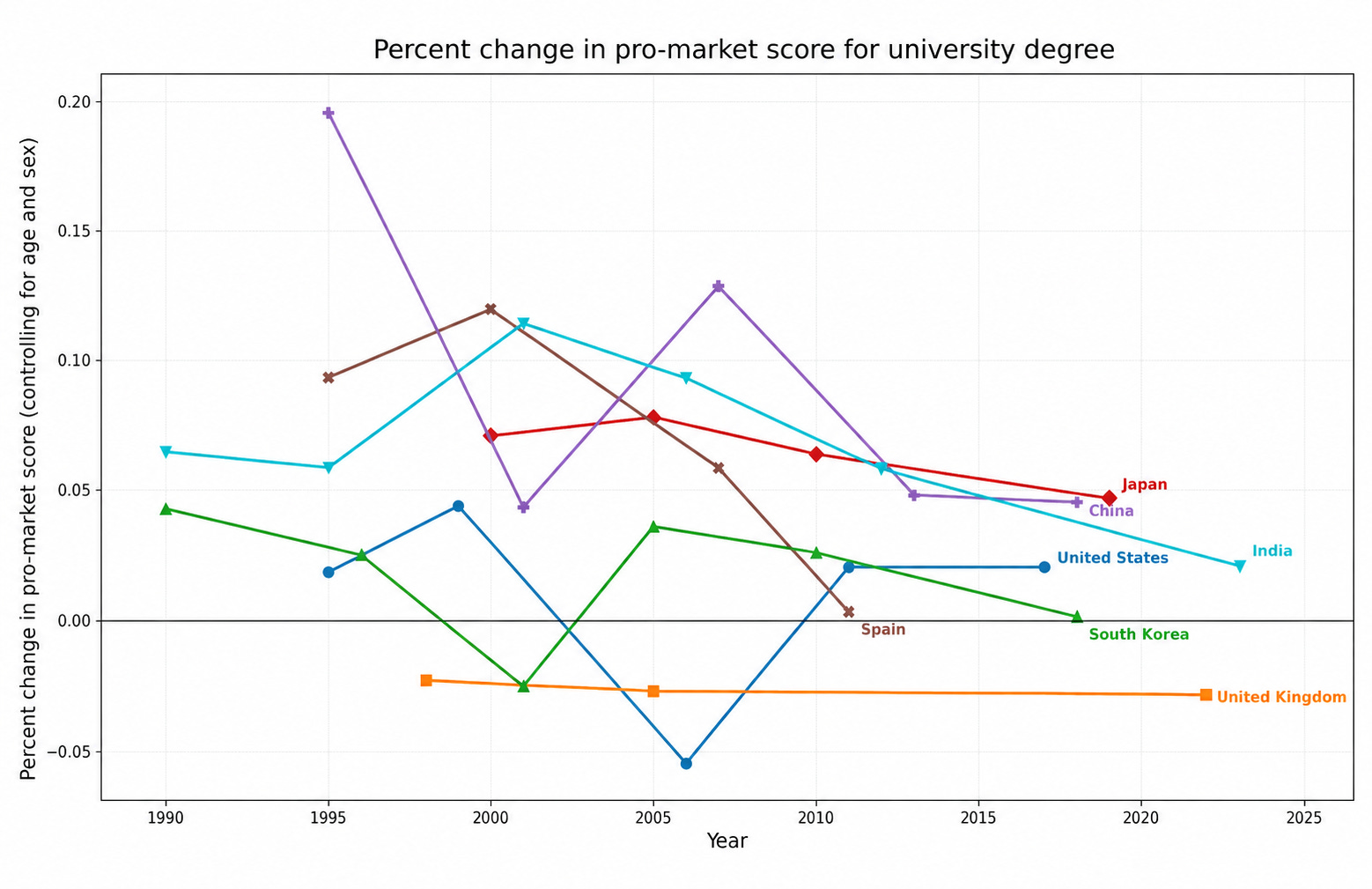
Below is the percent change in a pro-market direction associated with having a college degree for various countries across the last few decades.
Compared to most other places, college graduates in the US are not that much more pro-market. But note that even in America the sign is positive in four out of five years.
This is all pretty remarkable considering the state of the universities. And Nye et al. find that being more educated is associated with more pro-market views even among Russians who grew up in the Soviet Union. There is a deep connection between being more friendly to capitalism and being more educated that seems to go beyond what is taught in any particular education system. It is probably related to intelligence and openness.
By just looking at the US and the UK, we get the wrong impression about human nature, since these are unusual cases. That said, even American college graduates were more pro-market than non-college graduates as late as 2017, though just barely. Yet they still voted for Hillary.
Across the 277 observations with the relevant data, on average having a university degree gives an individual a 7.2% higher pro-market score. In the US, it is 0.96% across five observation-years. That’s pretty low, but doesn’t explain why in most cases it is the Democrats – the party of elites – who are pushing for higher taxes and a more expansive government.
I think the conclusion we should draw from this is that abstract attitudes toward markets aren’t explaining as much as people think. When Obama tried to provide universal healthcare, Republicans appealed to free market principles to oppose it. Democrats do the same when it comes to Trump’s tariffs. There was an amusing recent poll showing that pro-DSA Democrats were more likely to support free trade agreements than normal Democrats and Independents, with Republicans least favorable of all.
Democrats tend to like direct tax and spending, which redistributes money away from wealthy white people and toward poor minorities and elite white people who work in education and academia. Republicans primarily like anti-market interventions that signal hostility toward foreigners, namely immigration restrictions and barriers to trade. Neither side is that attached to free market or socialist principles for their own sake.
One reason I think that land use reform has taken off on the left is that YIMBYs have been able to portray opposition to the movement as stemming from a racist desire of white people to keep away minorities. As a result of this success, Republicans, who have traditionally been good on housing, are now sometimes attacking Democrats by talking about how their opponents are going to destroy the suburbs.
If you see an open box below, it means you are not yet subscribed to the newsletter. Sign up to get more articles like this in the future. Most articles are free, and always will be.
Since the politics of the masses generally aren’t motivated by economic concerns, party elites set the agenda. And “elites” doesn’t mean college graduates, but a smaller group of activists and media figures within each coalition. To stay influential, however, those elites need to be able to push the right cultural buttons.
A History of Class-Based Voting in America
The question I’m interested in is what exactly supporters of the free market can do to win over elites. And here I think that they must separate their ideas from those of religious fundamentalists, nativists, conspiracy theorists, and bigots. History indicates that, like in most other countries, in America it is most natural for elites to be more pro-market than the general public. Yet there is no way that elites can be part of today’s Republican Party with Donald Trump as its head.
FDR’s base was among the rural poor and the working class, and he was famously hated by the rich. As John Allswang documented in The New Deal and American Politics, in January 1936, Gallup polled Who’s Who, a list of affluent, educated elites. The survey found that 31% said they preferred Roosevelt be reelected over a generic Republican, compared to 53% of the national sample. Four years later, an August 1940 Gallup poll showed FDR down 42 points among upper-income voters and up 32 among lower-income voters, class gaps that are unthinkable today.
The chart below uses the ANES to investigate the diploma gap in every election going back to 1952.
Basically, the overall story is that Republicans were winning BAs and holding their own with postgrads, though they took a hit with these groups when George W Bush came along. Then things were stable, with a much larger collapse coming under Trump.
What happened in the Bush era? That was the first time that culture wars weren’t simply an undercurrent in presidential elections, but came to dominate the way people saw American politics. Here’s what the 1996 map looks like, and you can tell it was a different world.
Clinton won California and New York, but also West Virginia and Louisiana. This shows his unique political genius. Presidential politics isn’t everything, but for a lot of voters, whoever the main figures in each party are determines how they see the two sides. Although Republicans spent the 1990s trying to paint him as a draft-dodging hippie with a feminist lunatic wife, Clinton spoke in a thick Southern accent, ate McDonald’s, signed the Defense of Marriage Act, and was in favor of the death penalty. This was enough to neutralize Republicans’ attempts to force him out of office by appealing to cultural grievances.
Then came Gore, who was from Tennessee but more refined in his behavior and tastes and therefore coded as more elite. He ran against a plain-spoken Texan who made evangelical Christianity central to his identity.
It was the 2000 election that created the concepts of “Red State” and “Blue State” as political-cultural categories. You never heard these terms before that point in our history. The concept of a “Blue State” as a cultural marker wouldn’t make any sense in a world where California and Louisiana could vote for the same presidential ticket, and 1996 was the last time something like that was plausible.
Beginning in 2000, such an outcome was unthinkable. Even in 2008 amid an economic collapse under Bush and his rock-bottom approval ratings, Obama won Virginia and North Carolina, but could not crack the Deep South. West Virginia, which Clinton won by 15 points in 1996, went to McCain by 13 points in 2008.
While the Christian Right had been in the Republican coalition for decades, W took cultural appeals to new levels. In 2004, Republican activists worked to get gay marriage bans on state ballots so it would drive turnout among religious conservatives. This may have worked in the short run, but made gay marriage a litmus test for whether you were a good person in elite circles. It’s not a coincidence that support for Republicans collapsed among the educated at around this time.
In 2004, major musicians like REM, Bruce Springsteen, John Mellencamp, and Pearl Jam toured swing states encouraging people to vote for John Kerry. This was also the year of Puff Daddy’s “Vote or Die!” campaign, which was officially nonpartisan but targeted minorities and young people in the hopes that they would help the Democratic ticket. Hollywood was already heavily Democratic in the 1990s, and celebrities had participated in fundraisers, endorsements, and voter-registration efforts. What was more striking in 2004 was the scale of explicitly partisan, independent campaigning by A-list entertainers aimed at defeating a sitting Republican president.
Under Bush, the Republicans leaned into Christianity, and although that was more appealing to non-elites, chud racism is a different matter. Here, the gap between elites and the masses is most intense. Trump’s lying, corruption, and election denial are similarly much easier to swallow among less informed, populist voters. As a result, the bottom fell out for Republicans among the more educated.
One of the things that I find interesting about comparing the Bush and Trump eras is that elite liberal culture was always responding to whoever the Republican standard bearer was at the time.
In the 2000s, very serious intellectuals and Hollywood actors worried about theocracy, and were relatively indifferent toward racism as a threat. 9/11 plus the backlash to Bush created the cultural conditions for the New Atheists, a movement primarily represented by Sam Harris, Richard Dawkins, Christopher Hitchens, and Daniel Dennett. The years 2006 and 2007 alone saw major books with titles like American Theocracy; Kingdom Coming: The Rise of Christian Nationalism; Theocons: Secular America under Siege; and American Fascists: The Christian Right and the War on America. Intellectuals worried less about racism, because Bush went out of his way not to be racist. Despite his desperation to stress that he respected Islam and thought it was a religion of peace, elite liberals refused to give him the benefit of the doubt, and presented Iraq as a religious crusade.
Trump was a turn away from Christian conservatism, and he instead leaned into white identity politics. This was politically effective with the lower class, since the country was becoming less religious, and a lot of the Christian Nationalism stuff had a racial undertone anyway. Although the Great Awokening was well under way by the time of the 2016 campaign, Trump was an accelerant, and made virtue signalling against racism a priority for everyone from late-night comics to corporate boardrooms.
The lesson from American history seems to be that, when there are no culture wars, elites tend to be more pro-market, but when the culture war dominates, they adopt the economic views of whichever side is culturally liberal. Of course, by grouping all college graduates together, I’m obscuring a lot of differences, between accountants, professors, marketing majors, etc. But I believe this is the general story.
None of this should be taken to mean that presidential politics was the only cause of the culture war becoming what it is. There is very strong evidence that the rise of cable news, particularly Fox, made cultural issues more salient, and the internet and social media pushed us in the same direction.
But political leadership matters. Clinton’s unusual charisma probably gave us an extra five years or so before the culture war completely took over American politics. And it’s clear from the data that the nomination of Trump was a major break with the recent past, since we see the collapse of the GOP vote share among college graduates as soon as he gets on the ballot.
So far, I’ve been using “elite” to refer to college graduates or postgrads, which is a pretty broad definition. With professors, Democrats and liberals have been a majority for much longer, though the gap has grown. A 1963 paper surveyed professors at three Washington state colleges, and got a sample size of 114 individuals with an 84% response rate. Polled right after the 1960 election, 49% said that they had voted for Kennedy, compared to 41% for Nixon. The sample identified as Democrats instead of Republicans by only a 2-1 ratio. The following chart shows college faculty two-party vote share in each presidential election between 1948 and 1972, with 1960 missing, and how that compares to the general public.
The numbers today are much more lopsided. By 2024, college faculty supported Harris over Trump, 78% to 8%.
Overall, we can say that professors went to the left before all college graduates did, but that even on university campuses conservatives used to have a serious presence. Obviously, institutions where 90% of professors are on the left are going to have different characteristics from places where 60% are, and that is even more true if the students have similarly been shifting over time.
If we take a cross-national perspective, since the 1960s we’ve seen elites generally move toward the left, but the trend is much more pronounced among the most educated citizens than the most economically successful.
Of course, there’s a lot of overlap between economic and educational elites, so if you start to lose one you usually lose the other to some extent. But note that in most developed countries, economic elites tend to still support the center right. This is not true in the United States, where, according to the CNN exit poll, Harris defeated Trump 52% to 46% among households making at least $200,000 a year.
The egghead class might be inclined toward socialism, but right-wing parties can be competitive among college graduates and win economic elites as long as they have not given in to chuddery.
Compared to its own past decades and Europe today, the modern US is distinguished bt the extent to which the conservative party isn’t even competitive in major urban centers. Here is a list of the thirty largest cities in Europe and the US with the party affiliation of the mayor of each.
We see a remarkable difference here. In the US, 90% of the largest cities (27/30) have a left-wing mayor. In Europe – defined to exclude Russia, Ukraine, Belarus, and Turkey – it’s only about two-thirds (19/30). Of course, part of what is going on here is that European countries generally have more than two major parties, which has allowed space for socially conservative populist parties to rise up. In America, the chuds dominate the only large right-wing party, thus sending educated people overwhelmingly to the left. But the point here is that educated citizens of Western countries can vote for politicians who are conservative on economics but not social issues.
It wasn’t that long ago that Republicans were more competitive in major American cities too. Most notably, Rudy Giuliani ruled NYC from 1994 to 2001, and after that the city had three terms of Bloomberg. Los Angeles had a Republican mayor from 1993 to 2001. This is practically unthinkable in the Trump era. Local Republicans might not be able to do much to overcome the stench of MAGA. No matter what, they’re going to be brought down by the national party. It will require a cultural change at the top for Republicans to be more competitive again in higher socioeconomic areas.
Appealing to the Chuds as a Short-Term Strategy
From the point of view of the well-being of the Republican Party, appealing to the less educated portion of the public has worked out pretty well. The Trump coalition is a lot more electorally efficient than that of Bob Dole or Mitt Romney, who of course both lost.
If you’re someone who prioritizes social conservatism – whether in terms of immigration, race, or religious concerns – you should like how American politics turned out. Abortion restrictions, less immigration, and discouraging homosexual expression are simply not popular positions among elites anywhere, so you need a populist political party in order to enact your preferences at all.
But if you’re someone on the right who prioritizes economic issues, the alliance with social conservatism has brought short-term gains while doing long-term damage. Republicans win more elections. But educated elites in general have been moving toward socialism as the Republican brand – and the free market economic views traditionally associated with it – has been tainted by the alliance with social conservatives.
Personally, I care a lot about free markets, and on most politically salient social issues – abortion, euthanasia, and immigration – I agree with the left. I have some socially conservative views on topics like tattoos, the need for people to have more children, the rise of therapy culture, and diversity casting in movies, but these generally aren’t things that politicians influence all that much.
For someone who thinks more capitalism is important for human flourishing, it is a sad state of affairs to concede all urban centers to the socialist left while relying on riding a wave of social conservatism and anti-elite backlash from exurban and rural areas to check its power. And this may not be sustainable for much longer anyway. The natural state of the world is for populists to want more economic statism. The Trump-Vance era can be seen as a correction to an unstable equilibrium.
I think that until the second Trump administration, one could still say that generally Republicans were more “pro-market” than Democrats. Yet that’s a much more difficult case to make as a Republican president does what is possible to slow immigration, enact massive tariffs, and take government ownership shares of large corporations.
My strategy is to do what JD Vance is doing in reverse. His goal – beyond gaining power for its own sake – is hillbilly socialism, and he realized that to move Republicans in that direction he would need to convince them that he was with them on their social grievances. I want leftists to become more pro-market, and hope that by dunking on chuds this can happen. Trump has already done some of the work by making leftists more pro-trade and pro-immigration, and maybe Vance going full statist across the rest of the economy will polarize smart people into becoming good capitalists on other issues.
I am for supporting anyone working within either political coalition to make it more pro-market. But the bigotry, social conservatism, and conspiratorial nature of the modern right are a hindrance to winning over more intelligent people to the cause. Ultimately, for capitalism to rest on stable foundations, it must be deeply embedded in the views of elites, the people who actually run society on a day-to-day basis. That will require divorcing it from its current cultural connotations.
This post is sponsored by Mechanize. They are hiring software engineers at a base salary of $300K-$400K/year, plus substantial bonuses. They also have openings for other positions, including Research Engineer ($500K base pay), Recruiter ($200K), Growth Manager ($250K), Interns ($150/hr), and legal counsel ($400K). You can even “build your own role.” Here is their website, and you can apply here. If you apply, make sure to use the links provided here so I can receive credit, and name me as a reference in the process.


