
The conservative “vibe shift” has become a hot topic of conversation. See Yglesias, Nate Silver, and Niall Ferguson, among others. Observers have noticed that Trump didn’t just win an election. Conservatives have cultural cachet for the first time in a while. Sydney Sweeney’s boobs are out, and the other day I saw a commercial with an all-white cast. Until a few years ago, conservatives considered Big Tech an implacably hostile force, right up there with Hollywood and the universities as one of the bastions of the enemy. But now Trump’s inauguration looks like this.

What is going on? A 1.5-point popular vote victory shouldn’t feel this culturally consequential. Will the culture continue shifting right, or are we reading too much into a president winning a narrow victory and getting a fairly typical, and in fact not all that impressive, honeymoon period?
Below, I’m going to put forward two ways to understand the conservative vibe shift, and share a few thoughts as to where we go from here.
One thing that is important to note is that the woke era circa 2012-2022 was truly unique. There was a frantic energy that American society hadn’t seen since perhaps the 1960s, clearly reaching its peak in summer 2020. When I was growing up in the 1990s and 2000s, clothing companies, fast food restaurants, and even late night talk show hosts did not lecture you about homosexuality. 2010s views on gender pushed against human nature, and large numbers of kids wanting to change their sex was never going to last. So some correction here was probably inevitable. But the speed and pace of the shift have surprised practically all observers.
Theory 1: The X Theory of Everything
Here’s a simple theory that would bring a smile to the face of William of Ockham. Consider the following sequence of events.
Twitter starts becoming popular (2010-2012)
The Great Awokening takes off, everything becomes left wing (2012-2022)
Elon Musk takes control of Twitter (2022)
The culture starts shifting back to the right (2022-)
That all looks quite compelling to me. In early 2023, I wrote about how remarkable it was that conservative boycotts were actually starting to work the moment Twitter stopped being controlled by the left. Since that time, we’ve seen corporate America continue to run from DEI, and in many cases even embrace the Trump administration.
The timing lines up, but is the theory that who controls Twitter controls the culture plausible? It’s considered cool to say things like “Twitter is not real life,” because if you take the opposite view, you’re seemingly outing yourself as a shut-in who spends too much time in front of your screen and needs to go outside. Yet the fact that we have to keep saying this indicates that deep down we sort of suspect that Twitter actually is that important. No one says that YouTube or Facebook isn’t real life because that’s obvious.
Twitter is not the most popular social media site. But it is extremely addictive for influential people and those who care a lot about politics. Look what’s happened to Elon. Prominent writers like Ezra Klein and Sam Harris discuss their relationship with X like it’s an addiction they struggle to manage. Figures less reflective than them simply get sucked in without even thinking about what the site does to their brains.
And the reach is absolutely massive. I have the data from my Substack, and I can see what draws clicks and new subscribers. My articles have been cited in the New York Times dozens of times, and it doesn’t really do much for the success of this newsletter. But going viral on Twitter has a huge impact, and this was particularly true before Elon started throttling links. For a Substack article, getting six-figures on a page is a rare feat, only reached a handful of times. On X, my posts hit six or seven figures on a daily basis.
What Twitter does is make it much easier to let people know you’re mad. Let’s say LeBron James does something you don’t like. You could try to look up his address and send him a nasty letter, or set a calendar reminder for the next time he comes to your town so you can heckle him when he’s getting off the team bus. Most people don’t care that much about yelling at LeBron James over his politics, so they won’t bother doing anything like that. But you can take a few seconds and make a nasty comment under a post of his and dream of ruining his day.
I anger a lot of people on Twitter. Unlike most public figures, I keep my DMs open. I get a lot of angry messages, and even more angry replies in response to my posts. But even though it’s pretty easy to find an email for me, and I would be more likely to pay attention to an email than an X reply, I get orders of magnitude more negativity through Twitter. People aren’t maximizing their impact-to-effort ratio. They’re just angry in the moment, and if there’s the least bit of friction when they’re trying to yell at people, they don’t do it.
There’s a thin line between normal engagement on X and harassment. This is why moderation matters a lot. Both sides have many mean and nasty people, and depending on the political tilt of the company one side is going to feel emboldened while the other walks on eggshells, or sees many of its prominent personalities deboosted or banned.
Twitter is not only a way for angry people to yell when they’re angry. It creates common knowledge regarding what people are thinking, or at least creates the illusion of such. If you’re an employer, it’s one thing to know that one of your employees is being criticized. It’s another to log in and see your algorithm fill up with post after post of people attacking them and you for not cutting all ties. Imagine if there was a technology that allowed you to for no cost send robots indistinguishable from humans to go yell at anyone in the world who makes you angry, and which also guaranteed news coverage of the event. The effect of Twitter is not all that different. Even people who don’t perceive themselves as the types to give in to the mob are bound to be affected.
In the early days when Twitter was taking off around 2012, previously marginalized voices on both sides of the political spectrum had a moment. Liberals were pushed to the left on identity issues, while the alt right threw in with Trump. The Jack Dorsey regime at first took a nearly absolutist free speech position, but then after Trump’s 2016 victory the media developed a consensus that it was Russian interference and social media hate that were responsible. At that point, Twitter became openly and aggressively biased, and this set the stage for the acceleration of the Great Awokening. Since Elon’s takeover in late 2022, things have been if anything even more biased in a rightward direction and a lot of leftists have decamped from the site. And suddenly it feels like right-wing energy is everywhere.
Theory 2: It’s Just a Normal Honeymoon Period
According to the 538 average, Trump’s approval rating on January 25 was 47%. I looked up data on the six previous administrations, and that is not very impressive. Note that the results in the graph below are of different days in the first few weeks of each administration depending on data availability, though that shouldn’t matter much.
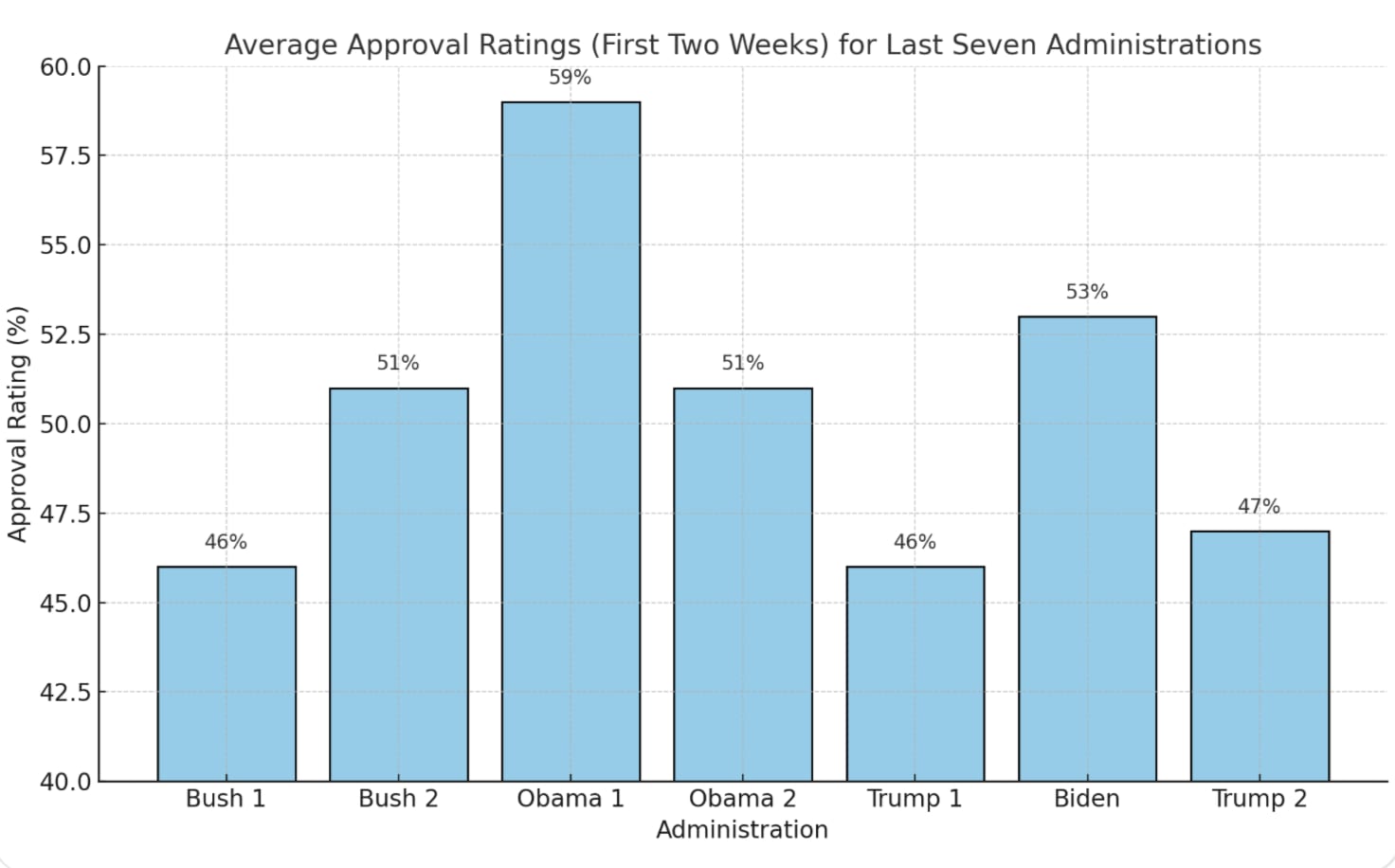
Trump is less popular starting out than the typical president has been in the twenty first century. Presidents generally get a honeymoon period when they come into office, and then decline from there. One of the most consistent findings in political science is thermostatic public opinion, where the views of the masses shift against whichever party is in power. This is why the president’s party almost always loses seats in the midterms.
So at least in the public opinion data, there’s nothing special here. Trump is in fact starting out low, and if public opinion shifts like it normally does against the party in the White House, Republicans should do quite poorly in 2026.
People are using the period after the 2016 election as the benchmark for deciding that the vibes have shifted. But that was a highly unusual time. The Women’s March on January 21, 2017 drew somewhere between 3.3 and 4.6 million people across the country, making it the largest protest event in American history. Liberals were a lot more powerful in the judiciary, and could more effectively resist new actions by the administration, which itself came in unprepared. The Trump administration was engulfed in chaos, and the president’s net favorability, which started out slightly positive, was in the negative double digits before long.
We’ve seen nothing like the Resistance this time around. But there was never anything like it before! Bush’s two victories were not followed by the kinds of mass demonstrations and cultural energy we saw in 2017. If Romney had become president, I don’t think we would’ve seen anything like the Women’s March. Trump’s victory was a shock to progressives. They were reading forecasts telling them that Hillary had something like a 99% chance of winning. The 2016 result was ideally suited to motivate political activism, since it got the attention of leftists by reminding them that historical progress wasn’t inevitable and yet Trump nonetheless looked weak. Meanwhile, polls said most people were expecting Trump to win this time, and the novelty of a crazy old racist in the White House has worn off.
Since a 47% approval rating is nothing special, why doesn’t it feel like that? Why do we imagine such a massive vibe shift? I’d argue that in part it’s that we’ve seen a great deal of polarization with regards to neuroticism. When the polls were tied in the 2024 race, Republicans exuded confidence while the Democrats were worried sick. Trump won by 1.5 points, which the president and his supporters call a “landslide,” while Democrats commiserate over what has gone wrong. Try to imagine what would have happened if Democrats had won the popular vote by 1.5 points while also taking the Electoral College. Republicans would reject the legitimacy of the election and say it was stolen, which they were preparing to do up until the moment it became clear on election night that Trump was likely to win. A clever recent poll shows that 49% of Americans think that Trump won in 2024 by a larger margin than Biden won in 2020, with only 28% answering the question correctly.
Vibes are to a large extent self-fulfilling prophecies. Because Republicans under Trump beat their chests and talk about how great they are, and Democrats are riddled with anxiety, a 1.5-point victory for Republicans feels like a landslide. I also think that our attention spans have gotten shorter and we increasingly have trouble keeping things in perspective. Remember Brat Summer?
The Long-Term Move towards Institutional Neutrality
My view is that both of these theories are correct, and they apply to different domains. The X Theory of Everything implies that the vibe shift will continue. But if having Twitter means you control the culture, this doesn’t necessarily imply that it helps you win elections. A party may turn off normal voters by being too captured by their base. So a Twitter theory of everything does not imply Republican electoral success going forward. Yet just as how during 2012-2022 the culture appeared to move left regardless of who was winning elections, it may be the case that Democrats can have political success as the wider culture keeps shifting right.
All that said, it would be crazy to count liberals out culturally. They are still about half the country, still dominate in the richest and most educated parts of the nation, and still control the most important opinion-making institutions. Liberalism is a sleeping giant, and could easily come back with a vengeance if public opinion turns significantly against Trump.
Democrats have probably lost X forever, but I think that tech executives bending the knee to Trump indicates less about what they truly feel in their souls than the degree to which business submits to political power. Trump in 2017 was the president, but elite institutions were united against him, his opponents had both social media and the MSM, and even his own administration was divided, with many top aides and cabinet officials being sympathetic to left-wing narratives about the danger he posed to the country. Now he’s completely surrounded by sycophants and the left is in disarray. Yet if say the economy collapses and the Democrats nominate a strong candidate in 2028 who achieves a decisive victory over JD Vance, we could see tech executives return back to the posture they had around 2020.
More likely, however, I think we’re probably headed to an era of institutions returning to political neutrality. The Woke Era was the result of a unique confluence of forces. Social media was brand new and elite political discourse had become centralized on one website that tilted left. If now conservatives have X and Facebook, and liberals still have YouTube and Google, there is a kind of balance. Conservatives have also begun to see the connections between political power and the state of the culture. Fifteen years ago, a national business worried that it might catch the ire of regulators in California or New York if it did anything that offended liberal sensibilities. But now firms also have to think about whether politicians in Texas and Florida have a problem with what they’re doing. The merger between leftist political power, entertainment, academia, and corporate America into one hive-mind motivated a backlash, one that has been largely successful.
Finally, there is a question of what exactly the Left is going to be going forward. With the Trump administration uprooting DEI bureaucracies and gender theory in the midst of suffering what might turn out to be a total defeat, and Republicans having public opinion on their side on these identity issues, it feels like liberalism is simply going to have to look different going forward.
We saw what may be a preview of the next iteration of the left in the Kamala campaign, where Democrats ran as the normal people against Republican kooks. The other side is a bunch of racists, bigots, and conspiracy theorists, and we’re the people who simply want to get the price of insulin down, protect your right to abortion, and not be too mean to minorities. That didn’t work in 2024, but a similar approach could be much more powerful in 2028 when Democrats are not running against Trump and will have the opportunity to conduct a real primary where they choose a strong candidate. Yet the best case scenario for Democrats from an electoral perspective doesn’t seem like it would be inspiring enough to move the culture. If Democrats return to a kind of mid-aughts sensibility, aesthetic, and policy orientation, it will have to be considered a defeat for the left given what the country has experienced over the last fifteen years.
Don't compare Twitter to Substack like-by-like. These are different beasts with complementary effects. Substack was crucial for penetrating the intelligentsia (or EHC as you would say). It isn't competing with X; it's competing with the NYT opinion columns and, at its best, with the news columns too. Academics don't send tweet links around their listservs. Substack has also been material in raising the intellectual level within the GOP, if nothing else by exposing the stupid and spotlighting the good.
I would also offer a third way to understand the "vibe shift": Progressive infighting split the Democrat coalition. Of course, any Quillette author would have told you this was eventually going to happen, but few expected it to happen that fast. Give Hamas some credit, or at least its fans on US campuses; great job on the "Genocide Joe" brand. It's now over a year since the loose cannons have set the ship on fire, and the fire brigade is still barely visible. Activists still have veto power over left-wing media (see what happened to Washington Post); dumb money still feeds NGO grafters and crazies; and with Bluesky, the center-left has fled right into the maw of the progressive firebugs. Will *that* change within the next 4 years? Theoretically possible, but it requires the kind of charisma you would associate with Trump, not anyone in the other aisle.
The culture shifting back to the right when Musk bought Twitter is a nice example of a just-so story, but it doesn't pass the smell test. Wokeness peaked in 2020, not in 2022. Democrats were panicking even when they won a trifecta because the win was way narrower than expected despite Trump's unpopularity and backlash to BLM and Defund the Police was clear even then. And then the Democratic trifecta plus the excesses of an administration with a low-energy leader that was largely outsourcing its domestic policymaking to progressive interest groups turbocharged the backlash.
Trump's popularity is likely to suffer the same fate: he has a trifecta and is too old and uninterested in governance to micromanage a coalition that is sure to do many unpopular things when left on autopilot. Plus there's the optics that billionaires have a front seat at the table and are now running the country that the public is unlikely to tolerate for very long. The energy behind wokeness might soon be channeled into "eat the rich".