
I learned about Diarmaid MacCulloch and his work from Tyler Cowen’s podcast, and decided to pick up a few of his books. The first one I’ve finished is Lower Than the Angels: A History of Sex and Christianity. The book is a journey through everything related to sex and Christianity from the era of the Old Testament to recent controversies over topics like the ordination of women and trans identity. I’ve been posting some of the juiciest excerpts on X:
On early Christians being tempted by women and Ethiopian kids
The history of Catholics castrating boys to preserve their voices
Early Christians castrating themselves to not be sexually tempted, and its modern relevance
Eighteenth-century Scottish pioneers in gooning
I often read various books on the same topic together, so this has sparked my interest in Christian history. In addition to MacCulloch, I’ve also started Dominion by Tom Holland, which I’ve enjoyed and may write something on, along with some academic articles. For now, here are twelve thoughts on Lower Than the Angels.
1. Was Christianity the original incel religion? I was struck by how sex-negative the movement was in its earliest days. Paul’s letters basically had the message that “sex is so awful, but fine, get married if it lets you avoid fornication.” The idea that celibacy is better than marriage, which is better than sex outside of marriage, seems to have been the common Christian view, and for Catholics and Orthodox believers might still be. This is covered in detail in the chapter titled “Virgins, Celibates, Ascetics (c. 100-c. 300).” Beginning in the second century, you find a lot of Christian texts discussing the merits of celibacy, and very few talking about marriage, which was usually addressed in a much more negative light.
In order to reinforce this view, thinkers cited Jesus’ parable about different sowers getting yields of thirty times, sixty times, or one hundred times. Without any good reason, this was interpreted by an early third-century North African writer as representing married people who renounced sex, virginal ascetics, and martyrs. It was the consensus up to the Middle Ages that this biblical classification system referred to the married, widows, and virgins, with of course the more sex you are currently having or have had in the past, particularly for women, the lower you are in the ranking.
Early Christians were so sex-negative that it was even a live debate whether castration was desirable.
To begin with, the developing Christian hierarchy was not certain how to react to this zeal for castration; should it be commended as demonstrating Christian self-control? Thus the Athenian convert and philosopher Athenagoras, addressing his Plea for the Christians to the Emperor Marcus Aurelius in the mid-170s, emphasized that ‘remaining in virginity and in the state of a eunuch brings one nearer to God.’ At what point did rhetoric shade into practice? Justin Martyr, pioneer among the second-century literary defenders of Christianity now known as apologists, sympathetically described the disappointment of a young man in Alexandria who petitioned the Roman governor in the city for permission to seek castration from surgeons, to show to the world how far Christians were from indulging in free love. The governor rejected the proposal, leaving him to be ‘satisfied with his own approving conscience, and the approval of those who thought as he did’. The Emperor Antoninus Pius was the notional reader of this apology, so Justin must have believed that elite Romans would have found the tale impressive rather than risible. In a slightly later generation in Alexandria, the brilliant speculative theologian and biblical commentator Origen is said actually to have undergone castration through similar youthful enthusiasm. Yet during the course of the third century Christian official mood-music on voluntary castration changed, and the fourth-century Church historian Eusebios (Eusebius), author of an admiring biography of Origen, reports the story with a mixture of embarrassment and defiant commendation – a confusion that probably indicates its genuineness.
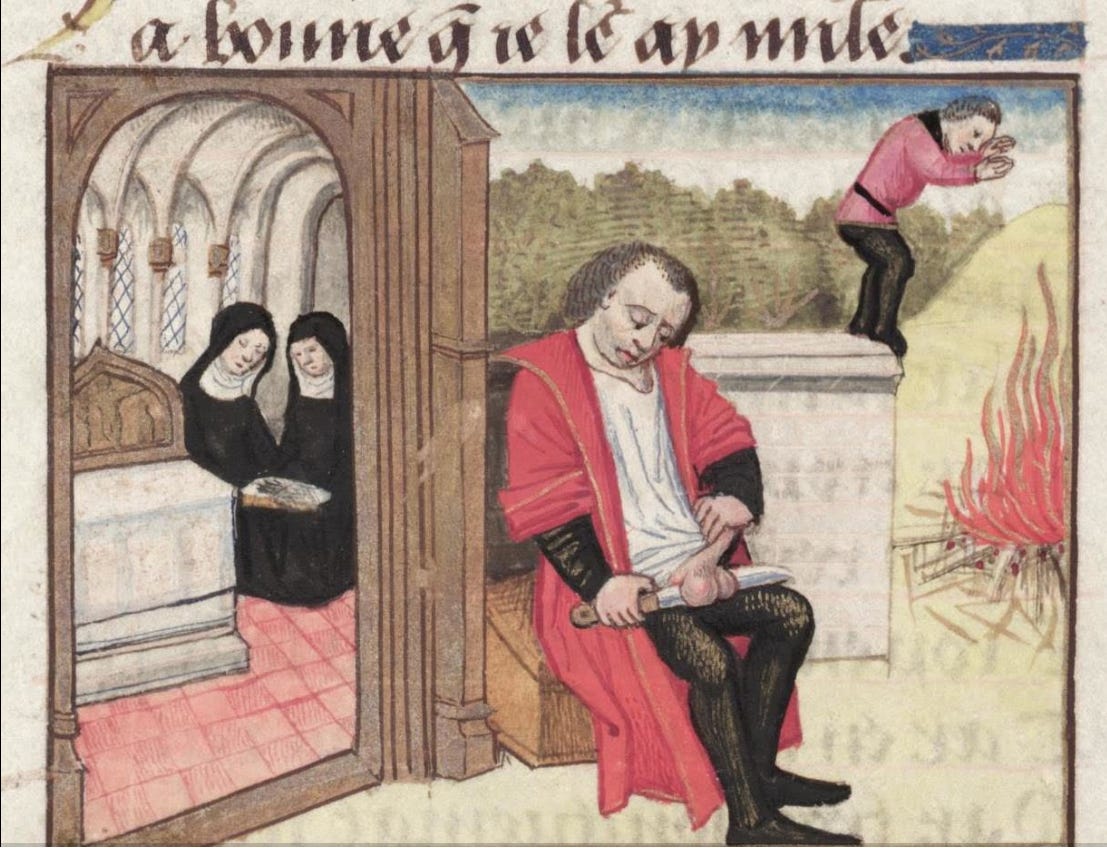
Here’s a satirical depiction of Origen castrating himself from late fifteenth-century France, included in the book.
Protestantism was in part a rebellion against the extreme sex-negativity of Catholicism, which still hadn’t completely subsided a millennium and a half later.
2. This got me thinking of another ideology that is less sex-positive toward family formation than rival worldviews, yet nonetheless has grown rapidly through conversion: liberalism. You would think that through the process of cultural evolution, more pro-natal ideologies would win out. Yet we have approximately three centuries now of liberalism being less conducive to forming and creating families than alternatives, and yet its growth has been rapid, outcompeting rival faiths.
