
Ruxandra Teslo and Amol Punjabi recently wrote about how a Chinese startup developed a new drug that significantly extends the lifespans of people with multiple myeloma.
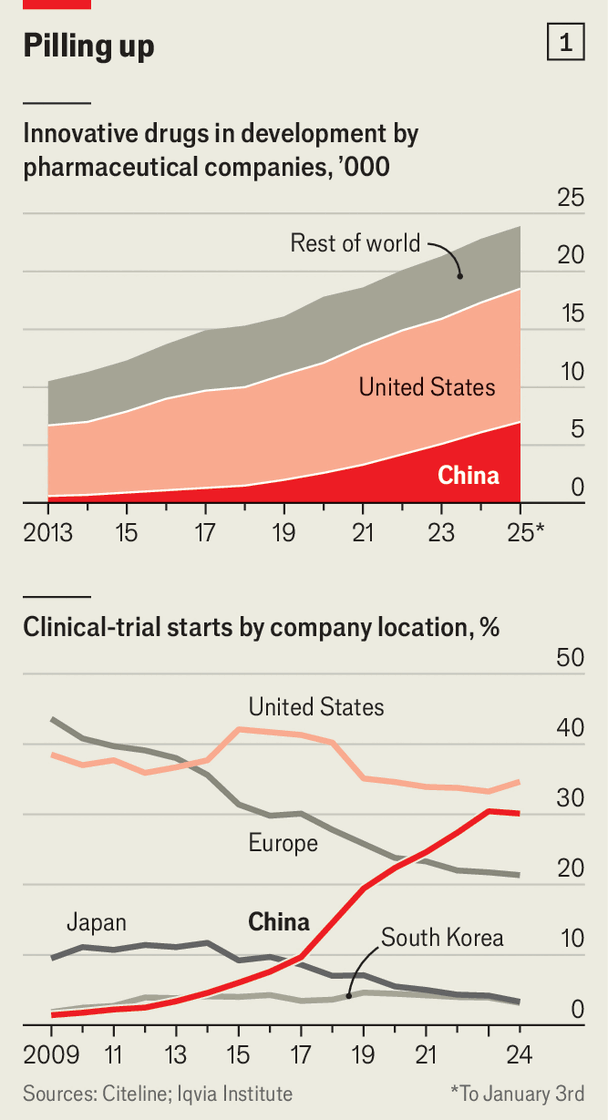
This is part of a larger story in which China has suddenly become a global leader in biotech over the last decade. Here’s a figure from an Economist report on the topic last year.
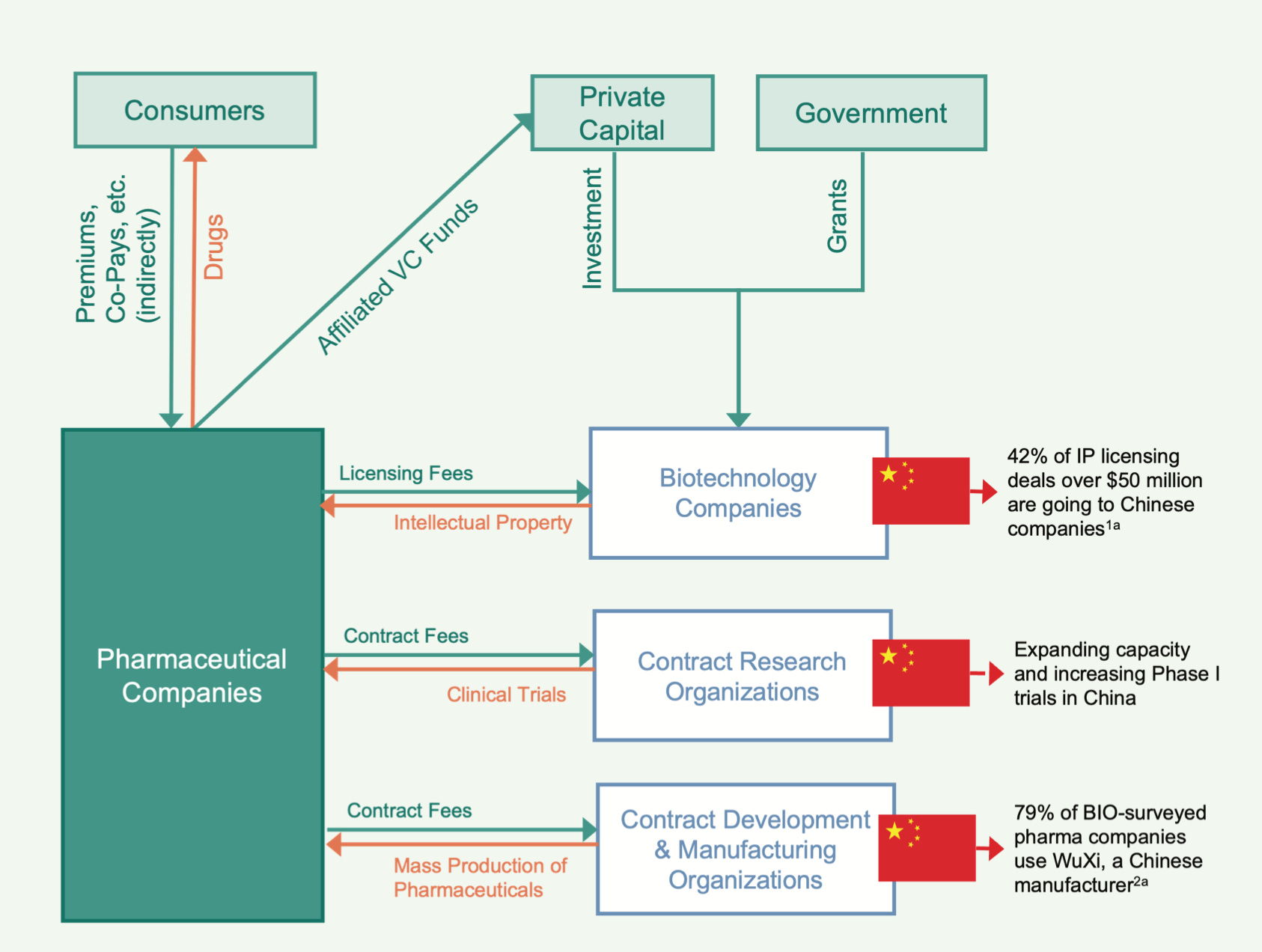
A figure in the December 2025 report of the congressional National Security Commission on Emerging Biotechnology (NSCEB) helpfully shows how drug development works and the rise of China in this area.
Teslo and Punjabi point out that the government has done this by enacting the kind of reforms that smarter critics of the FDA have been advocating for years.
China’s ongoing biotechnology transformation is the product of deliberate industrial policy. The Made in China 2025 initiative explicitly identified biotechnology and advanced medical technologies as strategic national priorities, and a series of targeted policies followed. Among them was the Thousand Talents Plan, designed to draw overseas Chinese scientists back from Western institutions. BeiGene, Innovent, and Junshi, which are now three of China’s leading oncology biotechs, were all founded or are now led by researchers who had trained in the United States before returning home.
Yet perhaps the most consequential advantage China has built lies in its clinical trial ecosystem. Chinese hospitals make extensive use of investigator-initiated trials. These are early-stage studies that allow oncologists to quickly assess whether a drug shows genuine promise. In China, such a trial can be up and running within roughly six months of a patient consultation with an academic oncologist. In the United States, the same process can take eighteen months or more, bogged down by regulatory preparation that includes a lengthy Investigational New Drug application. This is a document that can run to thousands of pages and is laden with a host of requirements which are unnecessary at such an early stage of development.
The most valuable thing early-stage trials enable is iteration. They allow tight feedback between the clinic and the lab. There are countless ways to engineer a better CAR-T cell, and many cannot be evaluated in the laboratory alone. No cell culture or animal model fully replicates the complexity of a human tumor, and AI is unlikely to close that gap anytime soon. We simply lack the training data to capture what tumors are actually like in vivo: their geometry, vascularization and biomechanical properties.
China’s ability to run these trials quickly and at scale gave it a structural advantage in that learning process, whereas the US is currently undermining itself through burdensome manufacturing requirements and regulatory bureaucracy that make early experimentation slower and more costly than it needs to be.
This isn’t that complicated. Talent acquisition plus the removal of burdensome regulations that don’t pass a cost-benefit test. One of the most significant reforms was enacted in 2018, and it ensured that clinical trials can begin upon an application being accepted as long as China’s National Medical Products Administration does not raise objections within a certain timeframe. The US formally allows something similar, but it involves more stringent paperwork, manufacturing, and institutional review board requirements.
I think that the narrative surrounding China’s rise in biotech is interesting because it’s a clear example of what I think is the overly zero-sum perspective we take when it comes to that country. A headline in Time Magazine from mid-2025 reads “The US Can’t Afford to Lose the Biotech Race with China.” Now, the idea that the US is losing to China in something can have a positive effect by encouraging needed reforms at home. But it can also lead to policies that harm ourselves because we think they’ll hurt China more, which is what we see in Trump’s approach to trade.
The Time article calls for limiting Chinese investment in American biotech companies. Now, usually when you see articles like this in a legacy publication on an obscure public policy issue, you can bet that it’s part of some lobbying campaign. And there is real momentum in Washington to try to hinder Chinese biotech, from both China hawks and probably business interests that see an opportunity to profit in some way.
John Moolenaar, a Republican congressman from Michigan, has pushed to restrict U.S.-China biotech cooperation, including by calling for the FDA to stop relying on certain Chinese clinical-trial data and by backing measures to curb licensing and investment deals between major U.S. drugmakers and Chinese companies.
While fraud might be a legitimate concern in theory, biotech investors aren’t morons. If there were concerns about whether data from China could be trusted on a mass scale, the private sector would surely know a lot sooner than our government. And the NSCEB notes that China has sped up drug trials, with “reforms also improving quality and alignment with international standards.” Here’s a recent Economist article on Chinese fraud in the form of a profile of an influencer who has been making a name for himself exposing it. A Chinese scientist recently gave a speech in which he said that his country deserves to be recognized both for its legitimate progress and its fraud. The point here is that you’ll often find people who will exaggerate problems in Chinese science to deny its real accomplishments.
Moolenaar’s letter to Treasury Secretary Scott Bessent notes that “Last year, 48% of all large pharmaceutical licensing deals globally of $50 million or more were inked with Chinese companies, up from 0% in 2020, and this trend is continuing to accelerate.” It goes on to complain that “One of the ways that China has sparked this growth is by creating the cheapest and fastest human clinical trial system in the world—a system that is marred by ethical concerns such as a lack of informed consent and involuntary trial participation.” Yeah, I’d like to see data or actual evidence on the involuntary part. As far as the “ethical” concerns more broadly, we have seen what the American conception of medical ethics gets us, where you hinder research into curing disease by protecting people’s medical privacy that their revealed preferences show they don’t care about at all.
The China-skeptical approach might make sense in other areas of technology. If China was moving ahead of us in ballistic missile production or atomic science, that would be a concern. AI is an intermediate case, which has mostly civilian uses but could in theory give one country a path to world domination. But biotech? Here we’re looking at a field that is almost purely positive sum. If China cures a type of cancer, they’re going to sell it to us. Even if they wanted to keep it for themselves and forgo massive profits, just observing China making a medical breakthrough can provide proof of concept and help American companies follow their lead.
Perhaps China can cut us off from a vital drug in the middle of a war or other emergency, but this is about manufacturing rather than development. Congressman Moolenaar complains about licensing deals, which generally involve an American company agreeing to develop, test, seek approval for, or sell a drug in certain regions of the world. These are win-win partnerships between US and Chinese firms.
If you’re really determined to, you can sit around imagining crazy scenarios in which China being ahead in biotech harms Americans. Maybe the president gets a disease, and the Chinese are the only ones with a proven treatment, so they bribe him into surrendering Taiwan. Or perhaps they discover some new way to treat battlefield injuries that matters in a war. But this is generally the stuff of network TV dramas. In real life, by far the most likely outcome is that better Chinese biotech just improves health outcomes for human beings across the world. Policymakers worry about low-probability outcomes that would be disastrous all the time, but to me, “preventing a US-China partnership that cures cancer” seems like a pretty disastrous outcome, and one that is much more likely than the made-for-TV-drama scenarios we might make up.
As for supply-chain dependency, I think this misunderstands what’s important in the field of medicine, and science more generally. The true constraint is knowledge, and the barriers to creating as much of it as possible. That’s the bottleneck in the process of improving human health. Once we know that something can be done, we can learn how to do it and build on the knowledge. Maybe not immediately, but, if something is worth doing, then some combination of market forces and government policy can usually help you figure out the manufacturing and distributional aspects of delivering a treatment or medicine in the long run.
So say China develops a cure for Parkinson’s, and maybe they’re the only people in the world who know how to make it. Eventually, China cuts us off and keeps the drugs for themselves. They probably wouldn’t do this absent some very weird circumstances, but let’s just say they do for the sake of argument. Having knowledge that there’s a cure for Parkinson’s out there and some access to the completed product would probably help Americans reverse engineer it before too long, unless it is the product of some complex manufacturing process. And even in that case, it would be strange if knowing something about the drug didn’t provide any useful insights at all. In the real world, information is always flowing across borders, and although China can cut us off from physical materials and factories, they can’t erase the knowledge of scientific discoveries. And we’ll be much more likely to have access to important information if Chinese firms are partnering with American companies, which is something that China hawks are now complaining about.
This is why China has been able to stay on our heels in AI, since they can simply observe what the major US labs are doing. The release of DeepSeek showed that China could produce near-frontier LLMs that, while generally not as polished or capable as the very best American models, are much cheaper to train and run. In medicine particularly, what matters is what technology ends up being developed, not whether one country is a few months or even a few years ahead of another on the knowledge frontier.
And yes, partnerships mean that China can engage in IP theft too, but this is something that has always existed, and it’s not even clear to me that this is always bad for American consumers. Someone involved in the industry testified “that for every innovative U.S. biotechnology firm, there is a ‘shadow’ Chinese firm working to replicate its work at a lower cost.” That sounds bad for US companies, but good for consumers. Maybe it’s harmful in the long run if it reduces the incentives for innovation. But consider that knowledge of how to create drugs more cheaply is a public good in the same way a fundamental discovery is. All of this is to say that IP theft is probably at most a small problem, and might actually be good on balance, even from an American perspective. This is not something that should make anyone hope that Chinese biotech fails.
There are lessons here beyond medical science. Whenever something is discovered or invented that improves living standards, it usually lifts all boats. Things like nuclear weapons, and possibly AI, are exceptions, not the rule. Biotech is unique in the degree to which the upside of cooperation and progress, no matter where it occurs, outweighs possible risks inherent in falling behind another country.
You will often hear people say that opening up trade with China was a mistake because the country never democratized, as we were told they would. But the theory behind such an approach was sound. The claim that economic development leads to democratization is one of the best supported ideas in political science. It didn’t work in this case, but there was no way for leaders at the time to know that. And even if they did have a crystal ball in the 1990s and saw that China would be just as authoritarian decades down the line, increasing trade with them was still the right thing to do. A billion-plus people innovating and getting wealthier has positive effects on the rest of the world regardless of what kind of political system they live under. I would rather China develop with a greater respect for human rights, but their internal governance is not something we can control, and to the extent that we can have an effect, friendly and commerce-based relations are more likely to have a positive impact than antagonism and attempts at isolation.
If you hear someone with a political agenda talk about the rise of Chinese biotech today, they fall into one of these two camps: those trying to improve American policy, and those simply interested in slowing down Chinese innovation, even if it hurts Americans too. It would be nice if you could use this language of a race with China to motivate reforms we should undertake anyway. This seems to be the approach of Ruxandra and the aforementioned NSCEB, which urges America to get its act together, without much emphasis on biotech decoupling. Unfortunately, people who are paranoid about foreign threats tend not to have the best judgment about these things. The debate on this topic has the strange quality where the same facts about China’s biotech rise can be marshaled in order to support policies that are either wise or destructive.
I see the pro-progress side here trying to co-opt populist instincts. It’s sad, but people seem to be more easily motivated by fear of outsiders than hope. “We’re going to cure cancer to BEAT CHINA” is a much stronger political message than “We’re going to cure cancer while working with China.” In theory, you take people’s dumb instincts and orient them in a productive direction. But this means you’re playing with fire, since you’re creating pressure for action to be taken when it’s often much easier to enact demagogic and destructive policies than to carry out sensible reforms.
Thanks for reading. One thing I’ve learned is that when you have a book coming out, you can never assume that even regular readers are aware of it.
For that reason, over the next few months I’m not going to miss any opportunity to inform my audience that I have a new book called Kakistocracy: Why Populism Ends in Disaster coming out in July – details here. If you enjoy articles like this, appreciate me as a truly independent writer, and would like to support my work, the best way to do so is to preorder the book, which you can do at the links here to Amazon or Barnes & Noble. All preorders count toward opening day sales, and will help determine how much attention it receives.
I will be reading the audiobook, in case that makes it more appealing.
On a different note, if a little box appears below, it means that you are not yet a free or paid subscriber. Sign up to get more articles and updates in the future.
I think if China really wants to destroy the West, fostering a biotech revolution that meaningfully extends human lifespans (say, by 5-7 years) would be the way to do it. Western democracies are run for the interests of retirees. Longer lifespans means increasing retirees’ share of the electorate while requiring greater outlays of retirement benefits. It would bring our budgets and total debt burdens to the brink.
Now, maybe you say the second order effects of such a biotech revolution would be eventually bringing down the costs of health care, including health care for retirees, but that is far from clear.
Excellent post. In order for China to achieve great success in biotech it will need a research environment where ideas flow fairly easily between Chinese scientists. In that case, it seems exceedingly unlikely that the basic idea behind any medical breakthrough would not leak out to the broader international community.