
I’m ready to announce that I have a book coming out this summer. It is called Kakistocracy: Why Populism Ends in Disaster. Here is the cover:
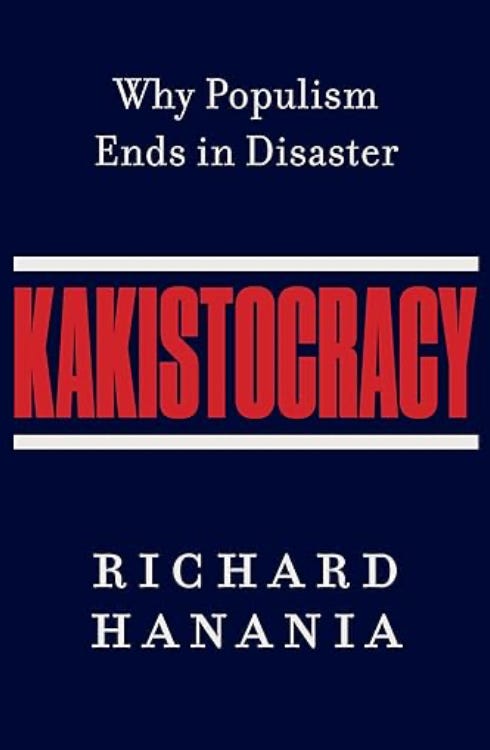
You can buy it here on Amazon in hardback, or on Audible or Kindle. For the audiobook, I think I’m going to read it myself this time, as I regretted not doing this for the last one. If you want to hear my sonorous voice for 12 hours or so, then the audiobook is for you.
I am encouraging everyone to preorder now and then forget about the book until July. I’m in an interesting place in the political discourse. There are a lot of people of all opinions and outlooks who do not like me. Rather than holding back on what I think, my goal has been to become so relevant – to insert my views into public conversations in ways that smart people find compelling – that I am difficult to ignore. Having a book that sells extremely well is one of the most straightforward ways I can continue doing this. So buying Kakistocracy is voting with your wallet that you want me to be an important figure who others listen to. I don’t think you’ll find anyone else who has been more honest with you about what they believe and why, and who has shown less regard for the reactions of any political faction, other than the one that cares about ideas and what is true.
Aside from providing support to me personally, Kakistocracy can be seen as a book that explains what has been perhaps the main global political development of the twenty-first century. It sets out to explain populism in a way that will be satisfying to both the political scientist and the interested news consumer. Until about a decade ago, we were all used to thinking about politics primarily in terms of right versus left. While it would be ridiculous to claim that ideology as traditionally understood doesn’t remain extremely important, one country after another has been shaken up by the increasing salience of the populist–non-populist axis. This often centers around the topic of immigration, but populism has also risen in countries where this isn’t a major issue, and it more broadly reflects a shift in how citizens interact with the institutions that rule over them and claim to provide structure, guidance, and information.
Kakistocracy argues that the rise of populism has been a negative in Western societies. One reason the book is sure to have value to any reader is that even if you disagree with my normative conclusions, anyone who reads it will have a better understanding of exactly what populism is and why it is rising now. Among the questions that will be answered are:
Is there a definition of populism that can work across nations and historical eras?
Can we define populism in a way that goes beyond politics and captures it as a cultural phenomenon?
What explains the rise of populism across different countries facing different circumstances around the world over the last few decades? In other words, why is this happening right now?
Is there a useful definition of “elites” that includes struggling journalists and grad students but excludes individuals like Donald Trump, Joe Rogan, and Elon Musk?
Why do even very smart people who identify with populist movements end up becoming stupid (the Elon Musk problem)?
Why are populist politicians more likely to be corrupt, authoritarian, and dishonest, regardless of ideology?
What is the relationship between populist movements and semi-authoritarian states that have high approval ratings among their populations such as Putin’s Russia?
Is the narrative that Covid-19 discredited Western elites based in facts?
Why is populism today primarily a rebellion of the right rather than the left?
What are organic elites, and why do they always stand in the way of both populists and budding authoritarians?
In a world where even the most educated among us cannot research that many topics on our own, what is the best way to obtain knowledge, and how do populists and non-populists differ on that question? What are the downstream political and sociological results of this?
What effects are populists in power likely to have on outcomes we care about like social cohesion and GDP growth?
If populism is in general more bad than good, what are the most effective ways to fight back against it?
Is there a case for populism under certain conditions?
Throughout the book, I will make my case by relying on data, academic research on populism and the study of media, and illustrative examples from around the world. You’ll learn a great deal about not only the MAGA movement, but Putinism, Orbán, AfD, Bukele, Milei, and how in the 1990s, Alberto Fujimori fixed the security and economic crises facing Peru. Even setting aside the populist framework, this book will leave you much better informed about the ways in which mass opinion, elite networks, and political processes work. I present a theory of democratic institutions that is new and builds on my previous work on Elite Human Capital, minus the confusing terminology.
The book is not necessarily as anti-populist as the title suggests. The upshot is I think that populism is a completely unjustified and destructive movement in the West, though I am open to a version in developing countries that have more serious problems and require drastic solutions to shake them out of bad equilibria. In plain English, whether “throw the bums out and do a bunch of common sense stuff” is a desirable platform depends on the nature of elites and the institutions they have built in any particular society. There are few places where populism makes less sense than the United States, which has not only performed better than other nations and remains the economic and technological engine of the world, but is a place where its people maintain more individual liberty than perhaps any other comparable country.
My last book was important in shaping the conversation around civil rights law. This one can be seen as undoing some of the damage that resulted from the revolution I supported going too far. I think that this book can shape the kind of politics that comes next, and hopefully point the way towards a future where we are ruled by better elites who understand where they have come up short rather than demagogues who get ahead by appealing to the mob.
Sam Kriss has argued that I might just represent the future of liberalism. Seems kind of crazy, but is it impossible? I think I’ve hit upon something unique and necessary, and if this prophecy does come true, it will be in part because enough of you bought this book.
Rob Henderson recently wrote: “Shortly after Troubled was published, two common messages I received were ‘Too much self promotion. It’s annoying’ and ‘I didn’t know you had a book out.’” Unfortunately, this poses a dilemma for me, as I want to sell a lot of books but hate the idea of being repetitive and boring. So please just buy the book now and place my mind at ease so I can be confident of its success and lay off the self-promotion in the coming months.
The Year I Left the MAGA Plantation
In August of last year, I endorsed Donald Trump for president. It only took a few months after the election for me to realize this had been a mistake. There is no reason to once again go over all the things I got wrong and why, as I did a thorough job explaining it all here. Now I will only say that I have found leaving the “MAGA Plantation” to be a relief. It was always tiring to say “yes, these people are stupid and immoral and are destroying our institutions and norms, but for reasons mostly rooted in historical accident they have better policy positions, which at this point they themselves don’t understand and can’t even articulate, so I have to do it for them.”
Then came the second Trump term, where you got all the stupidity and corruption that could have been expected, but also saw anti-vaxxers welcomed into the coalition, and nativism eating much of the remaining pro-market aspects of conservatism and leaving behind pure grievance politics. I no longer had to justify being part of this coalition.
Is there a place for me on the Left? Well, in addition to Sam Kriss, the governor of Colorado apparently thinks so. It’s kind of funny how in 2023, there was commentary along the lines of “this guy is finished, there is no way he has a future on the right.” It was true in the long run, only because I’ve become a figure who has transcended party lines and is deeply appreciated by the most thoughtful people across the ideological spectrum.
Despite most of my economic and social views, there is a certain sense in which I “belong” on the left. I’ve come to realize that having an intellectual orientation is simply incompatible with being a right-leaning figure, unless you narrowly focus on a single issue or a handful of topics. This is the end result of the Trump-Vance era, where their supporters are constantly put in the position of defending glaring hypocrisy and the most blatant lies. Nearly every right-wing panic and major talking point – Haitians eating dogs and cats, the immigrant crime wave, Trump’s legal troubles primarily being due to a witch hunt, “they” killing Charlie Kirk – depends on some underlying falsehood or misrepresentation. After the Trump era of nonstop nonsense, we’re going to get Vance, whose intellectual contribution involves inventing a new form of economics that blames immigrants for every problem in the world. “Intellectual” nativism has no serious intellectuals or scholars; at best, it puts together bits and pieces of the works of Pat Buchanan and Sam Francis – pundits of a previous generation – engages in “based” posturing, and scrapes together factoids from cherry-picked academic literatures it doesn’t even understand.
Sure, there are smart and honest actors on the right. But the highest status goes to the fake news merchants and charlatans. Here I’m thinking of not only bloviating Fox News hosts and social media grifters, but the people rightists consider more serious intellectuals like Curtis Yarvin and Patrick Deneen, performance artists who refuse to deal in the realm of facts. A pattern I’ve noticed is that on the left, the people who I find the most insightful tend to have large audiences and a lot of influence. On the right, the situation is reversed, and the absolute worst get ahead. Abundance is worth reading, while Deneen provides no insights and contributes absolutely nothing to human knowledge. There are certainly people on the right who can publish high quality books, but they don’t have a fraction of the influence of Klein and Thompson.
And it’s not like Deneen is that popular either. He writes in grammatical sentences, so that makes him an intellectual on the right, though he doesn’t have as large an audience as Klein and Thompson if you look at metrics like book sales or X followers. The true passion on the conservative side is on behalf of partisans, open racists, and grifters. But Catturd isn’t going to be directly influencing legislation and government regulations; that job has fallen to a group of less popular and prominent intellectuals who have figured out how to reverse engineer narratives and policy programs centered around the instincts of Trump and the right-wing audience. Again, there’s just little room here for anyone who wants to make a thoughtful contribution to political debates.
I told Destiny the night of the election that if RFK was appointed, it would show me that I was wrong about a second Trump administration. The reason MAHA was a watershed was that although I had already come to terms with the fact that I disagreed with conservatives on things like abortion, I thought there were still some guardrails against the movement embracing new forms of populist stupidity that did not have any connection to traditional conservative ideas. The MAGA movement is not just wrong about vaccines – the fact that they have embraced anti-vaxx demonstrates that there are few barriers between the most deranged corners of internet comments sections and the highest levels of government institutions.
To be a right-wing intellectual in the Trump/Vance era is like trying to conduct a serious philosophical analysis justifying the movements of clowns performing in a circus. The things that Republicans have traditionally been correct about have no role to play in shaping the right-wing hive mind. Prominent conservative influencers talk only about conspiracy theories and the dangers of foreigners – they never praise the efficiency of markets, and to the extent they take any interest in economics at all, it is to spin nativist and anti-left narratives.
The left still has something representing a real intellectual life, which means that there are hopes of things getting better. They read serious magazines and books, try to follow arguments to their logical conclusions, are embarrassed when they’re wrong, and trust institutions and gatekeepers, which are necessary, even if flawed. We cannot completely give up on the right, but need to realize that at the current moment the mob is in control, and the main group that is actually pushing in a consistent ideological direction is the nativists who are morally repugnant and wrong about nearly everything.
I see my goal now as providing a clear-eyed view of the contemporary conservative movement and explaining why people need to be against it. Much of my work over the course of 2025 has therefore been focused on this, and I think I’ve done an effective job applying a critical eye to the second Trump administration and the movements that support it. A fan told me that recently a girl told him unprompted that she had observed fewer instances of the Based Ritual than expected at an event. That article is now my third most read essay of all time, and I have made these people look ridiculous, even in their own minds. I’ve also written about the intellectual hollowness of the “New Right,” the umbrella term that covers groups like postliberalism and national conservatism that try to cultivate “based” energy and channel it into political outcomes.
In the short run, such ideas and impulses are almost certainly the future of the Republican Party, especially given the nature of the influencer space and Vance’s status as Trump’s successor. But on a longer time horizon, I’m hoping that something better can emerge from the ashes of the Trump era. This will require attacking the New Right where it is most vulnerable, namely its economic illiteracy, impracticality, and the degree to which it taps into emotions and sentiments that conservatives have always found disgusting, namely self-pity, hysteria, and prioritizing emotion over reason. Fifteen years ago, I was promoting immigration as the greatest threat to Western Civilization, and now this perspective has become close to conventional wisdom on the right. The rise of social media and the decline of the forces censoring it have led to these views triumphing, and it is possible that in another five years or so, postliberalism and adjacent movements will be so weakened by critiques and objective failures in the real world that the right will have moved on to something else.
Until then, the priority is to make sure that the current iteration of conservatism has as little power as possible over the national government, and that it is ultimately discredited. There are still good Republicans at the state and local levels that are surely worth supporting, but just about anything that succeeds on the terms of the right-wing media and influencer space is cursed.
Become a Founding Member
I’d like to increase my number of Founding Members, who make up a minority of all paying subscribers. The old price for this highest tier was $300 per year, but I’m going to raise it to $500 for new sign-ups. Founding Members from before will still pay the rate they originally agreed to. Up to this point, I have not actually given this kind of supporter anything beyond what regular Paid Subscribers get, who are on the plan of $7/month or $70/year.
I’ve been trying to figure out how to fully monetize this Substack while keeping as much content free as possible. At first I thought about seeing if I could have a more basic tier of paywalled material that would require people to contribute a very small price, like say a dollar or two a month. But I think that creates too much friction for getting my work out there, and instead have decided to ask those who can afford it to upgrade to the Founder level. If I can get a few hundred individuals paying $500 a year, it would allow me to paywall very little and continue to expand my reach and influence to the greatest extent possible.
In order to make it worthwhile, if you become a Founding Member, I will give you the following:
My phone number, allowing you to text me on Signal at any time. I will try to respond. You can send me suggestions for articles or critiques, or even pass along things you want to promote that might catch my attention. I first met Dennis McCarthy through Substack meetings, and because I found him interesting enough I ended up reading his two books and doing a podcast on them. I now regularly read his Substack and share his articles on social media. This is not because he paid me $120 for a meeting or he has a great smile, but because his work is good and now it’s on my radar. There’s of course no promise that I’ll ever find your blog, business, or whatever interesting or compelling, but if you are a Founding Member you will at least have my ear and I would be inclined to give some thought to just about anything you say. Maybe we even become friends. It has happened before!
Access to a group chat for founding members on Signal, assuming there is enough demand for it.
At least one meal together a year if we are in the same town
At least a few articles a year that are more personal than others
The joy of being an elite supporter of someone this relevant, brilliant, honest, and interesting
Of course, if you don’t want to text with me or get a meal together but would like to support my work, that’s fine too.
I’m in a very unique position in that I am completely independent, which is fortunate because I, to an unusual degree, value intellectual integrity over money or direct political influence. This has been a hard road. Being a critic of wokeness, blank slatism, and DEI can work, and so can being a critic of Trumpism, conspiracy theories, and nativism. But to do all of these things and expect to have anyone listen to you is probably too much to ask. To complicate my life further, I will also pick fights on topics like why Jeffrey Epstein wasn’t a pedophile, and why obtrusive sign language interpreters are anti-human. You will open your borders and your hearts but not create accommodations that inconvenience, distract, and demoralize most people.
Nobody should be able to get away with being as free thinking and honest as I am. But I’m compelling enough that people keep reading. Rod Dreher once wrote: “Almost everybody can find a Richard Hanania they love, and a Richard Hanania they hate.” Across the political spectrum, I’ve become a litmus test of whether individuals are open to ideas and able to think rationally. There is no publication or website anywhere on the left or right where bringing up my name won’t inflame a large portion of the comments section. This is quite impressive! Anyone can be hated by one faction in our politics. But to maintain an approximately consistent level of hatred across the political spectrum, and still have fans, from Groypers to major Democratic politicians and influencers…who else has pulled this off? Would anyone have thought such a thing was possible if I didn’t exist? My continuing relevance provides hope that Elite Human Capital will triumph over populism before too long.
Highest Value over Replacement Intellectual
In sports, there is the concept of being a high value over replacement player. This has been applied to politics, with some arguing that Joe Manchin was the highest value over replacement politician, given that he was pretty much the only Democrat who could hold a Senate seat in West Virginia. We can use a similar framework for thinking about intellectuals. Here are some of my accomplishments of the last few years:
Civil rights law: I put wokeness as DEI on the map as an issue, which led to the Trump administration going to war against racial preferences and undoing approximately sixty years of government policy
The Based Ritual, which has become a stock phrase in discussions over what has happened on the right.
Beginning the Sydney Sweeney as a symbol of anti-wokeness discourse, setting the stage for the American Eagle controversy over the good genes ad.
Being the first prominent figure to use the term “Tech Right.”
Critiquing the Tech Right for its intellectual and moral shortcomings.
Popularizing the idea that the right has a human capital deficit, and is the home of the people who don’t read.
Calling and documenting the Groyperization of the GOP.
Pioneering a new form of political sensibility, which attacks the populist right from the perspective that it is for stupid people and losers, and defends established institutions.
Helping Michael Tracey promote Epstein conspiracy debunking, a perspective that has become the default among many smart observers even as the moral panic continues to play a role in our politics.
This is quite a lot! My reach expands well beyond my audience, and I think that with Vance being Trump’s heir apparent and his embrace of chud populism, along with the void that will be left by the Orange Man’s departure, I’m going to be in my element within the next few years. This is a Substack that not only provides interesting discussions about a wide range of topics, but also has mattered in ways that few others have.
There is plenty of direct evidence of my influence, as when a major journalist cites my ideas. But usually the effect is more subtle, if no less real. An argument will be framed in one way instead of another, and echo something I’ve been harping about on social media. A line of critique of a political movement that hasn’t been seen before opens up. One prominent conservative writer, who has never publicly said this, came up to me at a party once and said that ever since she heard me talk about the human capital deficit on the right, it’s everywhere and she can’t unsee it. I see my influence among smaller Substacks and writers early in their careers who have limited reach today, but will be there as live players when the ground shifts again, as it inevitably does.
What’s interesting about the list of topics above is that I’m basically engaging in Hegelian dialectics with myself and dragging much of the rest of educated opinion along with me. I provided critiques of both wokeness and the backlash to woke in the forms of the Based Ritual and Groyperization. I documented the rise of the Tech Right, and pointed out how identifying with the Trump-era GOP made the brains of Silicon Valley entrepreneurs turn to mush. I tell people to take IQ seriously, and also point out that those on the right who talk about IQ mattering are living in glass houses. To be a prominent figure on a particular side of these discussions is one thing. To have a unique perspective that cuts through normal political debates and elevates the discourse is another. There is no one else who comes close to doing this as often or as well.
No wonder I confuse people. To the chuds all of this appears to just be pathological contrarianism; those with a higher resolution perspective can clearly discern a worldview that is morally based, deeply held, and solidly grounded in empirical realities. Little surprise then that I stress the importance of Elite Human Capital and hate populism so much. It requires sophisticated observers dominating intellectual life for me to have any hope of being understood.
I helped create the conditions for the right turning into what it has become. Observing the fruits of my labor, I have now been deconstructing the myths and impulses behind the dominant force in our politics. I’ve also been doing important work that is unrelated to this political project, such as providing a case for libertarians being open to government funded science, and putting forward data on the lack of any evidence for IVF leading to worse outcomes for children. These types of articles get relatively little engagement and tend not to have a direct effect on the same discourse as my most popular pieces, but I maintain my intellectual curiosity and continue to let it drive my work. Even if I never have any kind of political influence again, I will continue to inform you about the world, entertain the audience, and hopefully provide helpful life advice. That is worth supporting.
So please, buy my book now.
And if possible, please consider upgrading to become a Founding Member, or at the very least a Paid Subscriber if that’s all you can afford.
I wish you all a Merry Christmas and a Happy New Year. Posting will be pretty light until the end of the month, but after that we’ll pick up right where we left off.
Alright, I ordered the hard cover, kindle, and audiobook (I had a credit for the latter).
Not sure about the title from a marketing perspective. Most people (even the sort of people who read books like this) won't understand it, and I'll bet a decent-sized minority will confuse it with kritarchy and decide that you're a raging anti-semite!
Holding off on upgrade, mostly because I'm cheap but also it feels like an attempt to buy access to a public intellectual sphere that I haven't earned.
this is a bit tangentially related to the end of the article here;
I recall that Scott Alexander once wrote that if you are a relative moderate, then you should brand yourself as a conservative because you'll make a bigger impact there as a result of the lack of talent on the right, the Federalist society is desperate for members, conservative judges are desperate for clerks with a modicum of talent
Do you think that dictum still applies?