
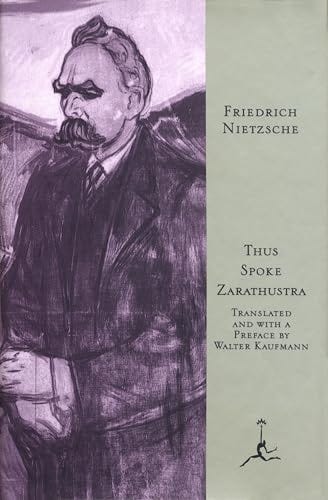
For the holiday season, UnHerd asked me to write about a book that has had an influence on my life, and I chose Thus Spoke Zarathustra.
Like every other young man inclined towards Right-wing politics, in my late teens and early 20s I fell under the spell of Friedrich Nietzsche. In particular, his Thus Spoke Zarathustra, published between 1883 and 1885, became something of a guide to life. A work of historical philosophy, its plot is very simple. The book follows the prophet Zarathustra as he descends from solitude to teach humanity about the Übermensch — the “Overman” who is supposed to transcend the merely human — delivering parables while confronting disciples, doubters, and his own evolving insights. Zarathustra is a stand-in for the author, and the reader is likewise drawn in.
Zarathustra, coming a mere 24 years after Darwin’s On the Origin of Species, is best known for its prophet’s declaration that “God is dead.” The main character’s moniker makes a mockery of the Christian deity — Zarathustra is the Germanized name of the Persian prophet who founded Zoroastrianism, a precursor to Christianity that may have later influenced it. With God dead, Zarathustra was to be a counter-gospel….
The truth is that it has been possible for individuals and movements with wildly contradictory views to embrace Nietzsche. There are postmodern Nietzscheans, nationalist and anti-nationalist Nietzscheans, and, in my heart at least, Nietzschean liberals. This last philosophy accepts his insights into human inequality and the psychology of resentment, while remaining skeptical of his attempts to assert a positive vision that can be imposed on society. Celebrating the idea of a heroic struggle, or one man’s will to overcome obstacles, can be useful in terms of self-improvement or even creating a cultural movement, but such impulses are likely to end in disaster if they are elevated to a governing philosophy.
We continue to see demonstrations of some of the same pitfalls of Nietzscheism today. Somewhere in Silicon Valley, there is a venture capitalist telling himself he is the Overman because he is investing in an app that more efficiently separates sports fans from their money. Nietzsche did not spell out the politics he supported, but he did provide an endless number of quotes that can be easily appropriated by those wanting to commit atrocities. And young people on X and TikTok, particularly those attracted to far-Right influencers, are often getting a bastardized version of Nietzsche, twisted to fit a political agenda. Better to go back to the original source. If you think the lesson of Nietzsche is that he agrees with your politics, it is more likely that you are a member of the rabble than a champion of individualism standing apart from it.
Still, there are few books that I am certain changed the path of my life, and Zarathustra was one of them. I discovered Nietzsche in an era before iPhones and ubiquitous social media, when something closer to the kind of solitude Zarathustra experienced was still possible. If my feelings of superiority were at first unjustified, over the years, I did develop a genuine — and, I like to think, well-earned — understanding of myself as a lone hero willing to stare down the mob. Seeing myself through the eyes of Zarathustra stamped out any fears of social isolation and rejection, and has allowed me to withstand – and even enjoy – the frequent demands for my banishment from public life.
The closest to a "Nietzschean liberal" in intellectual history is Leo Strauss. Step (1): “Nietzsche so charmed me between my 22nd and 30th years that I literally believed everything I understood of him.” Step (2): "We are not permitted to be flatterers of democracy precisely because we are friends and allies of democracy. While we are not permitted to remain silent on the dangers to which democracy exposes itself as well as human excellence, we cannot forget the obvious fact that by giving freedom to all, democracy also gives freedom to those who care for human excellence."
I too was a right-leaning young man who fell for Nietzsche in his late teens and early 20s, though I was also religious, which (for obvious reasons!) always stopped me from taking his philosophy on board in any kind of comprehensive way.
One thing you don't explicitly say, which is part of what makes Nietzsche so seductive, is just how good a writer he was, especially in German, but it comes through even in English translation. His rhetoric carries one along in a way that sometimes means that possible intellectual objections aren't at the forefront of the reader's mind. I can't think of another philosopher who is that good, except for Plato - who is, not at all coincidentally, another writer who was appropriated by a large number of apparently incompatible later thinkers.