
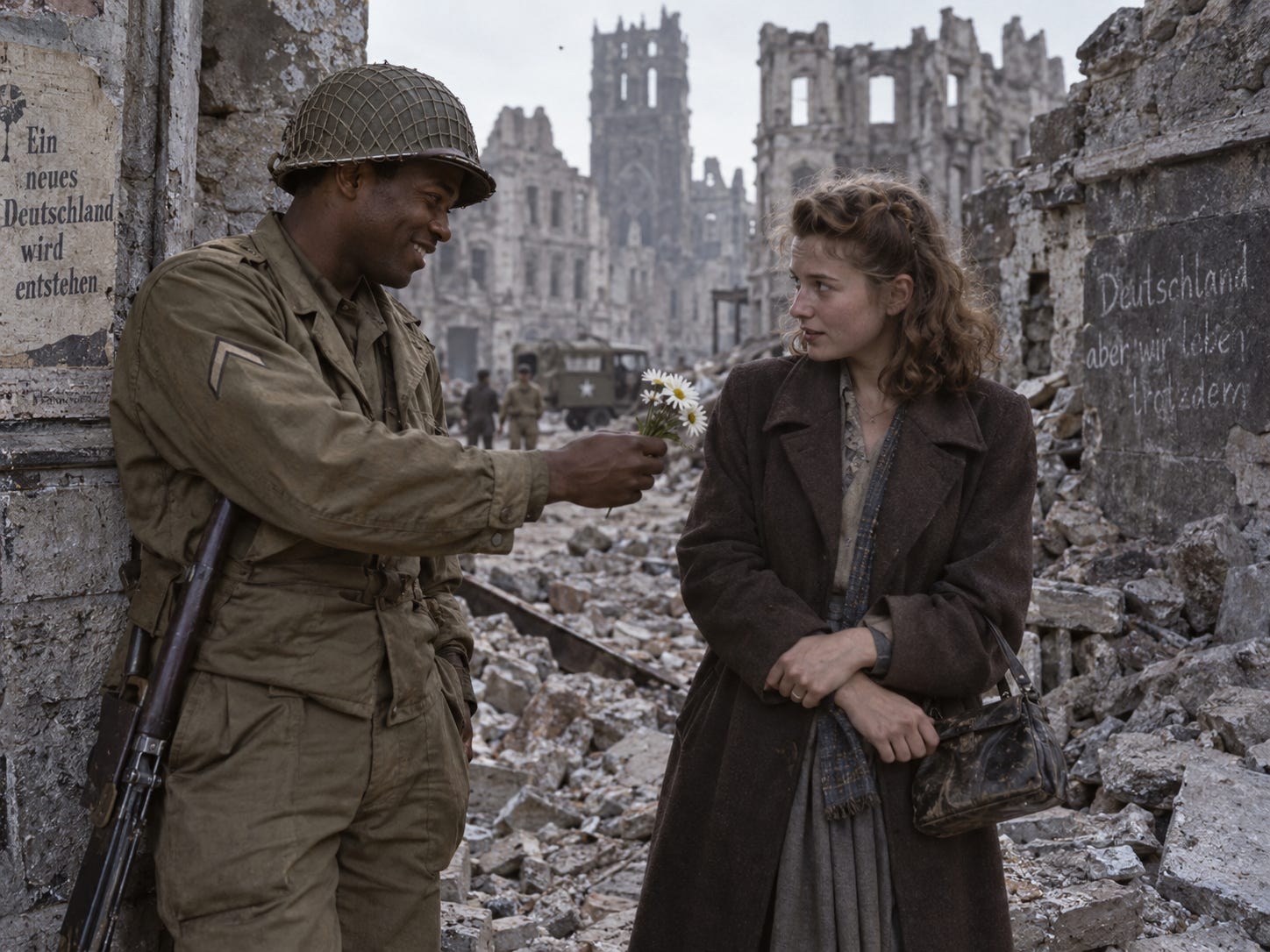
There are a lot of cross-racial behavioral genetic studies that support hereditarianism, but environmentalists have one 1961 paper they can point to. After World War II, Germany was occupied by the Allies, and sometimes the women of that country had children with soldiers from abroad. The psychologist Klaus Eyferth tracked some of these children down in the American and French zones of occupation when they were between 5 and 13 years of age and gave them IQ tests. In a 1961 paper, he compared the fully white offspring of soldiers to those with a father of African descent.
Here is the original article, and below is an English translation I got from ChatGPT.

Overall, the study included 181 colored occupation children, excluding 11 from the IQ analysis for being too young, and 83 white occupation children, of which 2 were excluded on the same grounds. The IQs of both groups ended up being practically identical, with about a 0.7-point difference in favor of the whites. This is obviously much smaller than you would expect in a study involving mixed-race children given the IQ gaps between whites and blacks that we have traditionally seen in the US. Eyferth tried to match the white and colored children on socioeconomic characteristics, and sometimes found both types of occupation offspring in the same classroom.
Eyferth reports whites doing better among males and the colored group scoring higher among females.
He calls these results statistically significant in each case, but he was using an approach that would not pass muster today. By our modern (and better) methods, there is no statistically significant effect within either sex. The takeaway here is that, pooled together, there was no notable racial difference in intelligence.
In 2005, J Philippe Rushton and Arthur Jensen explained why the study isn’t as much of a slam dunk for environmentalism as one might think.
Eyferth (1961; Eyferth, Brandt, & Hawel, 1960) reported IQ data for out-of-wedlock children fathered by soldiers stationed in Germany after World War II and then reared by White German mothers. The mean IQs for 83 White children and for 98 racially mixed children [these sample size numbers are errors; the mixed-race number was 170, reduced from 181, and the n for white children was 81 after exclusions — RH] were both about 97 (97.2 for the Whites, 96.5 for the racially mixed). As Loehlin et al. (1975, pp. 126–128) noted, however, these results are ambiguous for three reasons. First, the children were still very young when tested. One third of the children were between 5 and 10 years of age, and two thirds were between 10 and 13 years. As discussed in Section 5 (see Figure 3), behavior genetic studies show that while family socialization effects on IQ are often strong before puberty, after puberty they dwindle, sometimes to zero. Second, 20% to 25% of the “Black” fathers were not African Americans but French North Africans (i.e., largely Caucasian or “Whites” as we have defined the terms here). Third, there was rigorous selection based on IQ score in the U.S. Army at the time, with a rejection rate for Blacks on the preinduction Army General Classification Test of about 30%, compared with 3% for Whites.
So the least intelligent blacks usually weren’t sent to occupy Germany; we know childhood family environment matters less for IQ as people get older; and some of Eyferth’s children were actually the offspring of North Africans anyway.
One way to frame the problem is that we don’t know the IQs of the fathers or the mothers of the colored and white children. Given how racist Germany must have been at the time, it seems to me that a black man who was able to find sexual partners in the aftermath of Hitler’s regime might have been quite exceptional.
James Flynn argued that this is not the case, and if anything African Americans who fathered children in Germany were below average for their group. He points to a 1947 military study that looked at the relationship between cognitive test scores of black troops in Germany and whether they were involved in serious offenses, including contracting venereal diseases. Men who scored between 70 and 78 on the AGCT, the army’s general cognitive-aptitude test, were most likely to get in trouble, while those below 70 or over 100 were better behaved. If we assume that the population that contracts STDs is the same population that fathers children out of wedlock, then perhaps we may conclude that the black fathers of occupation children were unusually dumb.
At the same time, there is direct evidence that women in Germany involved with black GIs were not all from the fringes of society. A 1949 survey of 600 German mothers with black occupation children described 134 as upper class and 180 as middle class. Sixty-two had been married and living with cuckolded husbands at the time of their relationships (imagine the German rightoid memes they would’ve made about the men coming back from the Eastern Front if they’d had Twitter back then). Some expressed a desire to marry the black fathers of their children, indicating those men weren’t complete losers. Many of the black soldiers did try to get married, but they had to receive permission from the military, which rejected them at higher rates than white soldiers.
It’s possible that Flynn is correct that the blacks who suffered from venereal diseases were lower IQ, often getting infected by visiting prostitutes. But those who fathered children might have been smarter and more commonly in long-term relationships, sometimes with higher-class women, which would have required that they be impressive enough to overcome deeply entrenched prejudices. These populations do not have to be the same.
A 1956 West German government report found 67,753 out-of-wedlock children of occupying forces, of which 37,261 were American-produced. An unpublished tabulation from the same census shows that 3,491 children among the latter group were colored. Among American occupation children with unmarried parents, then, 9% had black fathers. But, as we’ve seen, blacks sometimes had more trouble getting permission to marry German women, so the percentage of American fathers who were black was certainly less than 9%, since here we are not counting those who married the mothers of their children. Regardless, black men having children with German women was quite common.
As for the characteristics of the women themselves, it’s possible that those who had black partners were smarter on average, as people with a greater openness to violating social norms in a liberal direction sometimes are. Or they could’ve been dumber, for the reason that having a black partner in a racist society makes one’s life more difficult, and women who do this might be bad at foreseeing the consequences of their actions. Eyferth tried to control for social class and other characteristics of the mothers, but that doesn’t mean we can dismiss the idea of a selection effect.
The Eyferth study still fascinates those interested in the race and IQ debate because it is the rare cross-racial behavioral genetics paper that cuts pretty directly against the hereditarian hypothesis. In nearly every other case, it’s the environmentalists who need to come up with reasons why the results didn’t come out as they expected. It is too bad that the Eyferth study is the product of a unique historical moment, meaning that it can’t be replicated, and there are too many unknowns to draw strong conclusions about what it tells us. Nonetheless, for those who dislike the implications of hereditarianism, it can’t be totally dismissed and therefore remains standing as a beacon of hope.
>with a rejection rate for Blacks on the preinduction Army General Classification Test of about 30%, compared with 3% for Whites.
This is the key point that undermines the whole article. And the rejection rate disparity doesn't even count people who self-rejected due to expected failure.
I mean cmon, "no disparity in the IQs of the children of black and white olympiad finalists" doesn't show anything at all.
"It is too bad that the Eyferth study is the product of a unique historical moment, meaning that it can’t be replicated,"
Of course it can be replicated. The U.S. has based troops in Germany for 80 years and countless half-black half-German children have been born, such as the late Rob Pilatus of Milli Vanilli and numerous members of the U.S. men's national soccer team who have participated for the U.S. in the World Cup (such as Malik Tillman, Jermaine Jones, John Brooks, and Timothy Chandler). U.S. men's national team soccer coaches traditionally like black nature and German nurture.
The Eyferth study could have been replicated at any point in the 65 years since 1961. Sadly, I've never heard of a replication.