
The Jason Arday story continues to surprise. I didn’t believe that there would still be much to talk about regarding this man’s individual story nearly a week after his death, even though I thought it was clear that his rise and fall exposed deep problems in academia. Instead, the reaction of the British left to the entire episode has been clarifying, and helps explain how we got a figure like Jason Arday in the first place.
What is interesting here is the split between different factions of what gets lumped together as the “liberal establishment” by conservatives. Some of the most devastating reporting against Jason Arday came not from Nathan Cofnas or others on the right, but pillars of the mainstream media in the US and the UK, namely The Guardian, The New York Times, and The Atlantic. The first of these found people who knew Arday as a child and contradicted his story about being non-verbal until eleven. The Atlantic harshly reviewed Arday’s memoir before it was released, tried to get his publisher to explain its fact-checking process, and even found his book proposal, which included additional lies that didn’t make it into the finished work like that he had testicular cancer and had spent several months in a coma. The New York Times published Jesse Singal on the Arday fiasco, and gave this brutally frank assessment of the man and his career in what was a news article, not an opinion piece, after his death.
When Cambridge University interviewed Jason Arday for one of the most prestigious sociology positions in the world, he was an early career scholar and underqualified, by the school’s own standards.
Cambridge’s requirements, reviewed by The New York Times, called for “an outstanding research record of international stature” and a “proven successful track record” supervising Ph.D. students. Dr. Arday had a modest publication record and had bounced from one university to the next — not staying long enough to oversee a full three-year-or-more doctorate.
Cambridge hired him anyway in 2023, making him, at 37, the university’s youngest Black professor at a time when the school was under pressure to diversify. In doing so, Cambridge thrust him into the international limelight, giving him a platform at one of the world’s elite universities to champion academic diversity and making him a target for critics…
If, in hindsight, elements of Dr. Arday’s story seemed too good to be true, Cambridge ignored repeated warning signs. A review of internal Cambridge documents and interviews with former colleagues and associates shows that, in addition to passing over more experienced candidates for the job, administrators gushed publicly about Dr. Arday’s scholarship and privately disregarded complaints about his work. They declined to investigate plagiarism concerns and accused his critics of a “vile campaign” to discredit him.
Dr. Arday’s claims about not speaking were false, a former classmate and a speech professional who worked with him told The New York Times. His supposedly remarkable trajectory from nonverbal preteen to Ph.D. had no precedent in medical literature, experts in developmental and speech delays say. That should have set off alarm bells for the Cambridge hiring committee, which included a child psychiatrist who had done research on autism, experts said.
As someone of the position that the media is honest and good, all of this was encouraging to see. The only acceptable view on Arday is that he was a fraud, and that his career exposes how low academia has fallen due to declining standards and a commitment to DEI. Who exposed him, their motivations, Nathan Cofnas’ views on how many black scholars would be at Harvard without DEI, etc., are simply not relevant. In general, this is how the prestige media has approached the story. The worst reactions from the prestige press that I’ve seen have not denied that Arday was a liar and in the wrong but simply denounced the feeding frenzy as racially motivated and going too far. See these pieces in the Financial Times and The New Yorker. It’s not exactly wrong that many conservatives were eager to take down a black scholar, but this was based on an accurate belief that Arday got where he was precisely because he was black.
I wish we could leave the story there. And indeed, I thought that the pro-DEI crowd would, being unable to defend Arday, try to forget that he ever existed. They wouldn’t necessarily admit that he had proved something was deeply rotten in academia, but surely they wouldn’t want to keep the focus on a story that makes a mockery of everything they believe in?
Maybe that’s what would have happened had Arday not killed himself. But his death seems to have energized the British left and brought out its authoritarian impulses. There are broadly two camps here. The first is actually pretending that Arday was right and his critics were wrong. Byline Times is an independent British outlet whose motto is “What the Papers Don’t Say.” Earlier this week, it published a bizarre article about how a “Peter Thiel-linked race science network” made its way into Cambridge and was responsible for the downfall of Arday. They helpfully included this picture showing the masterminds of this network.
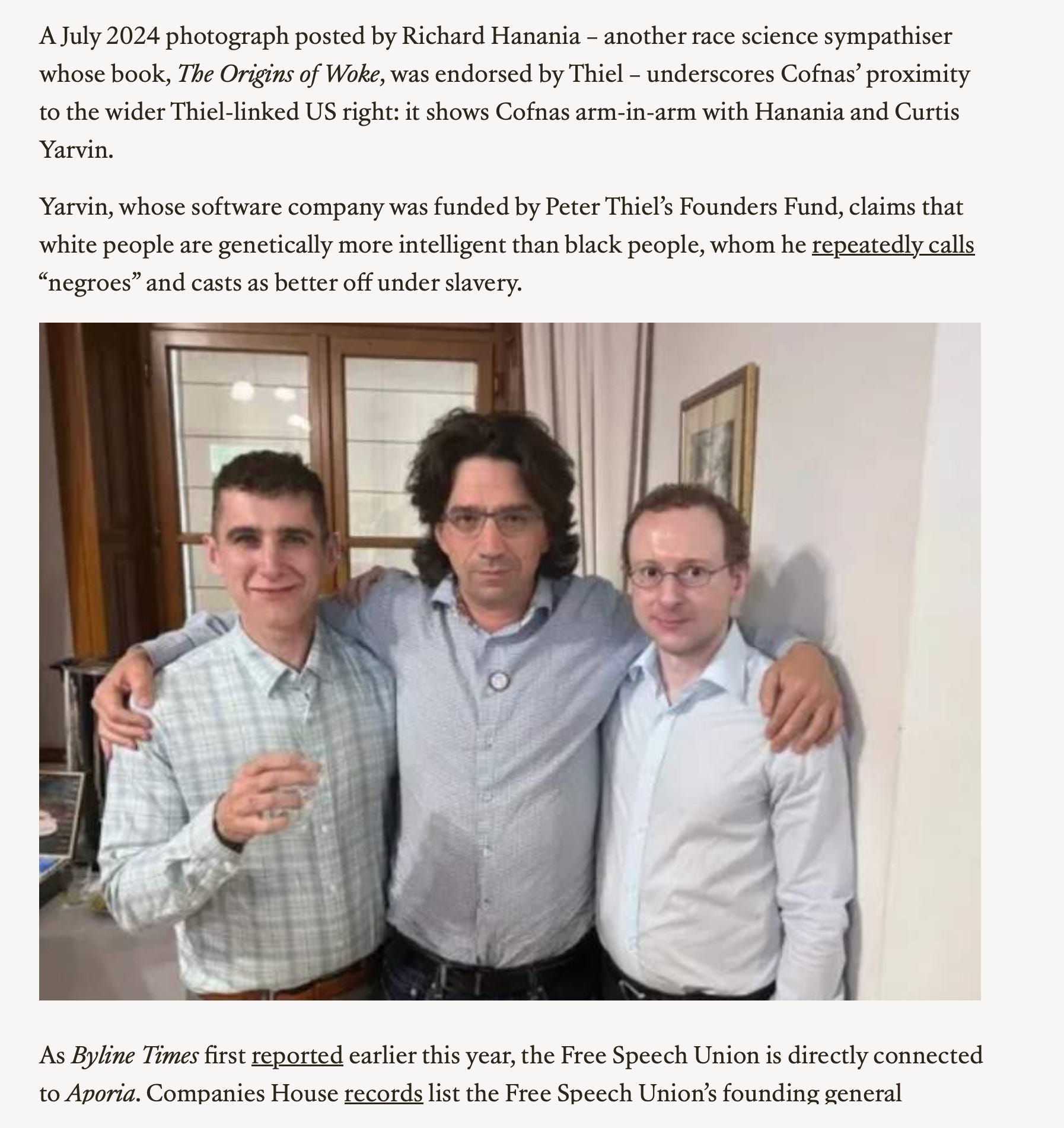
The piece describes Cofnas as an “anti-black racist” as if that’s his official title, noting that “many of these articles did not acknowledge that the central accusations were being made by a man who believes that inherited racial differences make black people less intelligent and would leave black people absent from virtually every elite position in public life outside of sport and entertainment.” Of course they didn’t mention that, because real journalistic outlets understand that whether an accusation is true or not doesn’t depend on its source.
Byline Times goes on to dismiss the plagiarism charges against Arday, and characterizes his claim about running 30 marathons in 35 days as supported by contemporaneous records – which only came from sources reporting what Arday himself said. The article continues in this vein, finding some post hoc rationalizations for some of Arday’s lies and exaggerations, while ignoring the ones that no one can plausibly defend.
Others on the British left aren’t trying to defend Arday on the merits, but are angry at the media for focusing too much on the man and his story. Unlike their American counterparts, British leftists have accompanied this with calls for the press to be regulated so something like this doesn’t happen again. Dozens of parliamentarians signed a letter demanding an investigation into the media over the Arday story, noting over 200 articles written about him before his death, which one signatory described as “reach[ing] way beyond what could be reasonably considered in the public interest,” as if this is a matter for the government to decide.


The Good Law Project has another open letter, signed by over 100,000 people, including members of Parliament, declaring that “self-regulation of the press has comprehensively failed” and calling for “an immediate public inquiry into how to ensure a responsible press given its contribution to Dr Arday’s tragic death.” For his part, Andy Burnham has reportedly not ruled this out, but for now doesn’t show signs of being inclined to immediately give the activists what they want.
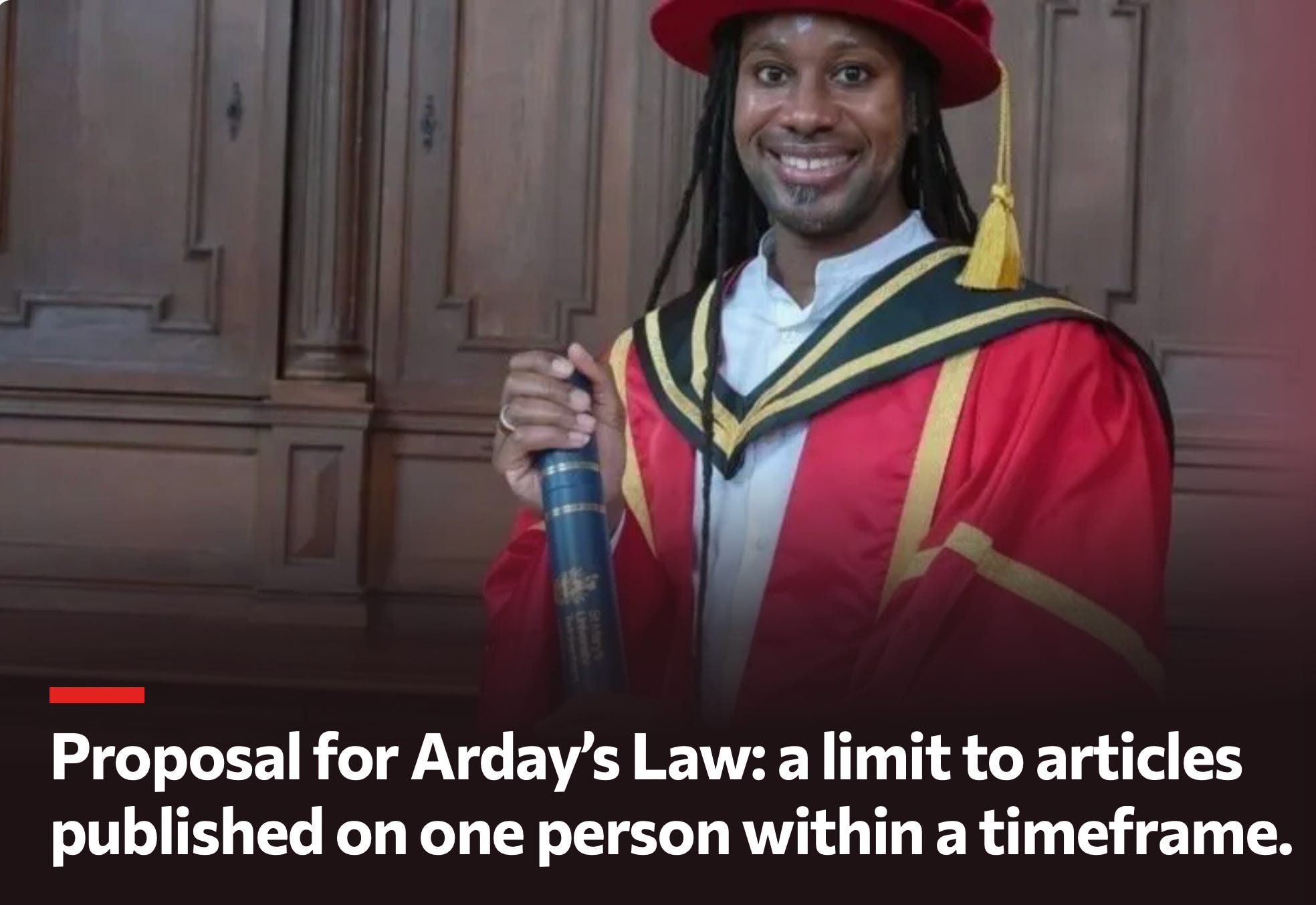
The most amusing proposal is a petition with 6,000 signatories advocating for “Arday’s law,” which would limit the number of articles that can be published about a person within a timeframe. I like to imagine Putin suing British newspapers for spending too much time covering the war in Ukraine. After they’ve used their Putin quota for the month, he can launch a nuclear weapon safe in the knowledge that no one will be allowed to know that he was responsible.
This entire episode highlights how left-leaning elites are not monolithic. Despite its problems, the mainstream press overall does a good job when it focuses on a story. It checks its facts. When actors are accused of lying, it will see whether the accusations are true. It is able to separate the merits of a claim from its source. And perhaps its most underrated virtue is that it is capable of shame.
This is not true for the British left, including much of academia. They have their narrative about right-wing racists, fascists, and oligarchs, and facts are not going to get in the way. If things look bad for Arday, you adjust the standards for assessing evidence, and change the subject to the motivations and behavior of his critics.
In terms of identity, the most prestigious journalistic outlets tend to have standards, which means that they select people who first and foremost see themselves as reporters, with whatever political commitments they have being secondary. When they behave ideologically and act contrary to their ideals, the rest of us can critique them on this and there is often a correction, as has happened on the trans issue.
We can distinguish the far left from the mainstream establishment by saying that it puts political activism first. Such people now select into more fringe news organizations like Byline Times, which thinks that The Guardian is too far right, or into the less rigorous fields of academia. From the perspective of a MAGA, these are all the “left” and it’s not much worth distinguishing them from one another, but the divide between the two camps represents the line between civilization and barbarism, and honestly between a camp that you can try to persuade and one that you need to find a way to destroy.
From the American perspective, it’s striking to see how many in the UK go straight to demanding regulation in response to media coverage they don’t like. This is a cultural difference, proving that the First Amendment is not simply a legal principle, but something that creates and reflects a distinctive attitude toward speech. No, of course, I haven’t forgotten about Donald Trump. Our president is certainly an authoritarian who wants to silence his critics, but explicit calls for censorship in America are for the most part a top-down phenomenon rooted in the unique rottenness of one man, and generally not made by activists in the midst of live political debates – at least not since around 2022.
Speaking of MAGA, a complete lack of shame is something that movement shares with the extreme of the British left. You can see this in the narrative around the 2020 election, where claims of fraud have routinely been unsubstantiated or even disproved for over five years now, and yet no Republican can remain in good standing with the base while admitting that Biden legitimately won the presidency. Conservatives who once said that they were radicalized by assaults on free speech, profiteering and the weaponization of government under Biden will look the other way now that the shoe is on the other foot and you can’t even measure the corruption of the current administration on the same scale used for every previous presidency.
MAGA is basically like if Jason Arday were the leader of a political party, and he used his power to build a movement centered around reinforcing his delusions. Thankfully, however, a lot of the pathologies of the current American right are rooted in the personality of Trump himself – whose very existence mobilizes the chuds and gives them power within their coalition – while the British left appears to be more organically hostile to principles like fairness and a concern for truth.
Another commonality between MAGA and the British left is that they both attack the mainstream press for its strengths, rather than its weaknesses. While more sophisticated media skeptics criticize it for not living up to its own standards of impartial truth-seeking, populists on the right and left hate it for being too honest and willing to challenge narratives they are attached to. MAGAs and British leftists even employ many of the same strategic arguments, alleging double standards when the underlying conduct in question is completely indefensible, as in the case of Arday’s fraud and Trump’s unprecedented levels of lying and corruption.
Frankly, we are lucky to live in a world where we have elites that will expose both Jason Arday and Donald Trump. Yes, yes, I understand one is the President of the United States and the other is a disgraced former academic, but if you add up all the Ardays and Arday enablers in the world, you get something that is often at least in the same neighborhood of being as threatening to liberal institutions as right-wing fascism, and almost certainly more so in a place like the UK. Trump and Arday are uniquely pernicious figures – both perfectly representative of the pathologies of their respective movements – so much so that you can tell a lot about a person’s discernment and ability to engage in good faith discourse by the degree to which they show any inclination to defend either man, or even to make comparisons that put their behavior in a more charitable light.
Thankfully, the entire Arday fiasco is a reminder that we don’t have to pick between these equally unpalatable choices. There are options other than a kleptocratic cult of personality permanently at war with empirically-oriented institutions and a movement so enthralled to the leveling instinct that it will destroy whatever is in its path to achieve its goals. Truth still has a powerful constituency in the form of the mainstream media. The challenge is to demand that the press live up to its own standards while defending it from those who would destroy it for adhering to them.
This post is sponsored by Mechanize. They are hiring software engineers at a base salary of $300K-$400K/year, plus substantial bonuses. They also have openings for other positions, including Research Engineer ($500K base pay), Recruiter ($200K), Growth Manager ($250K), Interns ($150/hr), and legal counsel ($400K). You can even “build your own role.” Here is their website, and you can apply here. If you apply, make sure to use the links provided here so I can receive credit, and name me as a reference in the process.
I'm glad that the American center-left media has recalibrated somewhat since peak wokeness. But the fact that no one was willing to break this story in the first place except Cofnas tells us things are not as copacetic as Hanania would have us believe.
I agree with the thrust of your point but it's too generous to parts of the establishment, non-fringe media imo. Take the BBC's coverage, to choose one example, which has been staggeringly awful and ideologically slanted. As it generally is on a range of different subjects ranging from wokeness to Israel to Brexit etc. A recent Spectator (better than the BBC) piece sums this up:
'The BBC spent years uncritically promoting the myth of Arday. Prior to July 2026, the broadcaster produced at least 11 radio programmes (totalling nearly six hours of Arday content), four news articles, and two TV interviews championing the academic and repeating his false claims.
When the initial story broke about his plagiarism and lies, the BBC doubled down on its defence of the academic. The first article which I would say features real criticism of the former professor was published on 6 August, a day after he resigned, more than two weeks after the original Arday exposé was published on Substack, and six years after the BBC’s first hagiographic piece about the late academic.
This was nothing short of a six-year propaganda campaign by the BBC on Jason Arday’s behalf
In that time journalists across the world published revelations detailing Arday’s long history of lies and exaggerations, from publications as diverse as the Telegraph and the Daily Mail to the Guardian and the New York Times. For weeks, the BBC ignored them all.
Following Arday’s death, the corporation has returned to its less-than-impartial reporting of the matter. Throughout the saga, the BBC has spent more resources smearing Arday’s exposer, the former Cambridge academic Nathan Cofnas, and participated in a genuine witch hunt against him. Even in articles detailing accusations of plagiarism against Arday, it is clear that the real enemy of the story was the infamous ‘race realist’ Cofnas.'