
I have a morbid fascination with JD Vance. Since I’ve thought about the man a lot, I didn’t think I’d get anything new from his most recent book, Communion. But I was wrong, as it led me to develop a novel theory about what makes him so unique and unsettling as a political figure.
There is a disparity between what we might call his meta-dishonesty and his micro-honesty. This is how Vance can be understood as an outlier in terms of both how genuine and how fake he seems at the same time.
On basic facts about his day-to-day life, I think Vance is honest. I believe his conversion story, because if any part of it were made up, it would have been a lot less lame. Vance cites two “miracles” for his conversion during the process of him contemplating whether to join a church. In one, while discussing theology with a conservative intellectual – later revealed to be Ross Douthat – a wine glass fell on the floor. In addition to this, he was listening to a psalm on the way to meet a Dominican friar, and then, when they went to a chapel together, they heard the same psalm! Vance is aware this isn’t going to convince anyone, and becomes defensive.
Now, I know it’s easy to make the skeptic’s case: “Oh, come on, JD, a group of Christians sang a song and then another group of Christians sang the same song in a different language? Total coincidence!”
But to quote Samuel L. Jackson from Pulp Fiction: “You don’t judge s*** like this based on merit. Now, whether or not what we experienced was an ‘according to Hoyle’ miracle is insignificant. What is significant is I felt the touch of God.”
The reader can decide whether a Samuel L Jackson quote refutes David Hume. As a reviewer for The Atlantic put it, “If I were Vance, I would be a little offended that God was not putting in more effort to recruit me.”
So it all rings true. Vance also doesn’t like lying in interviews, which is why he’s capable of being embarrassed when inconvenient facts are presented to him, in ways that Trump is not. When he was forced to defend the cats and dogs nonsense, he came out and admitted he was lying, which I guess is the most honest possible way one could’ve handled that situation without violating the principle of never saying Trump is wrong.
At the same time, Vance has an extreme degree of meta-dishonesty. When talking about his motivations, the quality of the arguments for the ideology he has arrived at, and facts related to his ambitions or his utility function, he tells himself stories that seem obviously absurd to any sophisticated third-party observer.
Vance writes that he came to religion after finding that he was good at achieving professional success but hungered for deeper sources of meaning. He was drawn to Christianity because it gave him moral guidance and a higher ideal to aspire toward, namely being a good husband and father.
Here, you might be thinking to yourself: how then did this simple family man who rejects striving go from analogizing Trump to Hitler in 2016 to being his running mate eight years later? Vance says it was all kind of an accident. He’s an Appalachian Chauncey Gardiner. Here’s Vance on how he decided to run for Senate, after spending the first half of the book telling us how religious faith pointed him away from earthly ambitions.
Usha and I were in California visiting her family. Because of the time difference, I was asleep when news broke that my home state’s junior senator, Rob Portman, would retire. I went back and forth for a while on whether to run before eventually deciding to do it. In some ways, my Senate run was a quirky intellectual project: an effort to make what I thought were more explicitly Christian arguments about the economy…
Much has been written about that Senate race, and I doubt I can offer much original here. But the most important thing to say is that I thought we’d lose but we didn’t.
He ran for Senate in order to make a point about Christian economics! But then, oops, somehow he ended up winning his seat. This happens all the time. One second you’re filing paperwork hoping that it’ll get you on talk shows so you can explain how Jesus wants you to be in a labor union, the next you’re actually in the Senate.
But he didn’t stay there long. Two years after winning his first political race, Vance was on the GOP presidential ticket. How did this happen? Vance explains this story while once again denying himself any agency in the process.
Though I had heard that President Trump might be interested in having me join his ticket in the national campaign now underway, I figured it was a long shot. I had only a year of political experience. As a white man from Ohio, I added no diversity to the ticket and didn’t deliver a swing state. When his staff told me I was on the short list, I almost thought it was a prank call. But I answered their questions and tried to keep the possibility out of mind.
Usha wasn’t looking to upend our lives yet again, but she eventually came to see it as an opportunity to serve the country. However, she insisted that we bring the kids on the road.
This, of course, is contradicted by abundant reporting about how Don Jr, tech billionaires, Tucker Carlson, and Charlie Kirk all lobbied heavily on behalf of Vance.
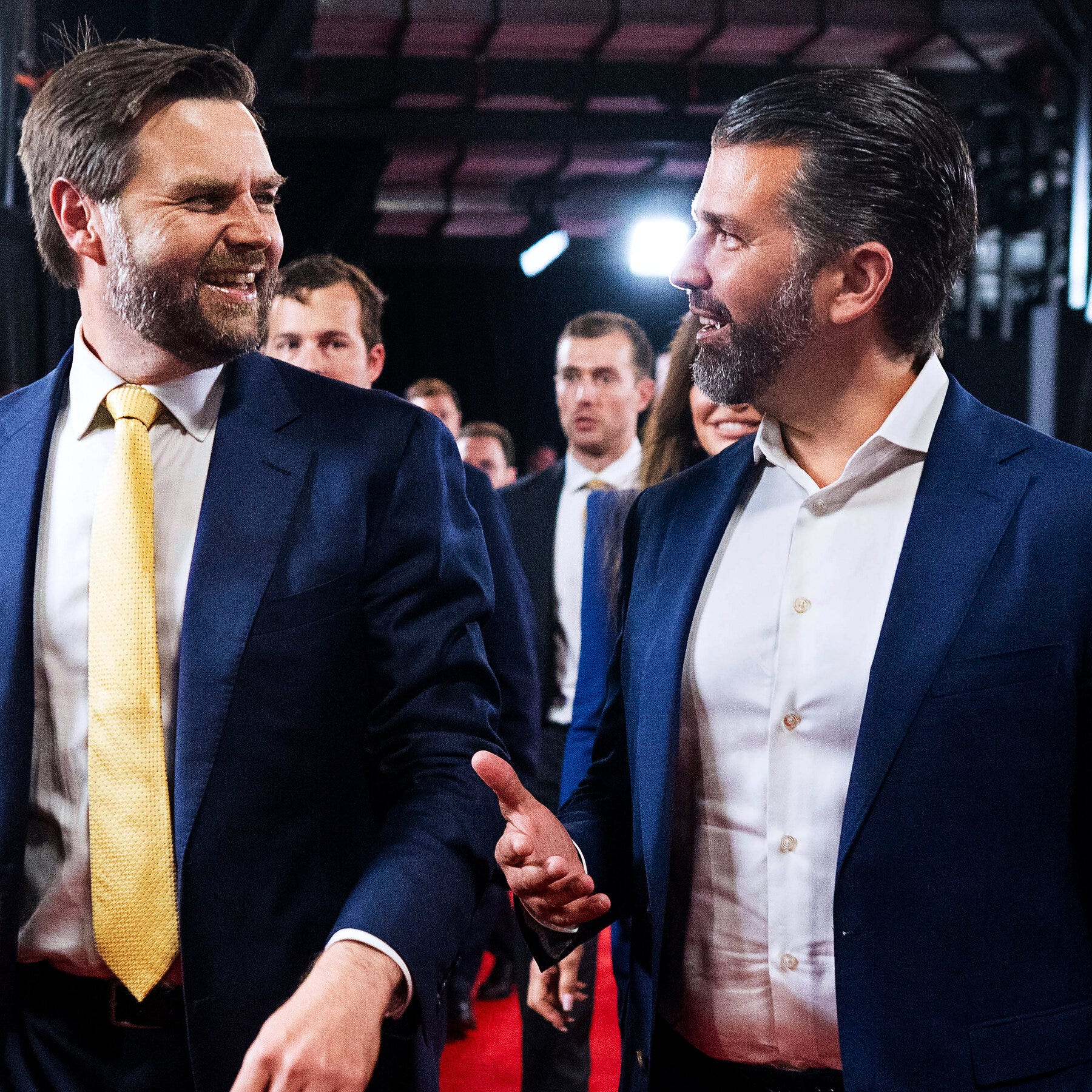
As the NYT reports, right after Vance was selected, he called Don Jr in order to thank him for his efforts. The two had become particularly close over the years.
Can you think of any reason an intelligent person would want to be friends with Don Jr if he wasn’t trying to get something out of the relationship? If you’ve never seen Don Jr talk, just browse YouTube a bit and ask yourself how much ambition you would need to have to be able to tolerate spending any significant amount of time with a man this vapid and aggressively stupid.
Getting close to powerful people who can help him has been a constant throughout Vance’s adult life. In law school, he fell in with Amy Chua, the famously connected professor known for being media savvy and helping her students advance in their careers. The relationship with Peter Thiel has been well covered, and Vance credits the entrepreneur with directing him away from atheism by proving that smart people can be Christians.
In terms of political views, Vance has shown an impeccable sense of timing. Writing his first book, Hillbilly Elegy, in the midst of the Tea Party era, it reflects the conservative consensus of the time, stressing individual responsibility and denouncing populism and nativism. When the entire American establishment was horrified by Trump’s 2016 candidacy and it looked like he would go down in flames, Vance went further than most of them in his personal denunciations of the man and his political project. After Trump spent the next several years remaking conservatism in his image, Vance came into MAGA with the zeal of a convert. Now, he wants us to think that a guy can just go from being one of Trump’s most fervent critics to becoming his successor in eight short years without in any way aiming for that outcome.
This meta-dishonesty extends to his economic and political ideas. I’ll be polite here and not go into the question of whether there are good reasons to believe Catholicism is true. I’m willing to grant people as much grace as possible when it comes to religious belief, since not much good comes from arguing about this topic. That said, Vance doesn’t really make intellectual arguments for his faith, or much of anything else. There’s an almost explicit self-awareness that he doesn’t base his beliefs on reason, arguments, or empirical evidence, but social context and pragmatism. As Usha said, “Therapy didn’t work for you. But church does.” Vance needed to find a religion because of his own angst about his place in the world, and picked Catholicism because it was old and seemed more structured than the evangelical Christianity he had grown up with. The back cover of the book has Vance writing in the first person about how he hopes that the story of his journey provides inspiration to others, but there’s little here for anyone looking for convincing reasons why Christianity might be true.
Vance has an entire chapter called “A Dismal Science,” which is framed as an attack on economics. We’re told that Japan has had slow growth over the years. But Vance went there and the strawberries were delicious. From this, he learned that “Maybe economics is just fake.” Vance then proceeds, in a style similar to that of academic Marxists, to blame capitalism and markets for everything he doesn’t like in the world, from fentanyl addiction to low birth rates. Vance’s image of an economist is some guy sitting in a room saying “More fentanyl deaths? That’s unfortunate. But we must continue to maximize GDP!” Economists are perfectly capable of realizing that country A might have a higher GDP than country B, but country B nonetheless might do better on some other measure, or that a policy that slows growth might be worth adopting if it saves lives. This isn’t anywhere close to controversial within the field, and Vance doesn’t show much evidence of having actually read any economists.
No economist is ever cited for espousing the view that maximizing GDP is all that matters, or that the concept measures everything of value in the world, because no economist takes these positions. While putting forth his anti-market views as representing a bold new approach to policy, Republicans have traditionally supported the war on drugs and other interventions to curb vice, showing that an old GOP establishment that focuses on economic growth and nothing else regardless of social costs is a complete figment of Vance’s imagination.
Vance’s real problem with economics, and why he has to constantly burn strawmen, is this: he has adopted a worldview that has practically no supporters in the field while being congenial to the prejudices of MAGA. It’s one thing to believe economists don’t know what they’re doing. It’s quite another to think that Trump supporters, not known for being a smart or intellectually curious crowd, understand what makes nations rich and poor better than the experts do. All the talk about GDP not measuring everything is a way for Vance to discredit a field that will simply tell you that MAGA is wrong on the facts. Even if you think immigration has been too open and trade has been too free in terms of improving American living standards – and these are very difficult cases to make – the idea that free trade and immigration are the major causes of the country’s problems is pure economic flat-eartherism, which is something that even those who are more skeptical of globalization will tell you. Republican and Democrat economists all agree on this, as does anyone with a respect for rational thought or data-driven analysis.
It’s not like Vance has non-economists who, by taking a different methodological approach, can justify his nativist views either. His entire economic outlook, by his own admission, appears to be drawn from a combination of what he feels in his gut and – despite him regularly fighting with the Pope – Catholic theology. Vance doesn’t go and cite mavericks from outside the field providing a theoretically and empirically well-grounded case for his anti-market views. The war on “economics” is really just a war on rational thought or data being applied to critique the opinions of ignorant voters that Vance relies on, and the things he feels he needs to convince himself are true in order to continue appealing to them.
Yes, politicians in general aren’t known for being systematic thinkers in the habit of questioning the beliefs of their base. But Vance is unique in the degree to which he seeks to intellectualize his demagoguery, with the pretensions of innocent truth seeking. The end result is a combination of smug ignorance and the trappings of thoughtful critique that is deeply embarrassing to anyone with a shred of intellectual integrity.
In addition to the crank economics, think about what it means to have had doubts about Trump’s character and fitness for office in 2016, and then decide your concerns were overblown after January 6, and watching a presidential term during and after which dozens of top officials he himself appointed later came out and confirmed the worst of your original fears. Or to get self-righteous over the idea that elites don’t care about regular Americans, while keeping your mouth shut as Trump literally takes billions out of the pockets of his supporters in a crypto scam.
Again, I think Vance has convinced himself of what he says about his lack of ambition, the accidental nature of his rise, and the reasonableness of his views on political economy, which center around the idea that the main problem Americans face is that they are in a zero-sum competition with foreigners. And I think he is a good husband, good father, and good friend. If he tells a story about a recent event in his life, I would be inclined to think that he is adhering more closely to the facts of what happened than most other politicians would in his situation.
When criticizing Trump was the position most useful for his ability to become a successful media pundit, Vance was one of the relatively rare individuals willing to drop the H-bomb. Now, he shows such genuine zeal in expressing outrage toward Democrats, journalists, and other enemies of MAGA that every online rightist feels a unique bond to him. Trivers’ theory of self-deception is the key to understanding what is going on here. The micro-honesty serves to convince Vance, and those around him, that he is a fundamentally decent man, which makes the meta-dishonesty easier to pull off.
And if you remove the political ambition that leads to taking absurd positions and telling himself false stories while deceiving himself about what is going on, I think one could say that Vance is in fact a good person. Ironically, it is that need to convince himself of his virtue that leads him to adopt such destructive political positions and makes him one of the most effective demagogues of our generation.
This post is brought to you by Mechanize. They are hiring software engineers at a base salary of $300K-$400K/year, plus substantial bonuses. They also have openings for other positions, including Research Engineer ($500K base pay), Recruiter ($200K), Growth Manager ($250K), Interns ($150/hr), and legal counsel ($400K). You can even “build your own role.” Here is their website, and you can apply here. If you apply, make sure to use the links provided here so I can receive credit, and name me as a reference in the process.
Just as Trump is a poor person’s idea of what a rich person is supposed to be, Vance is the ignorant person’s idea is what a smart conservative is supposed to be. Yet, as Hanania points out, Vance doesn’t actually appear to be that smart. My impression is that Vance’s odd pseudo-intellectualism is the result of grafting a Yale Law School Degree onto what appears to have been a very mediocre high school and college education. Vance may actually be fairly high IQ but he never had to work or think very hard to succeed relative to his mediocre peers. At Yale he had to suddenly shift into high gear intellectually without having really mastered the basics. He’s like a musician who has memorized some impressive technical pieces but doesn’t really know how harmony works.
Excellent analysis. To state it more precisely: most politicians have some awareness of their own motivations and feel a lingering sense of guilt or attachment to those original incentives when trying to convince the public of their moral highmindness. It hobbles their effectiveness on the public stage: sometimes you can see their eyes shift as they try to switch between the public and private modes. JD's eyes never shift.
In JD, the connection between motivation and rationalization is completely severed: his instincts identify the direction in which it would be politically useful for him to go, but when explaining that decision, his conscious mind starts from a clean slate. He's like a patient in the famous sectioned corpus callosum studies: he keeps waking up in strange circumstances -- running for a Senate seat in Ohio, endorsing a man he once compared to Hitler -- and has to figure out the explanation from first principles, with one of those principles being the Triversian assumption that he's simply trying to do good in the world. I can't stop watching his interviews because no one else has quite his combination of off-the-charts IQ, total moral conviction, and total dissociation from his motivational center.