
When people talk about what economic ideas they’d like to see implemented, there’s usually an underlying assumption that “we” (whoever that is) are in control of our destiny. I noticed this when talking to Samuel Moyn about Gerontocracy in America, in which the author argues that America should be a socialist society in which government takes more money from its citizenry and provides more public goods and direct support. DSA activists are motivated by the same underlying model of reality. There will come a point when Americans will “choose” to overthrow the oligarchy and build a country that works in terms of improving the lives of everyday people.
I think this worldview is deeply naive about empirical realities. For Americans to propose new costly welfare programs is like a guy who is going bankrupt, and has additional expenses coming down the line that will make his financial situation much worse, thinking about how to begin an expensive new project of remodeling his house. We don’t have the financial flexibility, and this doesn’t depend on who exactly gets into office in the coming years.
Our financial future is largely set based on decisions that were made long before most Americans were born. Social Security and Medicare were established in 1935 and 1965 respectively. In 1970, they made up a combined 19% of the federal budget. Now, the number is about twice that. And if you don’t include the cost of interest on the debt, without major restructuring Social Security and Medicare will likely be over half of all federal spending within two decades.
This wasn’t an outcome anyone planned for; it just happened as life expectancy increased, the cost of medicine went up, birth rates declined, and the elderly became a larger and larger share of the population. As a result of these developments, here’s what’s going to happen to different parts of the federal budget over the next ten years.
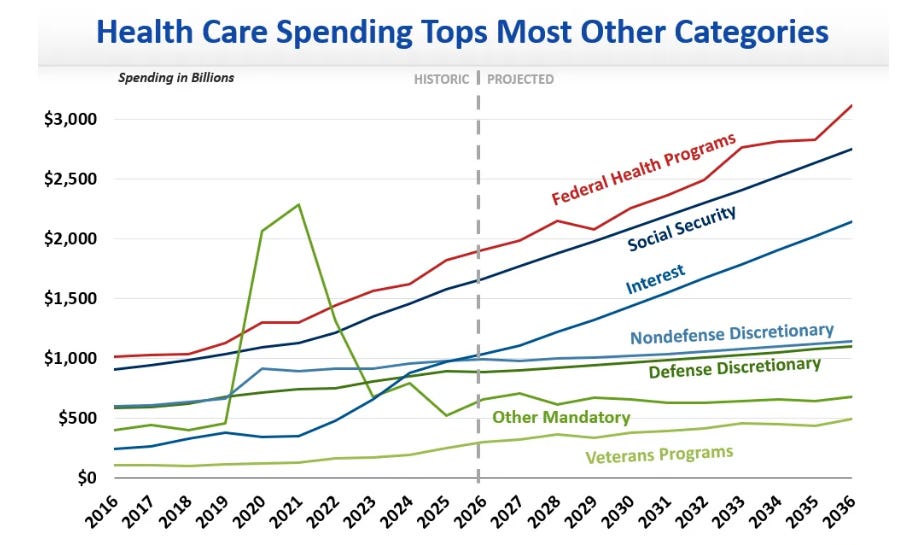
We’re already running a $1.9 trillion deficit. In other words, we have less money coming in than going out, and the problem is about to get much worse.
One might ask why we don’t simply cut Social Security and Medicare. These are programs that transfer money to old people, who are the richest age group in the country. Yet public opinion is overwhelmingly in favor of expanding these programs. The public doesn’t like large and broad tax hikes either, so something has to give. And no, simply “taxing the rich” doesn’t solve the problem. Removing the payroll cap on Social Security, for example, would impose an additional 12.4% payroll tax on earnings above $184,500 — paid entirely by the self-employed and split evenly between employer and employee for those with wage income — and only get you between half and two-thirds of the shortfall, depending on which assumptions you use.
So, in summary, this is the current state of the federal budget.
We spend more money than we take in each year.
Without us doing anything, spending on entitlements is in the process of skyrocketing.
These programs are more popular than just about anything else the government does.
In the end, you will need some combination of tax hikes, cuts to entitlements, and borrowing. You can’t indefinitely borrow with increasing deficits and no long-term plan to balance the books. To simply get to financial stability through tax hikes while largely shielding the middle class would require extraordinarily high taxes on affluent Americans – not just billionaires and the super-rich – and could push marginal rates above those found in much of Europe. And instead of paying those rates to finance a broad welfare state, Americans would be paying additional taxes simply to finance promises already made to the elderly. Relying only on borrowing and taxing to pay for entitlements would wreck the dynamism of the American economy, but relying too heavily on entitlement cuts will kill you with the voters.

It’s going to be a fascinating decade in American politics. But that’s not because we’re going to be choosing between implementing or not implementing socialism, which there isn’t room for.
I have no idea what formula of tax increases and spending cuts Congress will eventually settle on. But one thing I know for sure is that we won’t get massive new government programs.
Voters tend to strongly support welfare programs that exist while being pretty unenthusiastic about new spending. The latter requires higher taxes, and if we are willing to massively increase taxes, the money is going to entitlements. No politician is going to be able to enact a massive tax hike to maintain entitlement spending, and then implement another tax hike on top of that. Likewise, no politician is going to be able to cut Social Security and Medicare in order to fund something new.
The tradeoff between raising taxes and cutting entitlements is already going to put future politicians in a difficult enough situation. They will have to anger broad swaths of voters regardless of what they do. That means there will be no political capital left over for the federal government to take on substantial new responsibilities. New major forms of spending – whether Medicare for All, baby bonuses, or whatever – are simply not in the cards.
Here’s the Cato Institute on the costs associated with DSA proposals.
Public provision of goods and services, therefore, primarily shifts the cost from the individual consumer to the government, and at the scale envisioned by the DSA, those fiscal costs become enormous.
Comparable progressive proposals put the ten-year federal cost of Medicare for All at more than $33 trillion almost a decade ago. Large-scale energy and infrastructure programs have been estimated at $8 trillion to $12 trillion. Free college, loan cancellation, reparations, housing for all, job guarantees, and an expansion of Social Security would cost tens of trillions more.
Depending on the assumptions used, comparable versions of these proposals imply additional ten-year federal costs running from roughly $70 trillion to more than $200 trillion. That would come on top of a federal government already projected to spend roughly $94 trillion over the same period.
So, looking at a situation that is already financially unsustainable given current levels of taxation, the DSA envisages perhaps doubling federal government spending. You might as well treat this like Trump’s numerous promises to soon put a woman on the moon, though that is probably more likely than the US adopting a European-style welfare state.
Imagine in 2029 we get a President Alexandria Ocasio-Cortez and unified Democratic control of Congress. She’s already going to be facing the entitlements crisis, and let’s say that on top of that she tries to get Congress to pass Medicare for All. Whether she wants to rely on higher taxes or borrowing, the economy is likely to suffer, the stock market is going to go down, and borrowing costs will increase. Self-preservation alone will force socialists in power to back down. This scenario even ignores the political difficulties involved when you try to transition to a new healthcare system, as this almost stopped Obamacare dead in its tracks despite the fact that the changes that law imposed were nowhere near as radical as those of Medicare for All would be, and were undertaken when the country was in much better fiscal health.
The entitlements crisis is different from most other things in that politicians in power will have to do something. If they do nothing, spending on Social Security and Medicare will be automatically reduced in the early 2030s as the money runs out. So they can let that happen – which seems unlikely – or do something else that will be tough to swallow.
In practical terms, in the next decade where national politicians stand on entitlements is going to be more significant for the future of the country than their abstract views on capitalism versus socialism. Republican Senator Bernie Moreno, for example, has joined with Elizabeth Warren to rule out any cuts to Social Security. If this is what ends up happening, the advantages that made the US the world’s greatest force propelling economic and technological growth will largely be gone.
DOGE made a mistake that was the mirror image of the DSA’s spending proposals. Elon and his lackeys talked about balancing the budget or cutting trillions in spending through getting rid of fraud and unnecessary programs. But once you factor out Social Security, Medicare, Medicaid, the Pentagon budget, and interest, there really isn’t all that much spending to go after. DOGE ignored the sources of our budgetary difficulties for the sake of cheap wins that had little impact on the country’s fiscal health. They did get rid of a lot of employees, causing the biggest peacetime reduction in the federal workforce in history. And yet spending went up, because the salaries of government employees aren’t a large part of where our tax dollars go.
What DOGE demonstrates is that it’s unrealistic to expect major reductions in spending without tackling the entitlements issue. Look at the chart above again. Social Security, healthcare programs, and interest are shooting up; every other major category of spending is projected to remain stable and even decline relative to GDP. So those who would like smaller government are going to have to face the fact that the largest parts of the budget are extremely popular with the American people. Libertarians have one advantage over socialists in that the default under a scenario in which Washington is deadlocked is that entitlement spending is automatically reduced, given the way these programs are set up. This gives Republicans leverage in any negotiations, though they would have to actually want to use it to limit the increases in taxing and borrowing, and that is far from certain given the rhetoric of figures like Moreno and Vance.
All of this doesn’t mean that what to do about entitlements is the only political issue that matters in the coming years. But these programs are by far what’s most important in terms of thinking about the future of federal government spending, and here our choices are constrained, being limited to debating the exact parameters of the balance we accept regarding the combination of spending cuts, increased borrowing, and tax hikes that will make the math work out. The variation in possible outcomes is extremely limited.
When it comes to other forms of regulation – those that don’t cost a lot of money – the story is different. We still face more substantial choices on issues like how strong labor unions are, how easy it is to build homes, the scope of environmental regulations, what our immigration policies should be, and what theories of antitrust government officials rely on. A lot of these things will be decided at the state level, where leaders will still have significant freedom of action in the coming years.
But the federal budget is already spoken for. In the coming decades we will have a larger and more expansive government that spends more and more money on old people, including those who don’t need it, and approximately the same on everything else. The only question is the degree to which our gerontocratic future also hinders the ability of the private sector to continue increasing living standards.
This post is sponsored by Mechanize. They are hiring software engineers at a base salary of $300K-$400K/year, plus substantial bonuses. They also have openings for other positions, including Research Engineer ($500K base pay), Recruiter ($200K), Growth Manager ($250K), Interns ($150/hr), and legal counsel ($400K). You can even “build your own role.” Here is their website, and you can apply here. If you apply, make sure to use the links provided here so I can receive credit, and name me as a reference in the process.
You've found your way to another correct take here, but it's uncharacteristically lukewarm: in fact this problem is much worse than you say.
For one thing, entitlement trust funds running out of money is a fake issue - everyone in DC knows we'll keep funding the entitlements at the same rates and simply borrow more to do so. Nobody is voting against the "save grandma's social security act" or whatever enacts that change.
That's only one instance of the genuinely terrible political economy on fiscal issues right now. Anyone remotely serious about fiscal policy knows - and has known for decades - that we must either raise taxes or cut entitlements. Preferably both. We used to have one party that wanted to raise taxes and one that wanted to cut entitlements, so a grand bargain seemed possible.
But voters hate taxes and love entitlements, so they revolted from both sides against any compromise. Now both parties have learned that lesson and only talk about further cutting taxes or further expanding entitlements. Your faith that financial realities will "force" politicians back to reason is kind of autistic - if voters keep demanding something for nothing, politicians absolutely can, and will, drive the car off the cliff. Hyperinflation, sovereign default, the works.
Frankly you should be putting the general public on blast here. How did we get so irresponsible?
Well we can only hope for an AI powered abundance in the coming decades, so entitlements will become irrelevant. If we can automate everything, food and goods will become extremely cheap. Old people will no longer need welfare to buy food.