This year being the twentieth anniversary of Idiocracy, I have an article in UnHerd comparing our current reality unfavorably with that of the film.
This year marks the 20th anniversary of Idiocracy — director Mike Judge’s sci-fi comedy envisioning a future America staggering under the weight of popular stupidity….It returned as a cultural touchstone in the wake of the 2016 election, which many in liberal America saw as a harbinger of the kind of society depicted in the film: mindlessly consumerist and enslaved to low passions, with a public discourse more befitting of WWE-style wrestling than a Jeffersonian republic (Donald Trump had appeared in WWE events, after all).
Yet today, it’s clear that Idiocracy was, if anything, too optimistic. Twenty years hence, American public discourse is cruder and attention spans are shorter; mind-deadening drugs have become more pervasive, and politics is far more tribal and hateful than anything depicted by Judge. All this has taken place on a much faster time scale than Idiocracy predicted, moreover, and the changes are far more the result of ideologies spun up from resentment and hate than the biological degeneration featured in the film.
Read the whole thing here.
I just did a podcast with North Korea expert Peter Ward for the CSPI podcast. We discussed the clampdown that has occurred after the failed negotiations with Trump and Covid, Kim giving up on reunification, and what Kim is thinking by creating the impression that he has chosen his teenage daughter as his successor. For those who need reminding, I suggest subscribing to the CSPI newsletter and adding the podcast to your feed. All the material is free. Think about it as covering many of the similar topics as this newsletter, but more academic and without the personal touch.
I’ll be doing an event at Northwestern on May 5. More details to follow. If you want to invite me to something else in Chicago around the same time, this is the opportunity to do so.
I’m going to remind you to preorder my book again (Amazon link), as I will regularly until it is released. Find more details here. As I’ve written,
Aside from providing support to me personally, Kakistocracy can be seen as a book that explains what has been perhaps the main global political development of the twenty-first century. It sets out to explain populism in a way that will be satisfying to both the political scientist and the interested news consumer. Until about a decade ago, we were all used to thinking about politics primarily in terms of right versus left. While it would be ridiculous to claim that ideology as traditionally understood doesn’t remain extremely important, one country after another has been shaken up by the increasing salience of the populist–non-populist axis. This often centers around the topic of immigration, but populism has also risen in countries where this isn’t a major issue, and it more broadly reflects a shift in how citizens interact with the institutions that rule over them and claim to provide structure, guidance, and information.
Preorders are extremely important for how much attention a book gets, so please just buy now. For the superfans who read everything and are getting tired of the endless plugs, I ask for your patience. Somewhere out there is sure to be someone reading this who maybe glances at one in five articles and for the first time has just learned that I have a book on populism coming out. Endless self-promotion is the cost of being a writer who is almost completely independent (yes, yes, I didn’t forget about UnHerd and The Boston Globe).
I promised that I wouldn’t be too long in judging the wisdom of the Iran War, based on my belief that we should judge foreign policy decisions by their short-term impacts. I think this is increasingly looking like a blunder. I wrote that a leader-decapitation strategy approach to foreign policy makes sense, but not in a situation where you set off a war that has major costs and you have no clean path to finish. There was no way of knowing at the beginning whether the US and Israel had contacts on the inside or some coherent plan for regime change. It’s increasingly looking like they didn’t.
Below the fold, I review the new Netflix documentary Inside the Manosphere, and share thoughts on EHC liberalism versus EHC libertarianism, MAHA declining as Trump enters his lame duck phase, the problem with the Giving Pledge, and more.
1. Tyler Cowen has a new free book out: The Marginal Revolution: Rise and Decline, and the Pending AI Revolution (Sumner review here). I realized as I was reading this that what Tyler calls marginal thinking I always just thought of as economic reasoning. Examples of the insights of this method that he gives: congestion pricing forces drivers to pay for their externalities and can change behavior; closing abortion clinics can reduce abortions; if people don’t buy health insurance, it might indicate that they don’t care about health insurance that much. Here’s how Tyler explains the related concept of price theory: “The price theory approach suggests that you should think very carefully about basic economic concepts and try to figure out which of those apply to the problem you are working on.” I would hope so!
It seems to me that lurking in the background here is a fundamental political disagreement. Marginal economists are more pro-market, and economists who take different approaches are less so. These different approaches seem to be complicated mathematical models that many people can’t understand and empirical research using the highest evidentiary standards. One empirical result, or even a literature, rarely tells you what general approach to policy makes sense, and so if you don’t like the implications of marginal thinking – because it forces you to be too pro-market or come to politically incorrect conclusions – drowning your opponents in findings from studies is a good way to give yourself enough wiggle room to adopt whatever politics you want.
I’m generally impressed with the empirical work in top economic journals. Much less so in political science, which was my field of study. Tyler agrees. When discussing why economists write so many papers outside of their area of expertise, he notes “The dirty little secret is that what distinguishes economics as a field, right now, is a mix of higher standards, harder work, better math, and higher IQs.” This is clearly true; being familiar with economic papers has made me feel embarrassment toward the kinds of political science articles I used to take seriously, where you simply find some data, conduct a regression, and declare that you have found evidence for causation.
Despite this, it seems to me that we are now nowhere near the point of diminishing (marginal) returns of making the basic insights of marginal thinking better known and working to apply them to policy. Look how many cities have rent control, and how few have congestion pricing! How ashamed we should be that free parking on crowded city streets still exists! There is a long way to go. Sumner is right that the abundance movement is largely selling old wine in new bottles.
A question I had reading this is what the field of economics would look like if the marginal revolution were still going strong. Many of the fundamental insights can only be discovered once. A defender of where economics has gone might say that as we investigate more complex questions, we need more complex theories and empirical approaches. But I think that there’s probably a good deal of low hanging fruit that could be explored from a marginalist perspective. Yet when I try to understand what those are, I keep coming back to the idea that hypothetical younger marginal economists would simply test more theories that have politically incorrect or pro-market implications.
For example, most advanced countries right now are facing an immediate future that will be dominated by an aging crisis involving expensive pensions and too many old people relative to young workers. What political economy factors explain this? And what kind of incentives do we create when we shift so much consumption toward the end of life? A non-marginalist could investigate these questions as much as a marginalist. But he’s probably less likely to. Perhaps Tyler’s complaint can be reformulated as the field has moved too far to the left from the perspective of reaching important truths and benefiting society. That’s my “Straussian” reading anyway, which I’m sure Tyler would appreciate. The triumph of MAGA, unfortunately, has made such frontal political attacks that involve taking up the banner of the right more difficult since thinking people do not want to be associated with the current clown show.
2. Upon publishing my article on Christian history, Lyman pointed me to his piece from last year covering similar topics. He thinks Christians were not exactly prone to turning the other cheek, and actually got ahead through persecuting their enemies. He also argued that Philip the Arab was a Christian based on circumstantial evidence. I asked Claude about these claims, and it treats them as not crazy but open to scholarly debate.
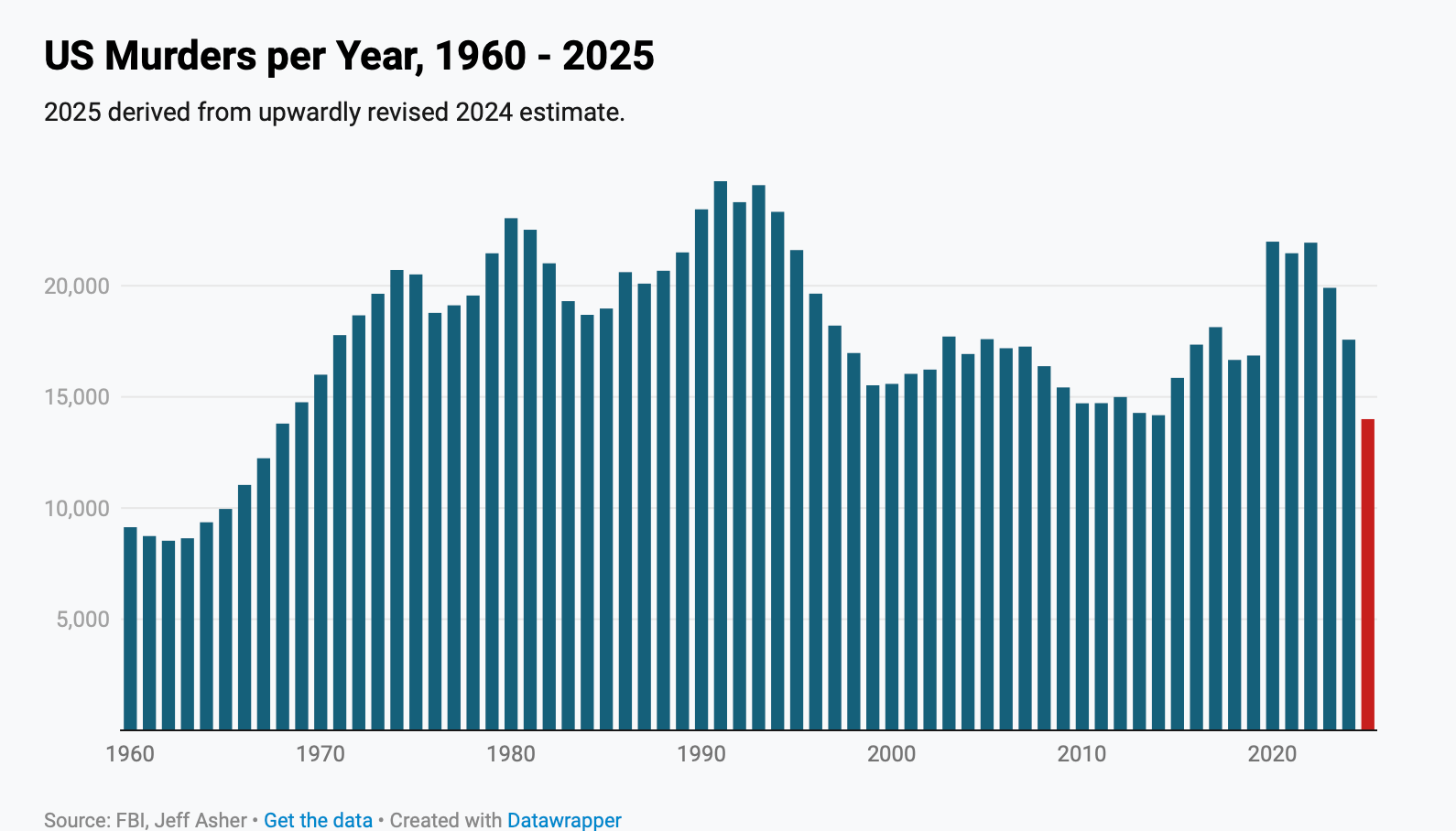
3. Multiple methods converge on the estimate that there were around 14,000 murders in the US in 2025. That is the lowest absolute number since 1968. The negativity bias in the news is incredible to ponder. You have to go to highly specialized Substacks to find this information, while every uptick in crime is a huge national story. Murder plummets and there’s zero interest in what we’re doing right. Perhaps at some point it goes up again, and we’ll be less prepared to deal with the problem because we put forward practically no effort toward figuring out what happened when things were going well.