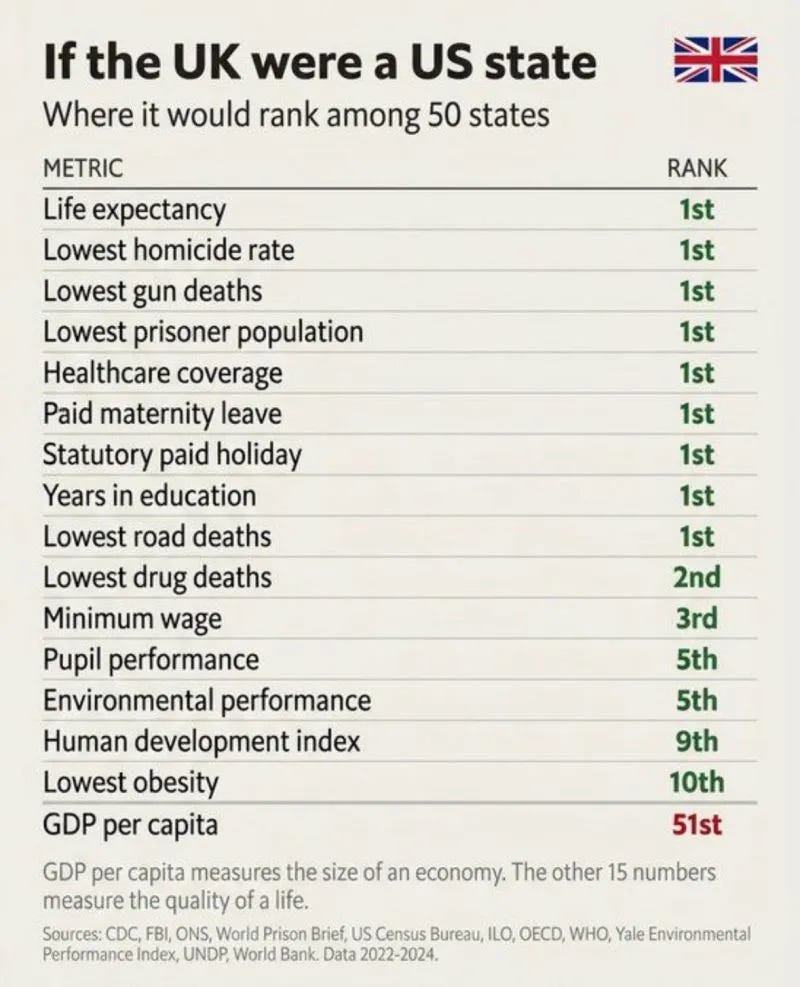
The US is wealthier than Europe, and the gap between the two keeps growing. No one can deny this anymore, so some have taken to arguing that we shouldn’t care that much about GDP, because other countries do better on other measures. Here’s one particularly annoying piece, which includes the following chart.
I like how this treats left-wing policy goals themselves as accomplishments. “Paid maternity leave”, “higher minimum wage”, and “statutory paid holiday.” What if a country just declared the entire year a paid holiday? I guess that would be a great success story. This reminds me of how the Soviet Union had an endless number of rights guaranteed in its constitution, for all that was worth.
Economic statism is always sold as something that will help make societies richer. When it fails, you can just point to the policies themselves as a success that refutes the need to worry about economic comparisons at all! I can just start listing right-wing political goals like more religious freedom, free speech, and lower taxes to prove America is a better place to live.
Even on the more objective measures, we can say that Nigeria does better than the UK on obesity and prisoners per capita. It also has a healthier birthrate. Is Nigeria better than the UK? Sure, maybe by some criteria. But the UK is still much wealthier, and it would be foolish to deny this or act as if it is unimportant.
Putting aside the clearly political criteria, the argument of the GDP skeptical crowd is that wealth is not the be-all and end-all. What good is GDP if you die sooner, you’re addicted to drugs, and you live in a state of constant economic insecurity? Of course, most alternatives to GDP per capita correlate very strongly with it. But when the differences between countries are relatively small in percentage terms – like between the US and UK, but not between the UK and Nigeria – we might argue that the poorer society is “better” in some sense.
It’s fine to say you’d rather live in Europe than America. But the denigration of GDP is always done to make an implicit or explicit point about policy, usually without explaining exactly how the things other countries do better on are related to them being poorer.
It’s not a big mystery why the US has a relatively low life expectancy: mainly opioids, higher obesity, car accidents, and murder. Slower European growth is caused by higher taxes, bad energy policy, and more stringent business regulations, particularly when it comes to labor. If the US adopted Western European economic policies, would our life expectancy match theirs? Would higher taxes make Americans skinnier or less likely to die in accidents? Nobody ever sells a tax proposal this way. “We need to raise the marginal tax rate. Sure, it might make us all poorer. But Europeans pay more, and they’re less fat than we are, so it’s definitely going to be worth it when we all lose weight.”
One may argue that the US can learn something from the way Europe enforces traffic laws or something. Yet I don’t know why such a conversation has to reference GDP at all. You can just say “I like X about Europe, we should do this specific thing in the way they do.” There is no pushing a button that says “Lower GDP, smaller waist sizes.”
Here’s a chart of GDP per capita versus obesity rate, with the US and European countries highlighted.
In America, 42% of adults are obese, compared to less than 13% in France. I would definitely sacrifice a bit of wealth to get down to France’s numbers.
But what is the policy implication here? This is mostly a cultural issue. But if the US just adopted French economic practices on taxation and business regulation, we’d end up poorer and just as fat. We probably should adopt French policies on things like housing and nuclear power, which would be good for GDP, but again I don’t think that would change the obesity numbers. If there’s an actual anti-obesity policy we can implement, it would be worth losing a few GDP points over, but nobody has put that on the table.
Sometimes life expectancy numbers are used to indict the American health care system. But there is little reason to believe that this explains why Europeans live longer. In fact, the evidence generally points in the opposite direction. When you contrast survival rates for the same kind of cancer between countries, the US generally comes out near the top.
Compared to four other advanced nations in one study, between 2011 and 2017, older Americans who suffered an ST-elevation myocardial infarction – a type of heart attack – were more likely to undergo percutaneous coronary intervention, though Canada was in first place. International comparisons show that Americans with hypertension are more likely to know they have it and more likely to be treated. One 2003 study found that, of those 35 to 64 with hypertension, 53% of Americans were taking medication for the condition, compared to an average of 27% among six European countries. And despite the higher American obesity rate, as of 2015 Europeans generally had higher high blood pressure, which may be attributed to more extensive treatment in the US.
None of this is surprising. Europeans spend less on health care, and socialized medicine means worse quality, for the same reason that socialism leads to worse outcomes in other contexts. The US health care system is a semi-socialized system, which is preferable to going all the way. It must also be noted here that the US is responsible for the vast majority of medical innovation worldwide, which Europeans and others benefit from. So the American system should get credit for advances in treatment that other countries make, though it rarely does because people inclined towards left-wing economic ideas don’t want to admit capitalism works and their preferred ideas would make the world worse off.
Another argument you will sometimes hear is that Americans work more hours, and that explains at least part of the income differential, which is true. In some cases, the gaps are substantial; Americans work about a third more hours than Germans and the French.
Of course, you would expect countries that disincentivize work to work fewer hours. You could imagine a government that taxed all income at 95%, saw working hours collapse, and then declared that it chose more leisure. That’s obviously not a desirable outcome. There’s nothing stopping Americans from seeking out jobs that have fewer hours, but generally people like earning money. They also appreciate leisure, and there’s no reason to believe that government knows what the right balance between work and rest is, or even that if it could be confident of the right balance, it would be wise to impose that on the entire society.
I don’t know what the “ideal” or optimal number of hours worked per week is. But we’re more likely to reach that point in a society that puts fewer barriers in the way of people earning as much as they want. I generally don’t see government policies as choices societies make in any real sense. They’re usually better understood as products of historical contingency and elite bargaining, given how sticky the status quo tends to be. The only way to meaningfully speak about choice is in the individual context.
The GDP-haters seem to interpret “the US has a higher GDP than Europe” to mean “the US is better than Europe.” So they want to respond that actually, Europe is much better. But they’re the ones who are acting like a child saying his dad can beat up someone else’s dad.
This is a dumb way to think about international comparisons. Which country is richer and which country is safer or has a higher life expectancy are different questions. If you think there’s something the US can learn from Europe, explain exactly what it is. But you can’t just say Americans shoot each other more, and therefore European tech policy is better.
There are GDP deniers on the right too. JD Vance doesn’t want to champion woke socialist Europe, so he picks Japan to make his point in his latest book. He writes that, despite the country struggling on conventional economic measures, the strawberries there are delicious and everything is clean, which led him to conclude that “maybe economics is just fake.” So does it follow that raising American taxes or stopping free trade would make our subways safer and our bathrooms more sanitary? You can go ahead and make the argument, I guess. But “economists say Japan is less wealthy, when it’s actually safe” does not argue anything. It’s little more than a cheap rhetorical ploy. The goal is to distract the reader, which one does by denouncing “economics” as a profession in order to create a permission structure that allows them to ignore logic and data and replace them with wishful thinking.
It’s like if someone says Car A is faster than Car B, and someone responds Car B has a nicer color. Maybe this is a sensible thing to say if there is a tradeoff between speed and how nice the car looks. But you actually need to show the connection! You don’t get to just assume that red cars are slower than blue cars because you have a bias against the engineering method that makes cars go faster.
Whether on the right or left, every GDP skeptic is basically arguing for policies that cannot be defended in a straightforward way. Japanese are always going to commit less crime than Americans. Telling us that Japan is safer has no relevance to debates over taxation, trade, or land use regulations, any more than knowing that Europeans are skinnier and have less access to opioids suggests that we should adopt socialized medicine.
You can bet that if Europe and Japan had higher GDPs than the US, all of the GDP skeptics would eagerly champion this fact. What would we think of a politician who promised higher living standards and oversaw an economic collapse, but then turned around and said it doesn’t matter because crime went down? We’d say good job on crime, but you still failed on economics.
I would actually turn this argument on its head, and say America is amazing for having such a high GDP despite its less responsible and well-behaved population. Compared to Europeans and East Asians, Americans commit more violent crime, drive worse, eat themselves into obesity, and show many other kinds of personal flaws. Despite that, we’re still wealthier than Europeans and East Asians. People talk a lot about the pathologies of the black community in terms of high rates of crime and out-of-wedlock births, but black Americans earn roughly as much as the French. This is quite remarkable, and should be attributed to our superior economic system. The fact that Germans earn about as much as Hispanic Americans do, many of them a generation or less removed from developing world poverty, is a strike against the German system. If you could send our Hispanics to Germany and bring an equal number of Germans over here in exchange, like in a fantasy novel written by Stephen Miller, I’m sure the Hispanics would end up worse off and the Germans would be much wealthier.
Wealth isn’t everything. But it’s really important, and the only time people deny this is when they don’t like the fact that free markets continually prove superior to high levels of taxation and regulation.
This post is sponsored by Mechanize. They are hiring software engineers at a base salary of $300K-$400K/year, plus substantial bonuses. They also have openings for other positions, including Research Engineer ($500K base pay), Recruiter ($200K), Growth Manager ($250K), Interns ($150/hr), and legal counsel ($400K). You can even “build your own role.” Here is their website, and you can apply here. If you apply, make sure to use the links provided here so I can receive credit, and name me as a reference in the process.


Your attack on GDP attackers is entirely on-target, but you create a straw man. There are real problems with GDP's failure to accurately assess national wealth.
Very logical and straightforward.
It's especially depressing how the new populist right has borrowed economic ignorance from the left.