
My book Kakistocracy: Why Populism Ends in Disaster will be released on July 7. Please preorder here, because if you do it’s a big help in making sure that the book becomes successful. Basically, if everyone who regularly opens these emails buys a copy early, it will almost certainly be a New York Times bestseller. So this newsletter alone is powerful enough to make sure the book breaks through. But I actually do need the help from my readers here.
I read the audiobook version myself. I now often buy Kindle and audiobook versions of books and cycle through both versions. It’s pretty cool because they can be synced together within the Kindle app. I will sometimes sit and listen and follow along by reading a book on the app, but then have to turn my head and get up or something, and I just let the audiobook continue. You get to save on price if you buy the audiobook and Kindle together. What I’m saying is that they’re good complements, so if you get one you should get the other too.
Populism is the political story of our time, and I seek to provide the most comprehensive account of why this thing exists and why it is currently having a moment across the world. I think that both the right and left will have a lot to make them uncomfortable here: the right because it uncovers the unpleasant motivations of its support base, and the left because the message is ultimately skeptical of egalitarianism and mass democracy.
Here are the blurbs, which are from three old friends and a new one.
“American elites are and have been greatly underrated. Whatever their flaws, we turn away from them at our peril. Populism, in turn, is a danger. Richard Hanania’s Kakistocracy makes this case better than anyone else and provides a fresh new perspective on what is happening in America and the rest of the world today.” — Tyler Cowen
“Richard Hanania is the world’s greatest living essayist. While I’m personally deeply prone to both-sidesism, he’s gradually convinced me that modern-day populists are objectively worse than the elite midwits they’re replacing. Kakistocracy — ‘rule by the worst’ — defends this thesis with grim aplomb.” — Bryan Caplan
“Richard Hanania has written a bracing examination of the populist age. Rejecting both romantic defenses of ‘the people’ and reflexive elite self-congratulation, Kakistocracy is a serious, data-grounded account of why movements that begin as corrections to genuine elite failures often end in something worse than what they replaced.” — Rob Henderson
“Only the man who helped create the online right could diagnose it this ruthlessly. Hanania shows how the fringe left accelerated the worst tendencies of the right, while the rest of us can only watch in horror. The result is a painfully accurate diagnosis of everything stale and deadening in American politics.” — Brianna Wu
I can announce my first podcast appearance as part of the podcast tour: Conversations with Tyler. We’ll be discussing the Conrad novel Nostromo, which is sort of related to the topic of the book. Here Tyler asks what he should ask me, but don’t browse through to the end of the comments if you want to avoid spoilers. I’m probably going to do a meetup in DC while there, so stay tuned to the X feed and Substack chat to get an update on that.
One of my Founding Members, Nikita Sokolsky, has a business in the Bay Area where he will take professional photos of you for your dating profile. He writes me: “Since I don’t rely on that income, I’m the only photographer in the US who offers a refund based off a tangible, fair metric that appeals to Rationalist people – and the photos do work like magic.” You can book a free consultation here. This made me wonder what will happen to dating apps as AI lets you basically create any kind of picture you want. Perhaps it will destroy them, which will be all the better.
If you would like me to advertise something you’re doing, as long as the product is something I can promote in good conscience, I’m happy to do it for Founding Members. More details on what you get as a Founding Member here.
Below the paywall, I’ll discuss a review of a new biography of Tucker Carlson, a way to reconcile the fundamental paradox of quantum mechanics, my reaction to listening to a Graham Platner interview, new research on declining fertility, and more. Perhaps most importantly, you will finally find out whether I think Michael Jackson is guilty of the accusations against him.
1. The word “lion” appears dozens of times in The Iliad. While reading the story (review), I wondered how the ancient Greeks were so familiar with lions since they are today only found in Africa and India. Apparently, they were in Greece at the time The Iliad was being composed.
But early 20th-century archaeologists in mainland Greece thought that there might be some truth to the existence of lions in the region in ancient times. Why else do these creatures feature so prominently—and realistically—in art from the late Bronze Age, as well as myths and actual reports by later scholars from the Classical period, such as Aristotle and Herodotus?
Though such theories were long dismissed by other researchers, in 1978, two prominent German zooarchaeologists made a startling discovery. During an excavation of Tiryns—the same city whose legendary king dared Hercules into action—they chanced upon a feline heel bone near a human skeleton. It was unmistakably from a lion, they concluded, and possibly of the same species that inhabits parts of the African continent today.
The bone was only the first of dozens to surface in Tiryns and elsewhere over the following decades. Though some details remain unclear, many archaeologists and historians now use this evidence to conclude that modern lions once lived alongside people in parts of what is today Europe, including Greece, for hundreds of years. Today lion bones offer a rare glimpse into the Bronze Age world and the fraught relationship humans had with these fierce predators, animals that inspired legends and creative works for centuries.
Here’s a map of Holocene lion finds.

At first, scholars thought that isolated lion bones might have all been pets. But the evidence piled up and now it appears that wild lions once roamed alongside humans across Southeastern Europe. There was an earlier European lion that died out thousands of years before, but the one from the time of the Trojan War is the same species found in Africa today.
I was inspired upon learning this, but also felt that humanity had been robbed of something special. It’s too much to expect that Ancient Greece could have had preservation programs. The thought crossed my mind that maybe we can reintroduce lions to the region at some point. Perhaps with rising temperatures and falling fertility, we’ll eventually get a southeastern Europe that is warmer and less populated, therefore making it possible? Big cats and raptors are where my effective altruist and utilitarian instincts break down. They feel too cool to subject to cost-benefit analysis.
Another thing I noticed in The Iliad is that they had a high opinion of boars. See here in Book 17:
No panther, lion, or destructive boar, the proudest and most spirited of creatures, matches the sons of Panthous in pride.
That’s quite illustrious company. Who puts boars in the same category as lions and panthers today? I guess when humans being killed by boars was a real possibility, they earned a lot more respect. Recall that when King Robert is dying in Game of Thrones, he laughs at being taken out by a pig, so Westeros seems not to share the Greeks’ admiration for the animal.
2. Wall Street Journal analysis finds that, on Polymarket, 0.1% of accounts make 67% of profits.
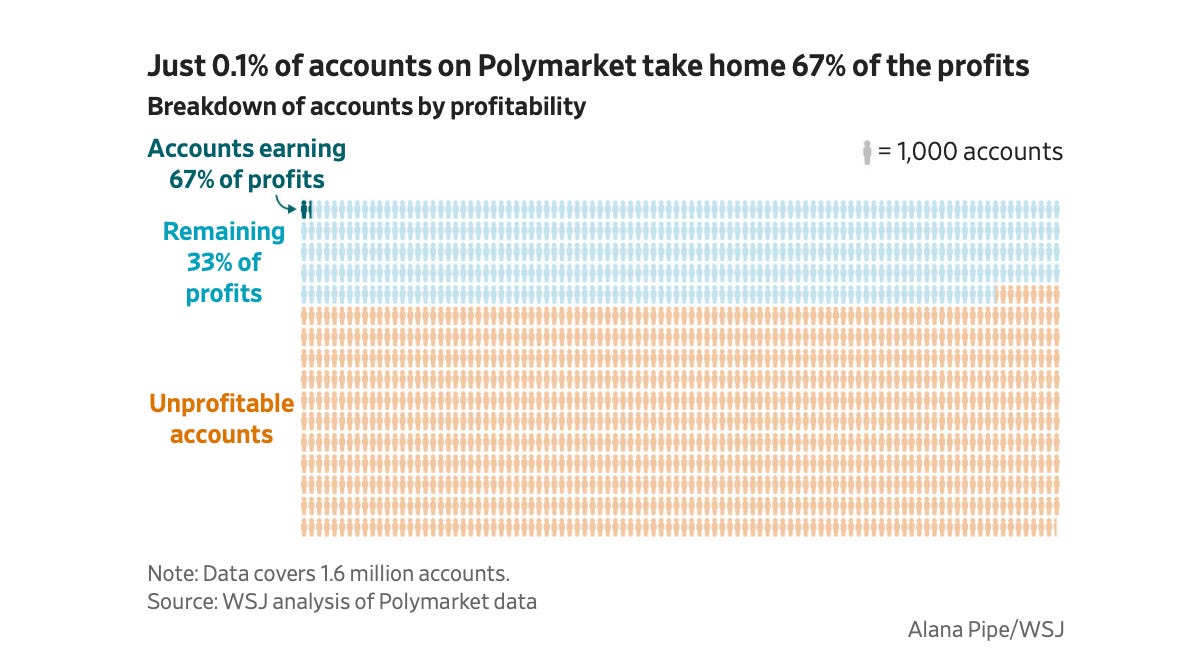
Even more incredible, the majority of accounts lose money except the top 0.1% most frequent traders.
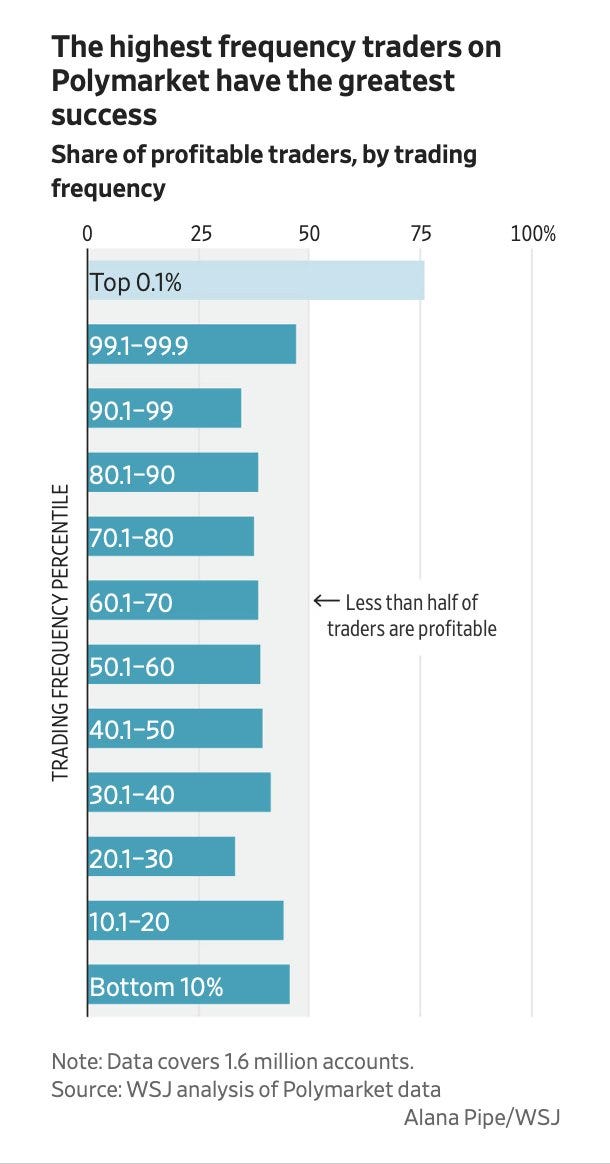
Basically, big data firms are simply preying on casual traders.
This is obviously bad for most people on the website, but good for society because these markets provide information. The big data folks being involved means the markets will be accurate, and less sophisticated traders are paying the price. It sucks for them, but it’s a free country, and in this case the externality is positive. Those with poor impulse control have always made self-destructive decisions. At least in this situation, they’re subsidizing human knowledge. Consider it the Chud Tax.
3. Ezra Klein now doesn’t think that AI will lead to mass unemployment. This is obviously correct, and I say this as someone who takes the Doom scenario somewhat seriously. From listening to Klein before, I was under the impression that he took the jobspocalypse scenario seriously, and that was concerning because he’s maybe the most influential pundit in America. But he appears to have gathered new info and changed his mind accordingly. This is a relief. Once you make policy on the basis of protecting jobs, that is the road to hell.
4. Why airlines are always going bankrupt. It’s an industry where a carrier has to be big for its existence to make financial sense, but costs are largely fixed and there are only a handful of players at a time. You’re always charging customers enough to make a profit and cover overhead costs, but then someone enters the market and supply is too high so everyone loses money. It goes around in cycles. You can’t add just ten extra seats. You either fly another route or you don’t. My question here is then why anyone would invest in this industry? Nonetheless, they do, and this is good for consumers. This helped me understand why the Civil Aeronautics Board was created in the first place. Airlines naturally then recreate cartels. Better it be done by private business than government. And airlines have also gotten creative: “Annual spending on Delta-branded American Express cards comes out to about 1 percent of US GDP.” Delta’s flights are a way for them to get credit card customers, where they actually make money. The genius of capitalism is very cool. A planner couldn’t come up with a system like this in a hundred years. This is why you should be skeptical of antitrust law and other intrusions into the market to supposedly improve competition. You simply don’t know what is economically efficient until people try stuff.
5. EU elites are starting to understand that they need to deregulate and take steps to create more of a common market. The question is whether they can overcome practical political difficulties. This is the European version of the abundance debate. Is smart people having good ideas enough to reform ossified systems with deep structural problems? Or do you need something more revolutionary? We’ll find out. It seems that between abundance and what the EU is doing, elite human capital liberals are good at realizing when what they’re doing is not working. It is yet to be seen whether they can actually reform, which will involve overcoming less sensible members of their own coalitions.
6. Two recent papers push me further in the direction of social pathologies being caused by phones.
