
In this article, I am picking a battle I am unlikely to win. Still, I feel the need to put this idea out there in the hope that it will start a ripple that leads to changes in language and social norms. While I’m fighting against something that is now deeply embedded, stranger things have happened, and I think I have a good case for why a certain societal practice has had negative consequences.
I want people to stop giving younger generations names. Except in articles like this where you deconstruct the concept, there is rarely any reason to use terms like “Generation Z” or (God help us) “Generation Alpha.” For cohort analysis, you can just split people up by the decade they were born and get all of the same benefits without the drawbacks. The names of generations used to mean something, and were applied retroactively. Today, we simply assign young people to arbitrary letter cohorts. This is pathological, and likely has had harmful downstream effects.
I asked ChatGPT to give me a table describing American generations, and this is what it came up with.
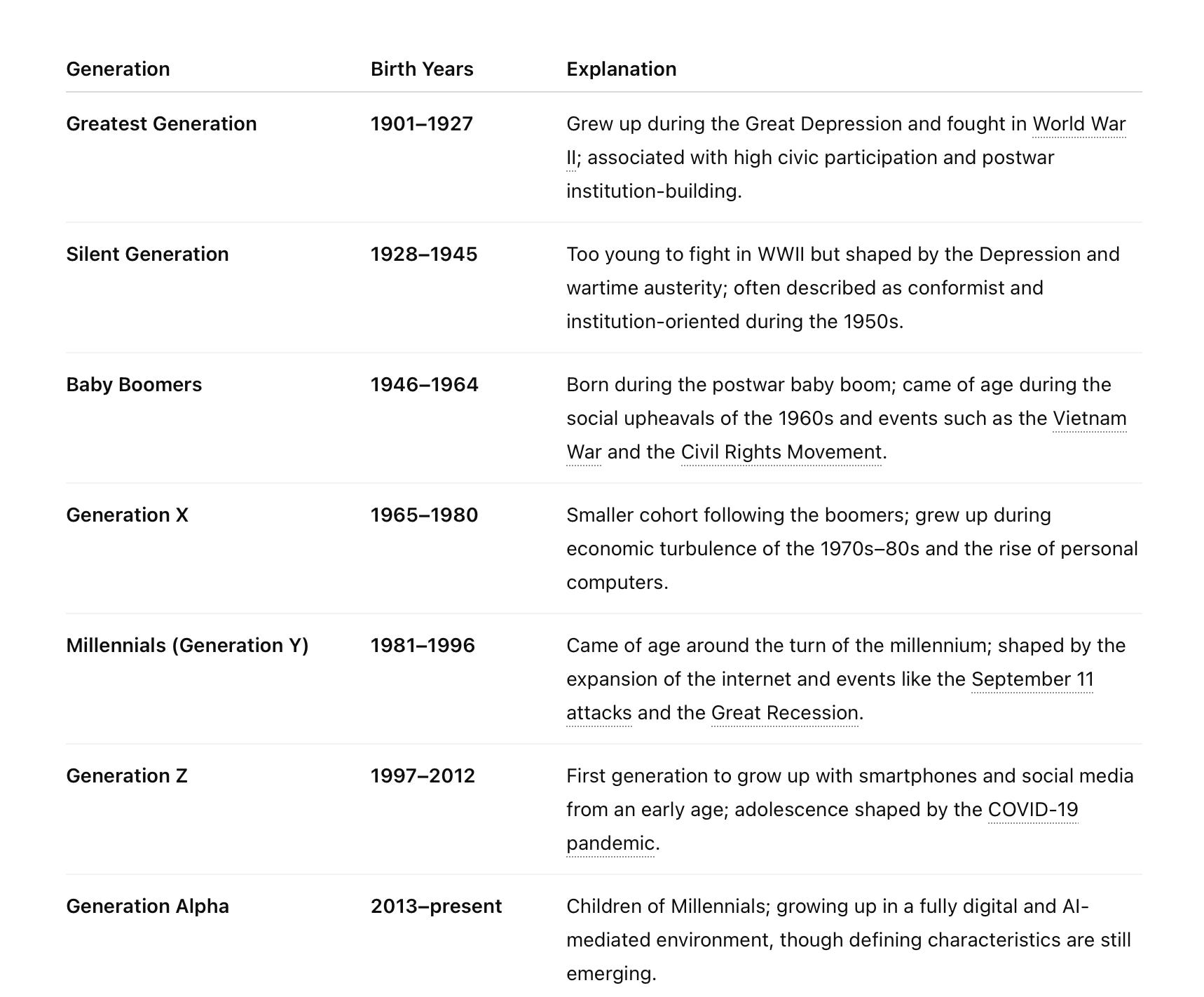
There is something strange about this list. Note that the first four are named after shared experiences. People born in the early twentieth century were “great” because they lived through the Depression and won World War II. Then came the Silent Generation and Baby Boomers. Gen X represented the idea that we didn’t know what was coming after the Boomers.
But for the last three generations, we are just phoning it in. X started out representing an unknown variable, but was reinterpreted as a chronological placeholder. We call those who came of age at the turn of the millennium “Millennials.” Then you get Gen Z as the second cohort after Gen X. Having run through the alphabet so quickly because we started near the end, we decided to start over and switch to Greek, and so say hello to Generation Alpha.
This is like if you’re having kids, and name the first two Tom and Sally. Then you call your third Octavian, because you’re a big fan of the Roman Empire. At that point, you start naming the next ones Nonius, Decimus, and so on. Octavian wasn’t your eighth kid, and Generation X didn’t get its name because it was the 24th generation since the founding of the United States. But for some reason, its label now determines what every subsequent generation is called. And this doesn’t work retroactively. If X is going to be our reference point, maybe we should change “Baby Boomers” to Generation W, and say that Abraham Lincoln was a member of Generation N or however the math works out, but no one ever suggests doing this.
The reason that generations now have generic names is we’re naming them much earlier than before. Here’s another ChatGPT chart, which lists the source or context of each label.
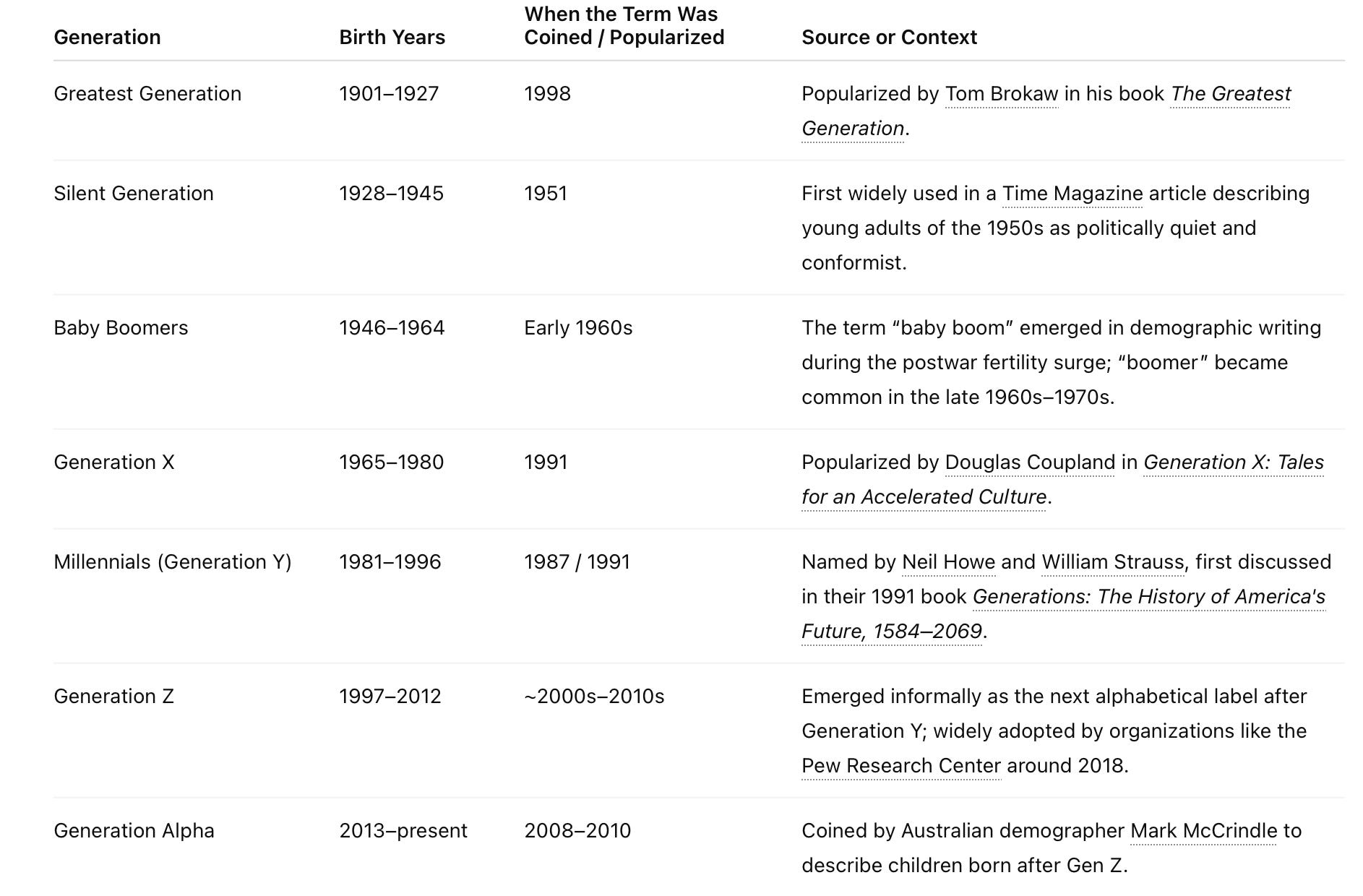
The phrase “Greatest Generation” wasn’t in circulation until all members of that cohort were at least at the cusp of old age. Even with Generation X, the popularization of the term is traced to 1991, when everyone in that group was between 11 and 26. This means that many Generation Xers reached adulthood without ever hearing about themselves as part of a specific generation. Now, we’re already talking about “Generation Alpha,” a bucket we’re going to presumably put all babies into until 2028. Here’s a Google ngrams chart demonstrating the same point.
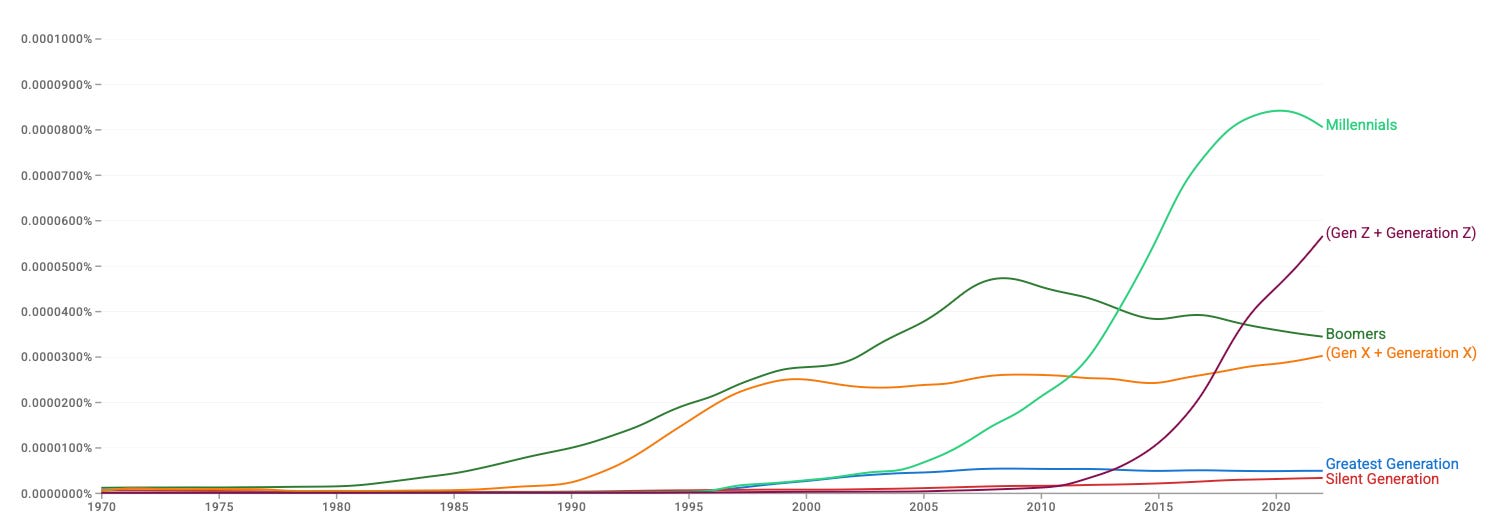
Confirming the ChatGPT analysis, almost nobody talked about Generation X until the 1990s. That’s more than a decade after the last of that generation was born. “Millennials” takes off much earlier. Meanwhile, the younger members of Gen Z were born in 2012, and at that moment Gen Z discourse was already a thing. The Greatest Generation was collecting social security when they got their label, but today Americans are already classified as fetuses. We’re naming generations so early that we have to default to letters of the alphabet since the kids haven’t even had a chance to grow up and earn designations that reflect common experiences or shared traits. Think about how lame it would be if today we were stuck referring to the men who landed at Normandy and fought through one island after another in the Pacific as “Generation U.” Or imagine the Gettysburg Address using our contemporary naming conventions:
Four score and seven years ago, Generations H through J brought forth on this continent a new nation, conceived in Liberty, and dedicated to the proposition that all men are created equal.
Now, those of us of Generations L-M-N-O-P are engaged in a great civil war, testing whether that nation, or any nation so conceived and so dedicated, can long endure. Our brave soldiers of Generation O and Generation P fought on a great battle-field of that war. We have come to dedicate a portion of that field, as a final resting place for those who here gave their lives that that nation might live.
It is altogether fitting and proper that we should do this, so that one day even those whom we shall call Zoomers may live in freedom, and the blessings of liberty will extend even beyond the Latin alphabet and into the Greek.
Beyond making everything sound ugly, I think that all of this has a subtle impact on the culture. Before we named generations, we used to talk of “young people.” A young person has certain traits that make them different from someone who is middle-aged or elderly, but there was a time that everyone was expected to reach certain milestones and graduate to later stages of life. You didn’t grow up with an identity that implied you were in the very essence of your being distinct from your parents and grandparents.
Yet when we name generations before kids have even become adults, you get something like the following process.
From a very young age, you know that you are a “Zoomer.”
People start to have stereotypes of what it means to be a Zoomer. Since Zoomers are young, these stereotypes relate at least in part to things that are universal to young people, namely being irresponsible and immature.
When Zoomers grow up, they still take the generational identity with them. A middle-aged Zoomer is still a Zoomer.
This contributes to extended childhood. Do Zoomers move out on their own, find stable careers, get married, have kids? Much less than previous generations. They’ve already internalized stereotypes about themselves that make them think of themselves forever as young people.
I obviously can’t prove this. But there’s a correlation: we started naming generations earlier, and people started growing up later. And the process makes sense to me. The real question is what we actually gain by saying “Generation Z” instead of “young people” when talking about the same group of individuals. I can’t think of many benefits. If it turns out that Zoomers maintain their traits into old age, we are free to make a retrospective judgment about that fact. Perhaps growing up during Covid or the Trump presidency turns out to have created lasting scars. Then we can start calling them “Generation Covid” or “Generation Trump” or whatever, instead of imposing the idea that they are going to grow up in a way that makes them different from previous cohorts. What we shouldn’t do is force an identity onto them, and then when things happen, peer over their shoulder going “See? See? You guys are so special and have been through SOO MUCH.”
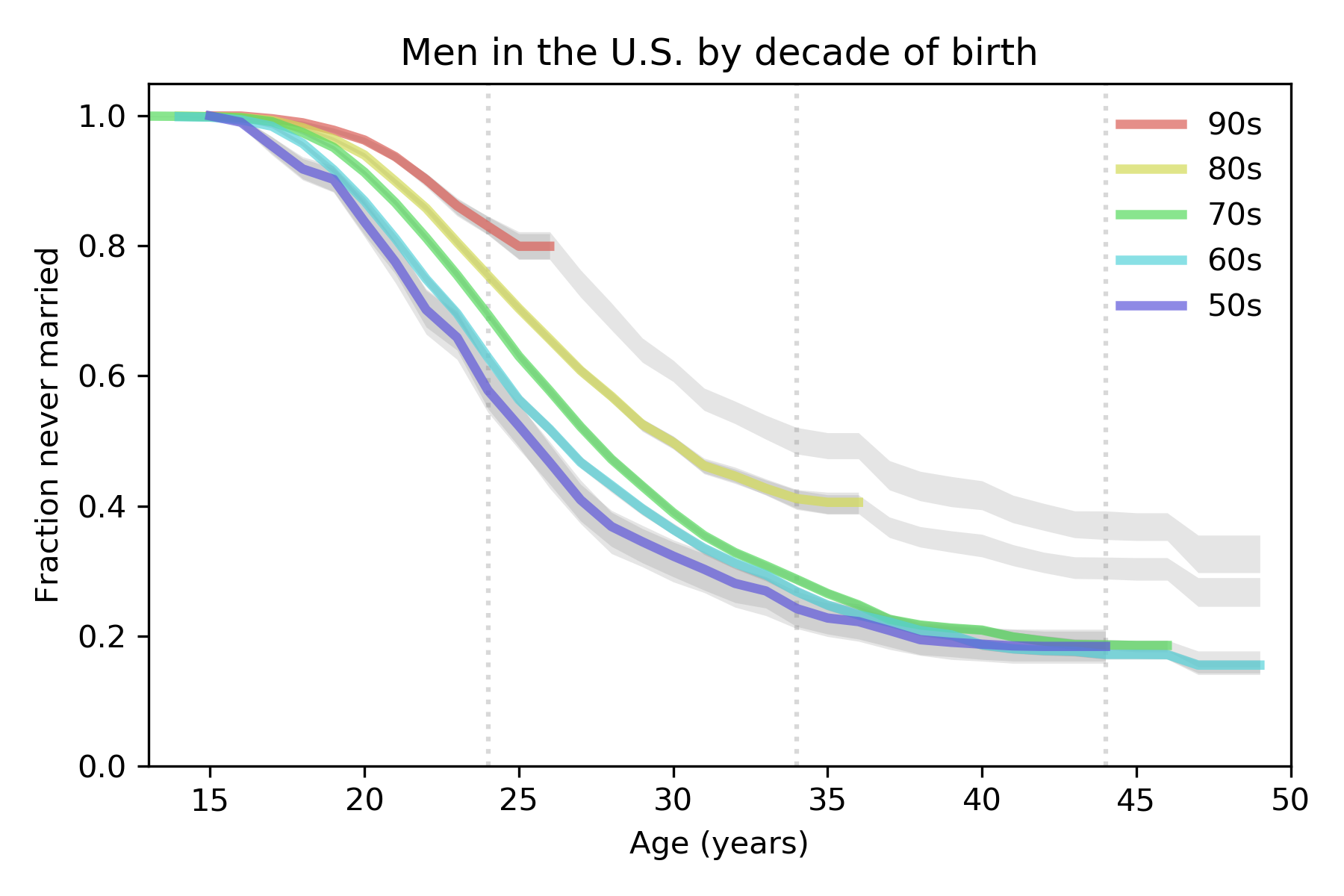
Think about meeting a thirty-year-old sometime next year. Maybe that person is considering getting married. They can ask themselves the question in one of two ways.
Is it normal and right for people to get married at 30?
Is it normal and right for Zoomers to get married at 30?
There is an important distinction here in terms of setting expectations for one’s self, along with the ones we have for other people. With (1), you are putting your experience and life situation in the context of the full scope of human history, or at least the time of your parents and grandparents, which serves as your reference point. With (2), you ask whether this is something that makes sense for someone in your generational cohort.
Of course, in 2027, we will all assume that of course “Zoomers” don’t get married at 30. No Zoomer has ever been 30 before (the same process can explain why they didn’t get married at 20 or 25, and might not at 35). And we’ve spent the last decade plus using “Zoomers” as a general term for young people. I think that even when Millennials and Gen X are well into their golden years, they will still think of Zoomers as a bunch of unserious kids. And maybe with Zoomers having set the bar so low, Generation Alpha comes along and starts to be thought of as even less mature and capable of adult living. That is, unless nominal determinism means that the name Generation Alpha increases their self-esteem. In that case, we will observe a precipitous rise in swashbuckling behavior among young men, before the next generation sees its confidence collapse as a result of always being told that they are Beta.
Instead of emphasizing what is common to the human experience as we reach different stages of life, young people now walk around with the implicit assumption that they are somehow different. When you say old people might have something to teach young people, it sounds plausible. But if you frame the same thing as a matter of whether a “Boomer” has anything useful to say to a “Zoomer,” we’ve defined people in such a way that we expect there to be unbridgeable gaps. I get frustrated when I hear young people talk about how nobody older can understand their dating or financial struggles. I think it’s in part that they’ve been taught their whole lives that contemporary adults grew up in a social context that was too divorced from their own to provide any insights. So if I say that some young man should stop acting like a loser and just approach women, they’ll act like this is impossible, as if human nature has completely changed and even basic lessons of evolutionary psychology – like things as fundamental as men care more about looks than women – have been completely invalidated by recent technological and social changes.

It’s deeply annoying, and I’ve observed that the more that people latch on to generational analysis, the more self-pitying and conspiratorial they are. When I hear someone talk about their experience as a Zoomer, it’s usually a red flag, like when someone centers their racial background in a discussion of how they view the world. I expect to soon hear about how hard their life is and how they lack the ability to improve it due to forces beyond their control. As with all forms of identity politics, focusing on generations leads to judging arguments by the traits of the speaker, and elevates “lived experience” over logic and empirical evidence.
A New York Times headline from last Thursday reads “‘It Feels Like There’s No Jobs’: 12 Gen Z Voters on the U.S. Economy." It’s obvious to me that as soon as the report is framed as Gen Z talking about its experiences, we know that the spin is going to be negative. The connection between the labeling of identity groups and the culture of victimhood is so strong that if the narrative were positive, it would be more natural to use a different term to refer to those being profiled.
Classifications have their own way of becoming self-fulfilling prophecies. I’ve previously discussed how terms like “Asian American Pacific Islander” and “Hispanic” were used as government categories before being adopted in the wider discourse. Once the state divides people into groups and distributes advantages on that basis, the relevant labels acquire cultural resonance. We are not even giving kids a chance to grow up before putting into their minds the idea that everything they experience will be different from all that came before. Of course, each generation does face new challenges. But we are biasing the way we view the world by deciding ahead of time that each cohort is going to experience something so unique that it needs its own label. This reinforces young people’s natural tendency toward self-absorption and creates a psychological barrier that prevents them from benefiting from the accumulated wisdom of previous generations.
And consider the arbitrariness with which we do this. For some reason, we have settled on sixteen-year intervals, maybe to accommodate our shorter attention spans as we seek out new things to talk about. I was born in 1985, and so I’m supposed to have more in common with people born in 1995 (“fellow Millennials”) than in 1980 (Gen X). But there’s no reason why that should be the case. I’m old enough to have gone through most of my formative years without the internet. This must have created a very different experience from that of the youngest millennials.
I actually didn’t find out what generation I was until Gabriel Rossman told me a few years ago. I’d always been so allergic to generational analysis that I refused to learn exactly where the lines were. My assumption was that I was Gen X, because that was the cohort people talked about when I was growing up in the 1990s. Had I known that I was a Millennial, perhaps I would’ve turned out much more emotionally fragile and lived up to that stereotype, or even gone gay.
Imagine if we taught history in this way. Maybe we decide that it should be understood as occurring in twenty-five-year intervals. So we talk about 1926-1950, 1951-1975, 1976-2000, etc. Instead, we discuss events thematically – the Protestant Reformation, the Enlightenment, the Cold War, etc., – since that is the best way to gain an understanding of what is important. The Boomers, the final generation not to span the now-standard sixteen years, were named according to a demographic trend that we could bracket as it was nearing its end. This one made sense, because large families create a different kind of society than one where more people go childless or stop at one kid. But as people were living through it, they just considered this the norm. They had no way of knowing that America would not stabilize at a TFR of 3-3.5 indefinitely, and the uniquely family friendly and pro-natalist culture that the United States enjoyed in the postwar years could only be appreciated once we saw what came next.
There isn’t any grand conspiracy behind generational naming conventions. This is something we’ve just lazily slid into without giving it much thought, as society has turned more toward therapy culture, identity politics, and navel gazing. We choose time periods like 1981-1996 because they appear to span a multiple of five years, without stopping to notice that they actually cover sixteen – which seems even more senselessly random.
I hope to convince people that this has all been a mistake, and instead of using letters to refer to people born during arbitrary sets of time, we should just talk about “kids,” “young people,” “teenagers,” etc, the way everyone did before the early aughts. When discussing the past, we can always look back and decide what was noteworthy in the formative years of any particular cohort of Americans, and where exactly we should draw the lines. But I see little evidence that imposing arbitrary generational labels prospectively has much benefit, and good reason to believe that it prolongs adolescence and creates unnecessary barriers to understanding between Americans of different ages.
"Generation L must study politics and war, that Generation M have liberty to study mathematics and philosophy. Generation M ought to study mathematics and philosophy, geography, natural history and naval architecture, navigation, commerce and agriculture in order to give Generation N a right to study painting, poetry, music, architecture, statuary, tapestry and porcelain.” - John Adams
The real problem is the one you get to late in the article: "generations" are something that exists in families, not populations. The reality is everyone has their own age cohort that includes everyone within a few years of them younger and older.