
Before I figured out women, someone told me that to have a girlfriend I needed to find someone I had things in common with. This made me sad, because I had never met a woman like me. If I did meet one, odds are I wouldn’t be attracted to her, since I am very annoying. I didn’t have a lot in common with men either. But everything about the way women viewed, experienced, and interacted with the world was especially foreign. If commonality was the basis for forming relationships, then my situation was truly hopeless.
This was of course wrong. I eventually found my way not by becoming more like women, but leaning into what was particularly male about my personality: willingness to break taboos, obsession with work at the expense of cultivating relationships, arrogance and defiance in the face of social pressure to conform, boldness in social interactions. The original “red pill” when it came to dating advice from the early 2000s was that many of the things we tell ourselves about relationships between the sexes are false. I’ve come to distrust the entire red pill mindset as applied to politics and life more generally, as it leads people in stupid directions on a wide range of issues. But I think that in this particular case, mainstream discourse is actively misleading.
Perhaps I took the advice about finding someone who was similar to me too literally. This goes back to anti-woke as a form of autism, where you hear the things people say due to social desirability bias and come to believe that they reflect underlying reality. But as I observe what has gone wrong in relations between the sexes, it seems that society is increasingly taking false beliefs and making them the basis of laws, norms, and social judgments. As is often the case, although our day-to-day behavior is more consistent with human nature, political and social attitudes are determined by what sounds good, and while it makes sense for every individual to adopt their views in this way, the net effect on society as a whole can be harmful.
In recent years, I’ve written about what seem like mostly independent phenomena relating to the ways society gets sex wrong. These include:
Opposition to age gap relationships
The taboos on dating at work
The injustice and utter depravity of putting women in jail for having sexual relations with teenage males
I’ve come to realize that there’s a general theme that ties all of these things together: Society is trying to make heterosexuals into lesbians.
In pornography and male fantasies, lesbians are feminine and attractive, performing for the male gaze. In real life, they’re often frumpy and de-sexualized. Long-term lesbian couples will have similar personalities, mannerisms, interests, and behavior. In contrast to male homosexual communities that become obsessed with physical appearance, lesbians will let themselves go since attractiveness matters less to their partners, and form attachments based on a holistic appreciation of the individual.
Male-female differences in partner preferences have been shown to apply to homosexuals. Klümper et al. (2023) surveyed LGB users of a German dating website and found that, like their heterosexual counterparts, among homosexuals men cared more about looks than women. Lesbians were most likely to value someone who was like-minded, heterosexual women came in second on this measure, and gay and straight men were further behind. Of eleven different traits that one might want in a partner, sex was a statistically significant predictor for each of them, while sexual orientation was only statistically significant for four, with gays caring more than heterosexuals about finding someone who is adventurous, wealthy and generous, and approachable, and less about whether a partner is child-friendly.
Overall, gay men still have the same kinds of preferences as other men, and lesbians still have the preferences of women. I suspect surveys if anything underestimate sex differences, because social desirability has a role to play. A lot of men probably don’t want to admit how much they care about looks, and how much they just want a wide range of short-term sexual partners.
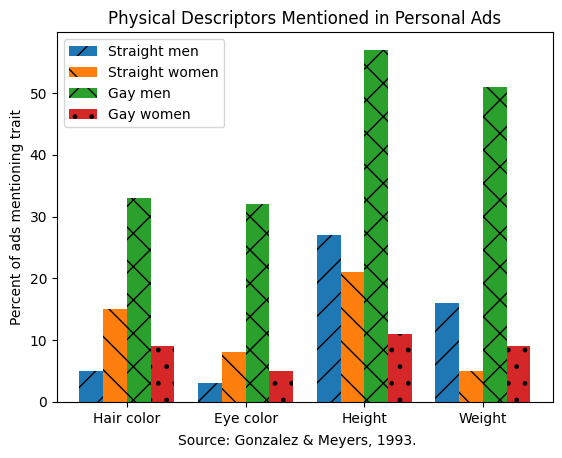
Revealed preferences seem to show much larger male-female differences than survey data. For example, in one 1993 study, the authors analyzed a random sample of newspaper ads for males and females, gays and straights, from four American cities. Gay men were by far the most likely to mention physical traits, and lesbians were the least. When each sex is left to its own devices, individuals can more fully indulge their true preferences.
Likewise, I’m not aware of any research on this, but I suspect that if you polled people on frequency of pornography consumption, male-female differences in how they respond would be much smaller than what you would find in consumer behavior.
The culture of lesbianization involves taking the female-female model of romance and, through cultural pressure and sometimes legal persecution, forcing it onto heterosexuals. The only true kind of romantic attachment is said to be based not on “superficial” characteristics like looks, money, or status. Rather, people should only be attracted to others based on things that are “real,” namely intelligence, personality, personal compatibility, and loyalty.
The problem is that heterosexual attraction doesn’t work like this. Men like youth and beauty; women like status, money, and power. We build friendships based on common interests and personality compatibility. But romantic attraction operates according to a different module in the brain, although there is of course some overlap. Often a woman will like a man precisely because he has a lot of money, has had worldly success, or even because he is in a position of authority over her. There are good evolutionary explanations of this, and the relationships that are formed on such grounds are not any less real or valuable than others. Men will, in contrast, like women because they’re young and attractive. Heterosexual attraction depends on complementarity and difference.
Trying to remove power disparities in heterosexual relationships is as misguided as working to eliminate them in the economy. If you’re going to have a rule that says no one should be allowed to become too rich because you worry about power differentials, the more seriously you take that approach the less of an economy you will have in the first place. Too much concern with equality will stand in the way of any attempts to redistribute resources to the poor and make them better off, because there will be little to redistribute.
Socialism sounds better than capitalism, but socialist principles are based on false beliefs and therefore lead to failure, while capitalist assumptions accurately describe the world. Likewise, Americans today may see lesbians as more enlightened in their romantic preferences than heterosexuals, but trying to make heterosexuals into lesbians just means you’ll have a lot fewer heterosexual relationships.

The quest to remove power differentials in sex is even worse than trying to do the same in the economy. I want to associate with Amazon not because it has power per se, but because it can bring a wide range of goods to my house quickly and cheaply. Power is simply a byproduct of Amazon’s success. Yet a power differential is often the very source of sexual attraction. You can’t get around this. A dislike of power differentials in romantic relationships always turns into problematizing some of the most prominent aspects of heterosexuality.
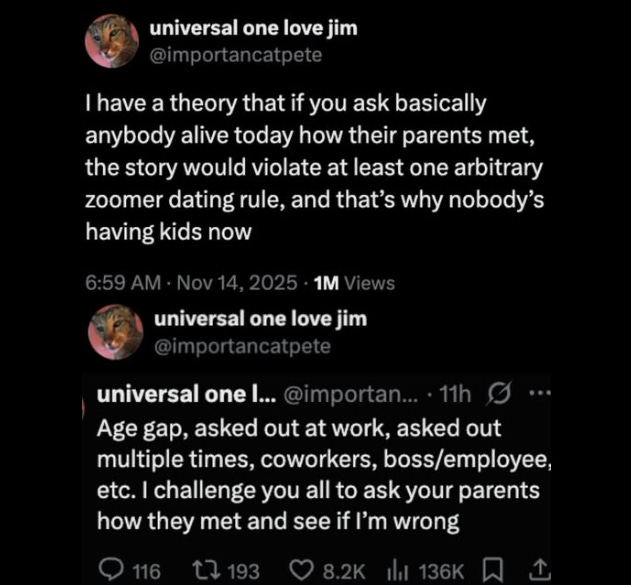
The lesbianization of heterosexuality would perhaps not be so bad if people were still pairing up and having children, which would mean we could be picky about which kinds of relationships we thought were deserving of social approval. But they’re not, and we need to be encouraging as much coupling up as possible. For nations with sub-replacement fertility to find new forms of heterosexuality to denounce and stigmatize is like a country experiencing a generation-long depression doubling down on going to war with the profit motive. Here’s a tweet that went viral a few months ago on how almost every relationship that formed in past generations would violate some arbitrary Gen Z rule about how couples are supposed to pair up, like no approaching people at work or having age gaps that are too large. This can be confirmed by checking out a wide range of books and movies made before the last few decades.
I suspect that there are some women out there who simply cannot be attracted to men who are equal to them in social status. They may need to find men who are more established and have had some success in life in order to have any romantic attraction at all. Talking to women, I’ve found that there is a wide range of feelings on this, from “Of course I only like guys who are rich/older/more successful” to “Ew Epstein is GROSS!!!” But in the marketplace of ideas, women who are hostile to what is seen to be a more transactional model of relationships are more likely to make their voices heard due to social desirability bias, and probably would be more inclined to write books and think pieces about their views even in its absence.
But I’m pretty sure that educated people in the modern West vastly underestimate the degree to which fellow humans prefer more transactional romantic relationships, or the degree to which they can be advantageous for all parties involved. Some societies take these things for granted. In more traditional cultures, for example, you might hear a young woman told that she should lock up a desirable husband while she still has her looks, and this only sounds awful to those of us who have been taught our whole lives that it is immoral to think in such terms.
I’m a bit puzzled sometimes when I see an attractive young woman working a low-wage job, and it makes me think of men I know who earn six- or seven-figure salaries who have had no luck in their romantic lives. I believe that there’s a failure in the dating market when older high-income men are not pairing up with attractive, lower-income women, and that such couples would be a lot more common if people weren’t pressured into believing that romantic relationships are only acceptable if they’re based on both sides having equal status on every significant dimension.
Our judgments are interwoven with class dynamics. Men who go all in on youth and beauty as criteria are seen as Donald Trump and Jeffrey Epstein types. Someone like Donald Trump is of course too shallow to have any kind of real relationship with anyone, so romantic partners just exist for sexual gratification and as a reflection of his greatness. Men who are more reflective in their outlook with upper-class sensibilities are more likely to actually want someone who is more intellectually and emotionally equal. And that’s completely fine! We just shouldn’t be stigmatizing relationships in either direction.
Partly the class difference in what men want from women reflects a selection effect, where society stigmatizes relationships with large power disparities, so men who break that taboo are willing to break taboos in other ways too. Again, Trump and Epstein. But I do think that this is one of those things where liberalism is correct, and we need to be nonjudgmental regarding how adults live. The societal interests here are making sure that people pair up and have kids, and also that they gain the benefits that appear to be correlated with, and maybe caused by, being married. Society does not have an interest in all heterosexual relationships living up to lesbian norms.
I think that the Clavicular phenomenon represents the flip side of the coin of lesbianization. Looksmaxxing teaches that heterosexual relationships most naturally operate according to the preferences of men. Just as female beauty is the primary thing that matters when it comes to women seeking heterosexual partners, men are judged by who mogs. When I was growing up and young males went online to get advice, the red pill dating gurus they found focused very little on looks and much more on behavior, confidence, and personality. I feel lucky to have been born during this era, which I think gave men much more realistic advice, so I spent my youth trying to improve my personality instead of smashing my face with a hammer.
Part of this shift was probably the rise of dating apps, where looks became more important because your picture had to reach a certain threshold to stand out from the large numbers of men who would be constantly bombarding any semi-attractive woman with a profile. But the other factor related to the digital realm conquering real life is that young people just started socializing less and ended up with poorer models of human relationships and how they work. Men and women stopped understanding each other and began to theorize about relationships in gender-segregated spaces. So women and feminized institutions decided that heterosexuals were lesbians, while male and non-mainstream spaces decided they were gay men. The incel movement is the pessimistic version of the heterosexuals as gays philosophy, while Clavicular and looksmaxxing represent a more agentic version. But the underlying assumptions are the same. Andrew Tate, a generation older than Clavicular, is a throwback to the previous red pill culture, which formed in the earliest days of the internet when real-life interactions had a much larger role in shaping people’s understanding of the world.
To talk about the lesbianization of heterosexuality does not mean that society necessarily treats men and women as equal in every way. Jeffrey Epstein used adult women – setting aside the at most tiny minority who weren’t of legal age – for companionship and sex. But the women just as much relied on their assets to use him for money, fame, and access to a good time. These were straightforward transactional relationships, but they’re now seen as one-sided exploitation. A more ideologically consistent form of lesbianization would condemn both parties. But feminist hypocrisy also gets a seat at the table, so we only denounce men for using whatever advantages they have in pursuing desirable romantic partners.
It’s probably unhealthy to give every man social carte blanche to indulge his inner Jeffrey Epstein. But we need some realism too. Yes, men will like younger women, and women will like older men who have power over them, whether it’s because they are wealthier, higher status, or have a position of authority. If this is the basis of individuals pairing up, finding companionship, and ultimately forming families, this is both consistent with human nature and good for society. The dividing line between “real” relationships that depend on commonality and ones based on superficial or problematic forms of attraction is rooted in a fundamental denial of the preferences of large portions of humanity. We have screwed up heterosexuality through the idea that we need to minimize power disparities in relationships. This is yet another instance of the harms that are caused when things people start off saying they believe due to social desirability bias eventually come to be taken to reflect the way the world actually works.
Rich men like being rich and they choose ambitious women with good careers. They have ample opportunity to choose hot waitresses, but they don't! Revealed preferences show that women choose men around 2-5 years older than they are; very few women want much older men. Revealed preferences show that wealthy men want wealthy women. Ambition wants ambition.
i agree with the article 100% but you have to acknowledge that at least wrt gen z men and women are equal status-wise (with women sometimes surpassing men; college enrollment, employment, thanks to affirmative action) This means that even if we were to normalize the idea of transactional relationships again it would do nothing against the loneliness epidemic or TFR. I think this is the real reason for looksmaxxing phenomena, the men have nothing else to attract women with so all they have left is looks.