
Last month, I had a discussion with Jesse Arm about Ezra Klein and Abundance liberalism on the CSPI podcast. We got together again this month to talk about his recent focus group with 20 Gen Z Republicans. I posted it on X, so check it out there if you’re interested.
I was in a symposium in The Free Press responding to the viral article by Jacob Savage on DEI harming white men. I say yes, take the issue seriously, but the data shows that white men are still doing pretty well, because markets are too rational and efficient to ever let things get too out of hand across the entire economy. You like fairness, opportunity, and merit? Protect capitalism, and any interference with those principles will be limited in its effects. Things get really bad when standards are subjective or market mechanisms are weak, which is the case in the arts, journalism, and academia.
Below the paywall, you’ll find my review of Ken Burns’ new documentary The American Revolution, along with links and discussions on Charlie Kirk’s sort-of successor on Ross Douthat, the coming Trump presidential library in Miami and what it tells us about 2028, the recent struggles of Las Vegas, why cancel culture might be necessary in Russia, Richard Spencer’s interview with Nick Fuentes, and more.
Finally, for those who missed it, my new book on populism is coming out in July. My 2025 year in review and a discussion of the book can be found here.
1. Elephants and bats live a long time in part because they don’t get cancer. This article explores the possible mechanisms involved. TP53 is a gene that encourages cancer cells to die. Humans have one copy, elephants have 20, and long-lived bats have up to seven.
Can we just add these genes to humans?
Unfortunately, elephants’ multiple TP53 copies are closely integrated into the elephant immune system and DNA regulatory system. Managing to get the same working in, say, mice, would require a ton of work to integrate these copies into the mouse immune system and DNA regulatory system. This is, as far as I know, currently beyond the capabilities of genetic engineering.
Maybe one day.
2. Recently, I was at a Barnes & Noble and saw Jack Weatherford’s The Secret History of the Mongol Queens on the shelf. Having enjoyed the author’s biography of Genghis Khan many years ago, I picked it up and started reading, and ended up buying the book. It starts with a mystery.
ON AN UNKNOWN DAY LATE IN THE THIRTEENTH CENTURY, an unidentified hand clumsily cut away part of the text from the most politically sensitive section of The Secret History of the Mongols. The censored portion recorded words spoken by Genghis Khan in the summer of 1206 at the moment he created the Mongol Empire and gave shape to the government that would dominate the world for the next 150 years. Through oversight or malice, the censor left a single short sentence of the mutilated text that hinted at what had been removed: “Let us reward our female offspring.”
In the preceding section of the text, Genghis Khan bestowed offices, titles, territories, and vassals upon his sons, brothers, and other men according to their ability and contribution to his rise to power. But at the moment where the text reported that he turned to the assembly to announce the achievements and rewards of his daughters, the unknown hand struck his words from the record. The censor, or possibly a scribe copying the newly altered text, wrote the same short final sentence twice. Perhaps the copyist was careless in repeating it, or perhaps the censor deliberately sought to emphasize what was missing or even to taunt future generations with the mystery of what had been slashed away.
Well, that’s certainly intriguing. Genghis Khan was woke on the woman question, but his misogynistic offspring and other Mongols wrote the daughters out of the story. Weatherford tries to piece together what we know about powerful Mongol women, from the time of the rise of Genghis Khan up until the rule of Manduhai (b. 1449). The next two hundred plus pages are filled with colorful stories about the heroic feats and follies of exotic queens and members of the royal family.
There are two stories I want to highlight that changed the way I see history, and made me much more skeptical of how much we can possibly know about much of anything before the last few centuries. First is this on Khutulun (1260-1306), the great-great-grand daughter of Genghis Khan, who we are told fought alongside her father, Qaidu Khan.
Khutulun followed an unorthodox method of confronting the enemy. She rode to the battlefield at her father’s side, but when she perceived the right moment, in the words of Marco Polo, she would “make a dash at the host of the enemy, and seize some man thereout, as deftly as a hawk pounces on a bird, and carry him to her father; and this she did many a time.”
Her romantic life was supposedly even more interesting than her battlefield heroics.
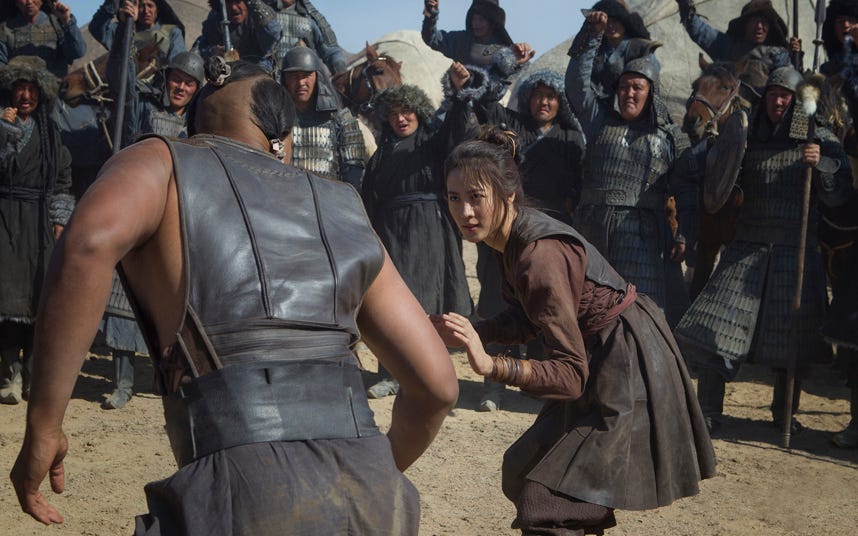
As accustomed as the Mongols were to seeing women on horses and shooting arrows from bows, no one had seen a woman who could wrestle as well as Khutulun could. According to Marco Polo, the independent princess refused to marry unless a man could first defeat her in wrestling. Many men came forward to try, but none succeeded. In order to wrestle her, each opponent had to wager ten horses on a bout, and thus she substantially increased the size of her herds. Her parents became anxious for her to marry, and so, around 1280, when a particularly desirable bachelor prince presented himself, her parents tried to persuade her to let him win. He was “young and handsome, fearless and strong in every way, insomuch that not a man anywhere in his father’s realm could vie with him.” He brought with him a thousand horses to bet on his victory.
A crowd gathered for the match that was held in front of Khutulun’s parents’ court. It seems that with the hope of pleasing the parents whom she loved so much, Khutulun wanted to let the prince win. That resolve melted, however, in the rush of excitement when the match began. “When both had taken post in the middle of the hall they grappled each other by the arms and wrestled this way and that, but for a long time neither could get the better of the other. At last, however, the damsel threw him right valiantly on the palace pavement. And when he found himself thus thrown, and her standing over him, great indeed was his shame and discomfiture.” She not only defeated but humiliated him, and he disappeared, leaving behind the additional thousand horses for her herd.
In tennis, there’s a long history of “battle of the sexes” type matches, and the lesson is that you have to get pretty far down in the male rankings before the best female players have a chance. The sex gap in wrestling must be much more extreme. And here we are told that a woman could constantly pin a long line of hardened warriors!
The second woman who sounds too tough to be real is Manduhai. We are informed that she produced ten children: two with a previous husband, and eight children with Dayan Khan, including three (!) sets of twins.1 Quite impressive before IVF.
