
I think that libertarianism is generally closer to the truth than any other political philosophy held by a substantial number of people. It is also the case that libertarianism attracts a lot of individuals inclined toward grifting, conspiratorial thinking, bigotry, and authoritarianism. For example, Angela McArdle, until recently the chairwoman of the Libertarian Party, is basically a right-wing culture warrior, down to her full embrace of what ICE has been doing in Minneapolis, and rantings about the Epstein files.
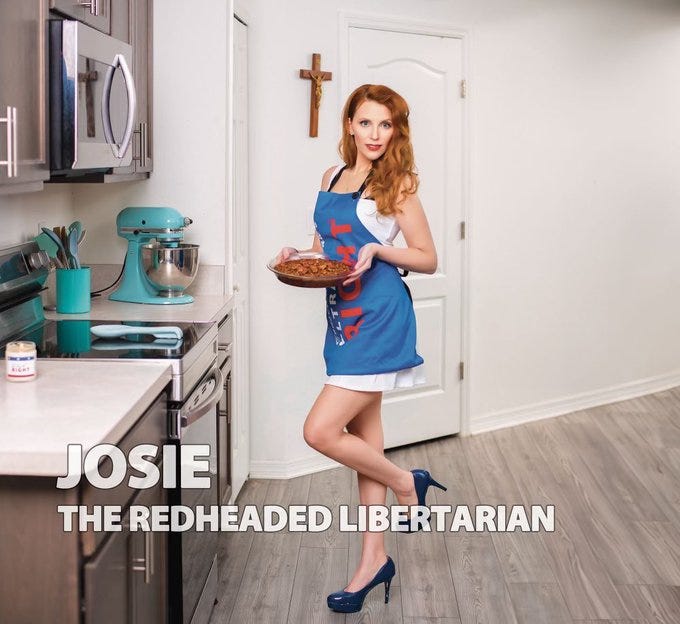
The Mises Caucus, a faction of the Libertarian Party as far as I can tell, has over 150,000 followers on X. It often posts about Pizzagate and the deep state stealing elections. It’s basically a nonstop firehose of based signalling and MAGA nonsense. There’s also a major influencer named “The Redheaded Libertarian,” who spends more time showing cleavage and talking about the crimes of pedophile elites than the ways in which prices allow for an efficient distribution of resources through the aggregation of information.
Compare these figures with libertarians at the Cato Institute or in the economics departments of places like the University of Chicago and George Mason University. We can divide libertarians into two categories: elites and populists. Compared to their populist counterparts, elite libertarians tend to be more socially liberal, less favorably disposed toward foreign dictatorships, non-conspiratorial in their thinking, and anti-woke when it is tied to statist projects but less horrified by tolerance as a cultural phenomenon. Not all populist libertarians are influencers. One might put Hans-Hermann Hoppe in this category for claiming to have put together a case for restrictive immigration policies based on libertarian principles. He’s also written a book on how democracy has failed to protect individual rights. Ironically, populist libertarians are more likely to be explicit defenders of authoritarianism, even though their ideas have very little appeal among elites, while elite libertarians are more attached to democratic norms and processes.
Most libertarian-leaning members of Congress, or those who talk about liberty in classical liberal terms, can also be considered populists. The Freedom Caucus, which on paper at least organizes around the idea of cutting spending and smaller government, puts its weight behind funding DHS and protecting ICE agents from scrutiny or legal accountability. It recently called on Trump to invoke the Insurrection Act “if Democrat-run Sanctuary Cities continue enabling Communist agitators assaulting ICE and federal law enforcement.” No matter what you think of this position, it is difficult to see how being on the side of the administration in its draconian vision of immigration enforcement and contempt for constitutional rights lines up with a strong commitment to limited government. If you believe these positions are consistent, let me also note that members of the Freedom Caucus were among the most enthusiastic members of Congress acting in support of Trump’s 2020 coup attempt. No reasonable person can argue there’s a consistent through line that in ideological terms unites small government, anti-immigration, and lying about a stolen election. From my perspective, I see the Freedom Caucus being correct on some economic issues, taking views inconsistent with any individualist philosophy on immigration, and then on the 2020 election engaging in a naked authoritarian power grab.
Not every member of the Freedom Caucus has gone along with Trump’s authoritarianism and election denial. But those who didn’t in years past became outcasts. One such example is Justin Amash, who was a founding member of the group but then resigned in 2019 after saying Trump had committed impeachable offenses. Given that he has no more role to play in Republican politics, this is a classic case of an exception proving the rule. The stolen election stuff is pretty much the purest instance of an integrity question one can find, since there are no ideological grounds on which to tell blatant lies about 2020 and try to overturn American democracy on that basis.1 And on this moral test, politicians with libertarian-leaning views on economics failed worse than practically any other congressional faction.
These are two very different tribes, and it’s an interesting question of how they can both identify with the same political label. What exactly does the Cato Institute or George Mason University have in common with “The Redheaded Libertarian”? To put it another way, how does a philosophy that prioritizes nonaggression and individual liberty above all else so often end up represented in politics and the media by collectivists and authoritarians?
I think that the explanation goes something like this. Very few people understand economics or the case for free market positions on most things. They only know that economic collectivism sounds good and capitalism sounds bad. Most psychologically normal human beings support the thing that sounds good over the thing that sounds bad, so they become anti-market. This describes most leftists and centrists.
Yet some people are into vice signalling. They want to convey that they do not suffer from pathological altruism, and are willing to do what it takes for the long-run future of their country. When they hear leftist propaganda about how capitalism allows a small, select group of elites to monopolize resources, keep marginalized groups in their place, and dominate the rest of society, they say “that sounds great, sign me up!”
If we’re being charitable, we could say that such individuals are not vice signalling, but instead signalling that they hold to a different set of virtues than most people. But I think the key to this crowd is that they are inclined toward “harder” virtues that are in practice difficult to distinguish from vice, like willingness to inflict suffering for a cause. The intellectual who is into libertarian ideas understands the arguments of Hayek and Friedman, and perhaps looks at empirical data showing that the US has been growing faster than Europe over the last several decades, which can in part be attributed to freer markets. The Tennessee congressman who riles up his high school educated constituents by talking about how we need to hang some pedophiles gets to many of the same positions because he sees small government as a way to express disdain for poor minorities.
I believe that the free market position on most economic questions is the correct one. So people who are intelligent, have good epistemological standards, and care about truth – a very small minority – will support capitalism for intellectually defensible reasons. Yet there are a lot more vice signallers (or “hard” virtue signallers) out there than good-faith rationalists. Thus, a large portion of any libertarian movement, unless it does a lot of gatekeeping, will be overrun by conspiracy theorists and misanthropes. And when libertarianism builds a mass following – whether reflected in the success of major influencers or elected politicians – it will be within a vice signalling framework.
If you’re a vice signaller, libertarianism is far from the most natural ideology for you to adopt. Most such people across history have gone for straight authoritarianism, rather than an ideology that is accused by its critics of being authoritarian but in practice grants a great deal of individual liberty. In the American context, vice signallers have flocked to libertarianism because historically elites in effect took more fascist-adjacent ideologies off the table.
With the democratization of the discourse, those with a taste for authoritarianism can go for the real thing instead of the classical liberal substitute. When Andrew Kolvet of Turning Point USA was on Ross Douthat’s podcast recently, the number one position he advocated for was an immigration moratorium. When Douthat asked him what else he wanted, Kolvet started talking about housing. He said we needed to build more, and also brought up large corporate investors buying residences. I was fascinated that he went straight for a statist solution to the cost issue rather than a free market one, especially given that even some on the left have come to acknowledge the primary role that land use restrictions play in making housing unaffordable. This demonstrates, I think, just how naturally disinclined modern rightists are toward any policy program that relies on increasing liberty, unless it is coded in culture war terms, meaning that it helps someone considered to be part of their tribe like gun owners or fundamentalist Christians.
Elite and populist libertarianism have fundamentally different projects. Elite libertarians understand that the masses are against them, and seek to build a coalition of the highly educated in order to implement a minoritarian agenda that will make society better. Populist libertarianism believes that the people are on their side, or at least can be tricked into joining them, and want to mobilize the masses against elites. In some ways, they’re right, since xenophobia and conspiracy theories are much more popular among the public than they are in elite circles. To be fair, populist libertarians are not complete statists, and will take their ideology seriously to a certain extent. The Freedom Caucus, after all, remains in favor of lower taxes and less top-line spending. But when libertarian ideology conflicts with right-wing culture war preferences – see topics like immigration and support for Trump – they play the role of enthusiastic soldiers in a coalition dominated by right-wing values and tribal loyalty. Ultimately, elite libertarians are driven by ideas, while populist libertarianism is a strategy for gaining a large audience and a mode of emotional catharsis for those angry at the world.
Most populist libertarians are not thoughtful enough to make good arguments on this, but there are ways to defend their ideology and approach to politics on pragmatic terms. Most of the public does not care for free markets or individual liberty, so the only way for libertarians to have any voice in politics is to act as an appendage to one side of the culture war. Conservatives may dislike markets as much as liberals, but it is the left where you find the true committed anti-market ideologues. Therefore, dabbling in Epstein conspiracy theories and anti-immigrant scapegoating is the only practical way to defeat the left, which is what matters. As evidence, look at how much better conservative run states have been doing over the last several decades. Republican messaging has been aimed at the chuds in the middle of the country, but because libertarians are part of the coalition, this has meant that where conservatives have power we see greater growth and more individual liberty.
I think that this argument worked until 2025, at the latest. In a previous generation, conservative elites would use culture war issues as a mobilization strategy but often end up governing in a reasonable, pro-market direction. Trump succeeded as a political entrepreneur in part by realizing that the Republican voter cared little for the issues that have traditionally animated conservative intellectuals. Parallel with Trump’s political dominance of the party has been the rise of the postliberal intellectual movement, which advocates more statist positions on issues like trade, immigration, and labor unions. Running on chuddery but governing in a generally pro-market direction was a balance that the Republican Party was able to pull off throughout approximately the period from the rise of Ronald Reagan to the beginning of Trump’s second term.
The populist takeover of the Republican Party has broken that alliance, and the second Trump administration now has little to offer libertarians and classical liberals. Vance, who pals around with postliberals and takes their ideas seriously, offers even less, and, if he becomes president, will likely complete American conservatism’s turn away from individual liberty as a guiding principle. Populism as a mobilization strategy for libertarian policies worked until technological changes disrupted the equilibrium that kept a lid on authoritarianism, racism, and conspiracy theories, and allowed for there to be a large gap between the instincts of the mobilized faction of the right-wing discourse and what Republicans actually did while in office.
I think at this point there’s no turning back to the old bargain. Libertarians were probably smart to be part of the conservative coalition for the last three generations. They got a lot out of it and can be proud that they have kept the US economically freer and therefore richer than the rest of the developed world. Yet to have lasting success – and to roll back the rise in state power, rather than simply check its growth – libertarians will have to win over intellectual elites and those who care about ideas. For better or worse, those people are now almost exclusively found on the left.
When I say you can’t defend Trump’s 2020 coup attempt on ideological grounds, I mean that you can’t defend it on ideological grounds given the stated ideology of practically all people involved in American politics. One could imagine a world where MAGA had a contingent of significant philosophers who were explicitly anti-democratic. Curtis Yarvin plays this role with more intellectually-inclined MAGAs, but nobody would say he’s actually been a major influence on most members of the Freedom Caucus or Trump himself. What makes the 2020 coup a sign of some combination of stupidity and bad character, independent of the merits of undertaking a coup at that moment, is that all of those involved pretended to believe in democracy and the American constitution.
This vice-signalling explanation looks at the phenomenon of illiberal self-styled libertarians as though it emerged in a vacuum.
However, I think a more parsimonious explanation would focus on The Right historically having genuinely been much more libertarian. As the country, as a whole, moved in a populist and therefore less libertarian direction, with the Right being hit especially hard (Low Human Capital Party), the movement shifted away from libertarian ideals, while retaining its symbols and imagery.
Thus, on the Right, words like 'liberty' and 'freedom' retain positive valences, even if the people touting them abandoned the actual substance behind them.
[To a degree, the same is true on the Left, with words like 'equality' and 'justice.']
This contradiction between word and deed isn't limited to self-styled libertarians. The vast majority of those identifying with the Right would probably react positively to words like 'liberty' and 'freedom' even if they don't actually espouse those ideas.
To be sure, there's still discussion to be had about those who retained not just the more general words of 'liberty' and 'freedom', but also the more particular label 'libertarian,' but I think it should be viewed as part of this larger phenomenon, rather than being a discrete phenomenon in which the libertarian label is used as a form of vice-signalling.
I don't think even the latter requires the vice-signalling explanation. Historically, the Right was generally more supportive of classical liberty (if inconsistently), so libertarians were Pure Right.
Today, the Right is primarily a populist cultural movement, heavily associated with Donald Trump, the person, rather than any consistent ideals, but the label "libertarian" can still be touted to signal being the real deal and undistilled, though in practice, among the Retard Right, being undistilled largely entails going full retard.
In examining the evolution of self-identified libertarians, attention should probably be paid to the Ron Paul movement, which I think associated the libertarian label with a more populist-Right less ideological movement long before Angela McArdle.
I always thought socially conservative libertarians were an oxymoron. Libertarians are supposed to be, by definition, socially liberal.