
Last night, less than ninety minutes before Trump’s deadline for Iran to open the Strait of Hormuz, Pakistan announced that there was a deal. The US and Israel will now stop striking Iran for two weeks. Iran will likewise refrain from attacking Israel, the Gulf Arabs, and US military forces. Iran sent the US a 10-point plan, which Trump calls a “workable basis on which to negotiate.”
This is quite remarkable, since nearly every point in the plan involves the US moving toward the Iranian position, rather than vice versa. Among the provisions are lifting all sanctions, continued Iranian control over Hormuz, US military withdrawal from the Middle East, reparations for the war, and acceptance of nuclear enrichment, although Iran commits not to build nuclear weapons.
Obviously, the US is not going to completely withdraw from the region or pay reparations. But Trump already lifted some sanctions during the war. And he’s now talking about the US and Iran working together to collect tolls through Hormuz! I would be shocked if this happened, given the many institutional and political barriers standing in the way of such an arrangement. Much more likely is that the US just accepts de facto Iranian control, which it could use to charge tolls or perhaps get other kinds of concessions from the international community. Understand that there’s a lot of room between Iran letting traffic flow freely and closing Hormuz. They now have the luxury to favor some countries and business interests over others, from which they can extract concessions. Even before the ceasefire, Trump was saying that the US didn’t care about Hormuz, right before demanding Iran open it or see its civilization destroyed. This indicates that he knew that the passage matters, but wanted to find a way to let the Iranians have control while saving face.
I was more optimistic than most at the outset of the conflict. But here’s what I wrote in an op-ed in the days after it began.
Now the United States and Israel have gone well beyond the Soleimani assassination, killing Ayatollah Khamenei and several other top Iranian officials. It is too early to say what will happen, and there may yet be negative consequences for the greater Middle East and perhaps some terrorist attacks elsewhere, like the shootings that just occurred in Austin, Texas. But note that anti-interventionists no longer discuss “World War III” or make such apocalyptic forecasts, which generally depended on the assumption that Russia or China might come to the aid of the target of American intervention. And although a broader regional war is possible, Iran would fight it practically alone against the United States, Israel, and the Gulf Arab states. Trump’s latest gambit may be ill-considered, but through the killing of Soleimani, the decimation of Hezbollah, and our maximum pressure campaign, over time we’ve learned that the Iranian ability to inflict significant harms on the United States is quite limited.
Most of this holds up. We didn’t have terrorist attacks, major American casualties, or World War III. But the last sentence should be modified. Iran’s ability to harm the US may be limited, but, by shaving a couple percentage points off the stock market and sending oil well over $100, they could clearly do enough to make fighting them a negative sum proposition for the US.
I’ll admit getting a bit too excited in the first 24 hours on X, but I was impressed that we wiped out much of the leadership of the country right from the beginning, and that indeed was a pretty remarkable accomplishment. But even here, again, I did not claim that the war was obviously a good idea, and said we’d have to see how it turns out. Yes, I know Trump is an idiot, but you cannot get around the fact that Venezuela was a clear victory, and I maintain it wasn’t completely irrational to think that this could’ve worked out too.
Of course, it was too early within the first few days to pass judgment, since we didn’t know what information the US and Israelis had access to. Looking back at Venezuela, it seems likely that there was some kind of agreement with Delcy Rodriguez and perhaps others. Plausibly, something like that could’ve been going on with Iran, and we needed a little time for it to be clear whether this was the case.
A few weeks ago, I wrote that you should judge foreign policy decisions by their short-term results. Not the first 24 hours, but on the order of weeks or months rather than years or decades.
Now we’ve arrived at a ceasefire, which means either the war is over, or we’ve reached the official end of its initial phase. Either way, I consider a ceasefire to be the absolute latest point at which you can pass judgment – a sufficient condition, though not a necessary one. And here I am concluding that the decision to launch the war was a failure. Maybe wiser decisions will be made down the line and things will work out anyway, or currently unforeseeable circumstances will emerge that leave us better off, but as far as the original initiative, the status quo ante was clearly preferable to what we have now, and this should be the verdict of history.
Stanford political scientist James Fearon once posed the question of why wars occur if they are costly. We might think that perfectly rational actors would forecast the likely end result, and simply negotiate toward that position, without the downsides of actually fighting. One answer is that there is often asymmetric information about capabilities, intentions, and resolve. Country A might make a threat against Country B, but Country B doesn’t know if they’ll actually follow through. Neither side, of course, has perfect insight into the other’s military capabilities or willingness to fight. There are also cognitive biases, and the world is just too complex to expect each side to come to the same conclusion regarding the likely outcome of a conflict. From this perspective, one way to understand what happened over the last six weeks is to ask what we have learned, and how the new information changes the contours of international politics.
Iranians Had More Resolve Than We Thought
The New York Times reported the following the week before the US attack:
“[Khamenei] is expecting to be a martyr and thinking, this is my system and legacy, and I will stand until the end,” Mr. Nasr said. “He is distributing power and preparing the state for the next big thing, both succession and war, aware that succession may come as a consequence of war.”
Iran is operating on the basis that U.S. military strikes are inevitable and imminent, even as both sides continue to engage diplomatically and negotiate on a nuclear deal, the six officials and three Guards members said. They said Iran had placed all of its armed forces on the highest state of alert and was preparing to resist fiercely.
The country is positioning ballistic missile launchers along its western border with Iraq — close enough to strike Israel — and along its southern shores on the Persian Gulf, within range of American military bases and other targets in the region, the three Guards members and four senior officials said.
Iran said it would resist fiercely, but its response to previous attacks had been quite limited, so it was possible to expect that the same thing would happen this time. Consider the following timeline:
In January 2020, Trump killed Qassem Soleimani, commander of the Quds Force of the IRGC, and Iran retaliated by firing more than a dozen ballistic missiles at US bases in Iraq. No troops were killed, and Iran signaled that there wouldn’t be any more strikes.
In April 2024, Israel killed senior IRGC officers at an Iranian diplomatic compound in Damascus. Iran’s response was firing 300 drones and missiles directly at Israel.
In June 2025, in what came to be known as the “Twelve-Day War,” the US and Israel struck Iranian nuclear facilities. Iran again fired on Israel and a US air base in Qatar, while some drones were intercepted over neighboring countries and smaller incidents occurred at US sites in Iraq.
Notably, the US and Israel broke new taboos in each of these strikes. Before January 2020, it was considered practically unthinkable for the US to publicly assassinate a top Iranian official. April 2024 involved hitting a diplomatic compound, something that has traditionally been off limits. Finally, June 2025 was a further escalation, with the US and Israel finally bombing Iranian soil.
In each case, the Iranian response was mostly limited, symbolic, and designed to save face while avoiding escalation. Notably, there were no significant or lasting attacks on the Gulf Arab states, and no closing of the Strait of Hormuz.
Trump was certainly feeling confident after the success of the Maduro raid. But we know that the other factor weighing on his mind was how weakly Iran had responded to previous attacks. He dismissed the idea that Tehran would close the Strait of Hormuz rather than capitulate. It wasn’t that crazy of a view.
But, as it turned out, the US and Israel went to the well once too often, and this time the Iranians decided to really fight back. In a way they had no choice, because once you kill their top leaders, demand regime change, and try to wipe out their military capabilities, there isn’t much reason for them not to keep going. But, as will be discussed below, it looks like regime change wasn’t something the administration even considered really doable, in which case that raises the question of how exactly they expected this to go well.
The Regime Is Not That Fragile
In addition to showing more resolve than expected, the regime has more control over the country it rules than we thought. In the early days of the conflict, it looked like there might actually be a plan to overthrow the current government. Trump recently revealed to an interviewer that the US sent guns to the Iranian opposition, but he thinks that the Kurds kept them. There was initially talk of having the Kurds themselves go fight the Iranian regime, which would have made sense if they had in fact been armed, but Trump poured cold water on the idea, and it seems like they were unwilling.
Regarding what the expectations were going in, the New York Times tells us that on February 11 Netanyahu gave a presentation to Trump and other top US officials arguing that there was a decent chance of regime change. For its part, American intelligence said that killing the ayatollah and reducing Iranian power were achievable, but regime change and a popular uprising were much less likely. The Trump administration decided to go in anyway, on the grounds that the first two goals were enough. To me, regime change was the large payoff that could potentially justify a war, but if that was never really on the table, then it’s a lot less clear exactly what a positive outcome would have looked like, other than a complete Iranian surrender.
The realizations that the Iranian government has resolve and that it is not that fragile are related. When dictatorships fall, it is often because there are factions within the state that will not act decisively to crush a protest movement or uprising. This is what happened with the overthrow of Mubarak in Egypt, and during the collapse of the Soviet Union. But the Iranian government is competent, self-confident, and brutal enough to both face off against the US and its Middle East allies, and also stop any grassroots uprising from below from threatening its power. Now that we know that, the war has put it in a better position at home and abroad.
The US Cannot Open Hormuz by Force on a Politically Realistic Timeline
So if regime change was off the table, the second-best result was to have a weakened Iranian government, further away from having a nuclear weapon, and with many fewer missiles and offensive capabilities. But the reason that we didn’t want a strong Iran was in part that it could menace its neighbors and the global economy, by hitting oil producers and closing the Strait of Hormuz. Yet during the war, it did both of those things, and will probably hold on to Hormuz.
The Iranian regime cares about its own survival, and Trump presumably cares most about the stock market and low gas prices, so Republicans can win office and he can keep all his gains from the presidency and not go to jail. So even though the US can do more damage to Iran than vice versa, the mullahs it turns out had more leverage. During the fighting, Iran didn’t have to dominate the Strait of Hormuz or destroy the Arab Gulf states. All that was necessary was to keep Hormuz closed by making the waterway a war zone and harassing its neighbors.
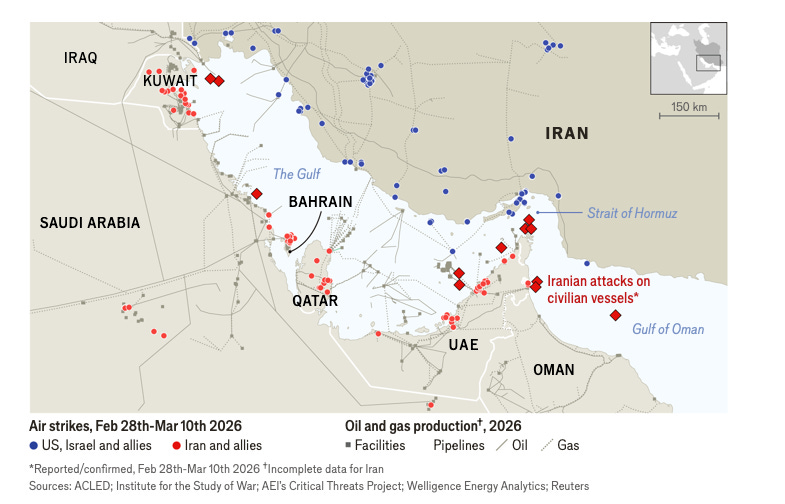
That’s what it did, as shown in the map below, which tracks strikes in the region between February 28 and March 10.
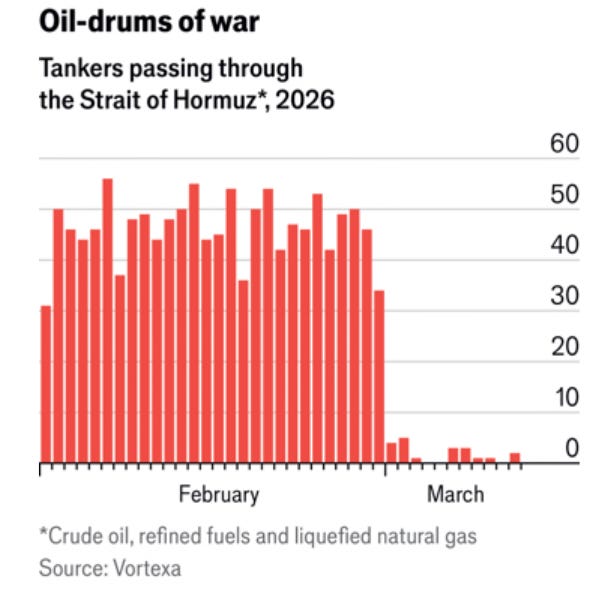
As a result, traffic in oil, fuels, and natural gas through Hormuz all collapsed.
The experience of the conflict with the Houthis of the last few years gave few reasons to have been optimistic regarding any battle for Hormuz.
On the other side of the Arabian Peninsula, diagonally from the Strait of Hormuz, there’s another passage called Bab al-Mandeb.
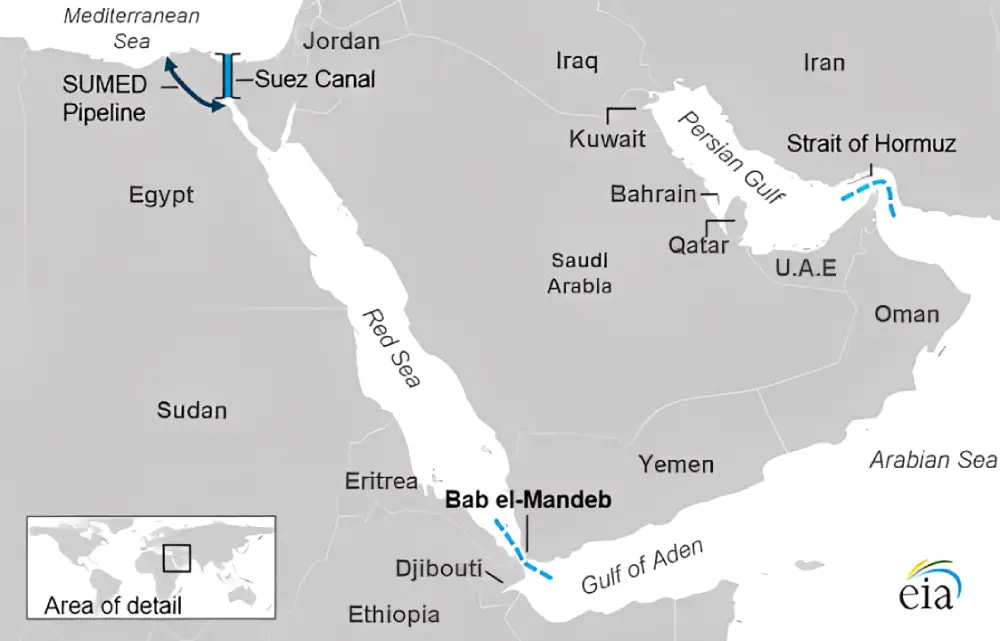
After the beginning of the Gaza War in October 2023, the Houthis began to fire at Israeli cities and commercial vessels. In December, the US launched Operation Prosperity Guardian, which involved defensive naval escorts and shooting down drones and missiles. The next year saw the US conduct airstrikes against Houthi targets within Yemen, and Trump escalated the effort in March 2025. That operation can only be considered a failure. The US dropped $1.5 billion worth of munitions on the Houthis and lost more than a dozen Reaper drones worth about $30 million each. Three fighter jets valued at $67 million each also fell into the ocean, including one that went overboard when the USS Truman swerved to avoid a Houthi attack. Houthi leaders were killed and many of their weapons were eliminated, but their ability to disrupt sea traffic remained intact.
A ceasefire was announced last May, in which the Houthis promised not to attack US vessels, but they would otherwise continue to do what they wanted. By summer, the Houthis were attacking merchant vessels again. Today, traffic through Bab al-Mandeb remains half of what it was before October 2023.
Trump could afford to walk away from the conflict with the Houthis because Bab al-Mandeb is not as important to the global economy as the Strait of Hormuz. Before the war with Iran began, one-fifth of the world’s oil supply went through the Strait of Hormuz, compared to about 9% for Bab al-Mandeb when the Houthis began disrupting shipping. Aside from the numbers involved, the goods that went through Bab al-Mandeb had an alternative route that involved going around the Cape of Good Hope, which can be seen in the chart below.
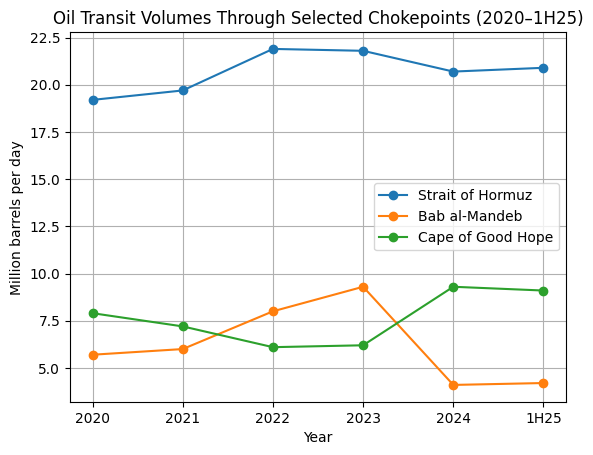
As oil going through Bab al-Mandeb declined after 2023, the amount transported via the southern coast of Africa went up by about the same amount. But there’s no alternative sea route to the Strait of Hormuz, and available land options can only handle a fraction of the traffic. Moreover, Iran was hitting oil facilities directly, which added more to the strain on the global economy.
Of course, although the Houthi conflict did not provide encouragement, before the war we couldn’t say for sure that the US wouldn’t be able to open Hormuz by force. There may have been some reason that the situation in Bab al-Mandeb was different. In fact, according to a March 11 report from the Congressional Research Service, “Prior to Operation Epic Fury, there appears to have been consensus among analysts that the U.S. military has the capacity to counter Iran’s forces and restore the flow of shipping in the event of Iranian attempts to disrupt the Strait.”
One could have thought before the war that simply threatening to bomb Iran into the Stone Age would be enough – the Houthis were already there! (not literally, obviously, but closer than Iran) But Trump tried that, and ended up folding. Other countries rejected American requests for help with Hormuz. If Trump was being told by military leaders that the US could open the Strait alone fast enough, given his character I think there’s a good chance he would’ve tried. But it looks like it was never considered possible, or at least not on a short enough time scale for it to make sense politically. If Trump was informed that it could be done, but it would take two years, obviously he wasn’t going to accept that given that he thinks more about his financial interests than his legacy.
What Comes Next
I think Iran has won a kind of peace of mind. They’ve shown that they can cause great pain for the rest of the world, and that their regime won’t fold or collapse in the face of a major attack. Every American president from now on will know that deciding to go to war with Iran will tank the global economy and become the dominant issue of their presidency, hindering the ability to achieve all other political goals. Before, they could delude themselves that it could be quick and easy. Even future presidents hostile to the regime are unlikely to care so much about Iran that they think that the issue is worth tanking their approval rating by ten points and risking nearly all of their political capital.
This likely applies to Trump too once the two-week ceasefire is up. I expect him to find a way to save face and not restart the war. The thing to understand about Trump is that he’s very petty and selfish (I know, I know, breaking news). He wants to do well in the midterms and have a Republican president as his successor, since the goal is to – in addition to looking like a winner – avoid investigations and potential liability for the corruption and crimes of himself, his family, and associates. You obviously never know with this guy, but from the way he talks about Hormuz, it seems clear he wants a way out.
Iran didn’t even go all the way up the escalatory ladder, and promised to hit the energy producing facilities of the Gulf Arab states if Trump followed through on his threat last night. It was Trump who blinked, and no president is likely to be even more willing to accept such a risk. Closing Hormuz is no longer a theoretical cost of war. Iran will probably maintain some control, and that makes it a sure thing in the event of another conflict.
Assuming the Iranians wait out Trump, the next president will be much saner, so of course will likely conclude that a war with Iran is basically off the table unless they do something really crazy. Which they actually might, given that US intelligence believes that they tried to kill Trump.
From this perspective, it doesn’t matter much that the US and Israel have degraded Iranian military capabilities and added to a potential timeline to obtain nuclear weapons. Before the war, the regime was building its strength but had to worry about an American attack. Military force only works to permanently set the regime back if you can credibly promise to keep doing it, which I don’t think any US government can at this point.
Does this mean that Khamenei the younger goes full steam ahead for a nuclear weapon? Perhaps not. This is one of the things that can turn the world fully against the Iranians. If they judge that they extracted a high enough cost that they believe that no American president will launch another war, the rational approach would probably be to rebuild their missile program and other conventional capabilities, while holding off on nukes. Recall that even after Trump left the JCPOA, Iran stayed in the deal for nearly two more years because it valued what it got in terms of better relations with other powers and sanctions relief. Of course, there’s no guarantee that the Iranians see things this way, and perhaps the new supreme leader, who is said to be more extreme than his father, might now be determined to build nuclear weapons. But I think the regime doing so would be much more likely if the result of the conflict was more ambiguous.
I expect Trump to pivot away from fully supporting Israel. Honestly, it’s a bit of a mystery why he hasn’t up to this point, and I would chalk it up to the personal influences of Jared Kushner and Steve Witkoff, along with Fox News. But positioning as anti-Netanyahu would get him good coverage both among the MSM and right-wing influencers, along with creating more goodwill among the international community. There are some among Trump’s fans who still like Israel, but they are the ones who are most cult-like – think Catturd – so will change positions as soon as he does. Trump may also feel misled or betrayed by Netanyahu’s advocacy on behalf of war. That said, Fox, Kushner, and Witkoff are still there, and so maybe nothing changes in the general US approach to the Middle East.
This all sounds kind of bleak, but I think an unambiguous result in either direction may have been better than a stalemate. Best case scenario was of course the regime falling and being replaced by something better. But given that didn’t happen, it might be preferable to take another war off the table than have a more uncertain result. Iran has shown it can inflict enough damage to make another attack all but unthinkable for any American president, perhaps including Trump. This is in the end what matters, and the regime is stronger now that everyone knows this.
Thanks for reading. One thing I’ve learned is that when you have a book coming out, you can never assume that even regular readers are aware of it.
For that reason, over the next few months I’m not going to miss any opportunity to inform my audience that I have a new book called Kakistocracy: Why Populism Ends in Disaster coming out in July – details here. If you enjoy articles like this, appreciate me as a truly independent writer, and would like to support my work, the best way to do so is to preorder the book, which you can do at the links here to Amazon or Barnes & Noble. All preorders count toward opening day sales, and will help determine how much attention it receives.
I will be reading the audiobook, in case that makes it more appealing.
On a different note, if a little box appears below, it means that you are not yet a free or paid subscriber. Sign up to get more articles and updates in the future.
It seems to me that you misjudged this war for a very similar reason that you voted for Trump: a pathological degree of risk appetite and a failure of imagination, leading to irrational optimism about the odds of a best case scenario.
I do not see Trump changing his position on Israel. Trump is sensitive to public opinion, but he has a rough sense of trade-offs. Let's say that 1% of Democrats, 1% of independents, and 1% of Republicans, maybe 1% of the country, might move toward Trump if he attacked Netanyahu. When I say 1% of Republicans, I mean that there are 1% of Republicans right now who will be voting Democrat or staying home in November, but who if he changed his tune on Netanyahu, would come out and vote. This is potentially what Trump has to gain.
On the other hand, attacking Netanyahu would alienate a huge chunk of his base: Evangelical Christians who love Israel. Again, maybe these people are only 10% of the Republican coalition at this point, but that's bigger than the 1% he has to gain from attacking Netanyahu.
This is a pretty simple calculation, and not super complicated. Yes, there are a lot of people who criticize Trump for his friendship with Netanyahu -- but very few of these people are going to *switch* their votes in November over this singular issue. Democrats who criticize him will remain Democrats; Republicans who criticize him will remain Republicans. He would just come off as weak.
Trump hates admitting he was wrong. If Netanyahu is a bad guy, but we just went to war to help Netanyahu, then Trump is an idiot. He would rather double down and stick to his guns than admit he made a mistake.