
Whatever happened to caring about suffering Africans? “We Are the World” was before my time. But I remember that throughout the 1990s and early 2000s, the idea that the Dark Continent was full of war crimes, starvation, and suffering that Americans had a duty to alleviate was a prominent part of the culture.
After the Soviet Union collapsed, there was a question of what exactly the US would do with its massive military. American force posture abroad had been centered around stopping communism, particularly a Soviet invasion of Europe. Hence, all the troops in Germany, Italy, Japan, and Korea.
Within a few years, the US was regularly involved in humanitarian interventions abroad. We either bombed or sent troops to Somalia (1992-1994), Haiti (1994-1995), Bosnia (1995), and Serbia (1999). Today, the US still carries out smaller counterterrorism and security missions abroad, but these are lower profile than the earlier interventions, partly because they usually involve much smaller commitments.
Scholars used to discuss a phenomenon they called the “CNN effect,” named after the first 24-hour news network, which was founded in 1980. The argument was that, while in previous generations atrocities were ignored, news coverage of humanitarian crises abroad created pressure for intervention. Major thinkers like Samantha Power pushed for a doctrine of “Responsibility to Protect (R2P),” arguing that America had a moral obligation to stop genocides and massacres when it could do so. The US remained passive as 800,000 people were slaughtered in Rwanda, and President Clinton called this one of his greatest regrets.
Then came 9/11, and US foreign policy felt like it was about actually defending the country again. But up to the early 2010s, there was still this idea that there were unfortunate populations abroad that needed to be protected. Beginning in 2003, we started hearing about a genocide in Darfur involving Arab militias under the control of the Sudanese government slaughtering black civilians in the western part of that country. This story made the cover of TIME Magazine in October 2004. I remember a prole friend I had at the time being aware of it, and he was one of those people who never talked about the news. Since 2023, there’s been a civil war in Sudan that has directly killed at least 150,000 and, as of early last year, had displaced 11.6 million people internally, more than a fifth of the population. Yet nobody cares.
This is strange, given that you would expect that the rise of smartphones and social media would give us something like the CNN effect on steroids. We should be getting a nonstop stream of atrocities calling out for a response. Gaza is an exception, but this is more of a culture war football involving American identity and geopolitical interests, in contrast to the purely altruistic concerns motivating the focus on African suffering in previous decades.
I suspect that this is due to a general turn toward pessimism in the culture. When people feel happy and secure, they are more generous. When they are depressed, anxious, and into navel-gazing, they lose interest in the problems of others, and have trouble focusing on anything other than their parochial interests and grievances.
A great cultural time capsule here is the film Kony 2012. In less than a week, this short documentary became the fastest video ever to reach 100 million views. The premise was that there was this bad man named Joseph Kony, who went around capturing children, forcing them to kill their parents, and turning the boys into soldiers and the girls into sex slaves. By making Kony famous, he would be stopped and the children would be freed. That’s not as dumb as it sounds. American troops were already deployed to assist African forces on the continent in trying to catch him, and by keeping the pressure on, it was thought he could eventually be brought to justice. I encourage people to watch the whole thing, because it is striking to me how much the culture has changed in a mere fourteen years.
The video opens with filmmaker Jason Russell showing videos of his young son being an innocent kid. This is juxtaposed against children of the same age in Africa, who are forced to pick up guns and kill people. There’s an end of history feel about how he describes his son’s circumstances. Americans have achieved peace and prosperity, so have the luxury of looking around the world and trying to help children suffering abroad. Today, a filmmaker wouldn’t directly say that Americans suffer as much as Africans, but the culture generally shies away from anything that tells Americans that they don’t have it that bad, even by implication. The culture of Kony 2012 is one in which people are secure enough to feel genuine sympathy and take into account the problems facing others.
Kony 2012 has a cringe-inducing sincerity. Young people stand together and stare determinedly at the camera. They won’t stop until Kony is brought to justice. Russell, speaking in front of a crowd of young people, asks “Who are you to end a war? I’m here to tell you, who are you not to?” Politicians from both sides of the political aisle are featured in the film without any hint of partisanship. And the Kony movement did have some successes by making this a cause célèbre in Washington, with the film showing Russell reading a letter from Obama informing his organization of the decision to send American forces to Africa.
Of all the ways MAGAs are morally repulsive, one of the worst things to me is how they talk about Ukraine. They’ll often oppose military aid not on the grounds that it is fruitless or that there needs to be more effort toward a durable peace – which can be a reasonable argument – but because our people at home have their own problems. Marjorie Taylor Greene denounced Biden for going to Ukraine on President’s Day instead of East Palestine, Ohio, the site of a chemical spill that killed no people and thus far has had no proven long-term health effects. Before the last decade, I think you would’ve found few Americans in positions of power or influence comparing the plight of people living in the United States to that of those suffering in the midst of a war zone. As an “anti-woke” backlash rose on the right in the Trump era, conservatives adopted the left’s self-pity and victimhood fetish, minus the universalism, making it all the more pathetic.
Perhaps the culture hasn’t changed that much, and there are simply fewer war crimes and atrocities to respond to? This is pretty much what happened with hunger, where economic growth across the world practically eliminated starvation. But there still seem to be a lot of wars and atrocities in Africa. According to the Early Warning Project, the number of ongoing mass killing episodes was stable between 2004 and 2024.
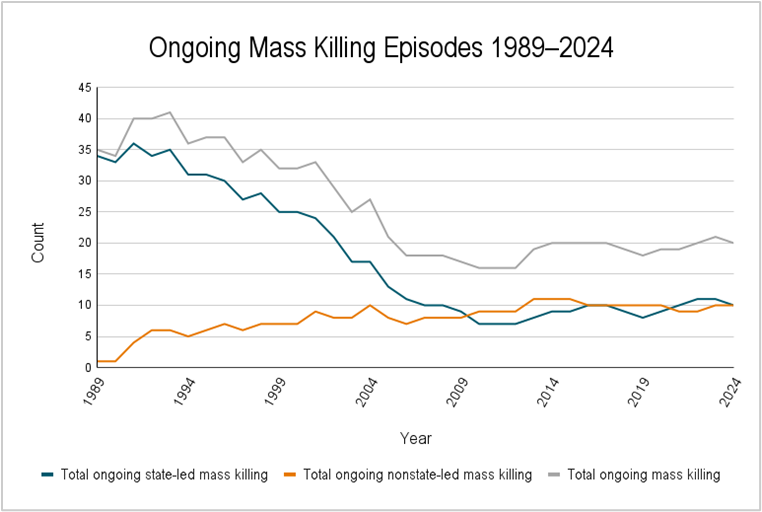
A mass killing is said to begin when at least 1,000 noncombatant civilians of a certain group are killed within a year, and end when fewer than 100 members of the group are killed for three straight years.
Yet these are simply cutoffs to determine the value of a binary variable. Here’s the Uppsala Conflict Data Program tracking deaths from state-based conflict, non-state conflict, and one-sided violence from 1989 to 2024.
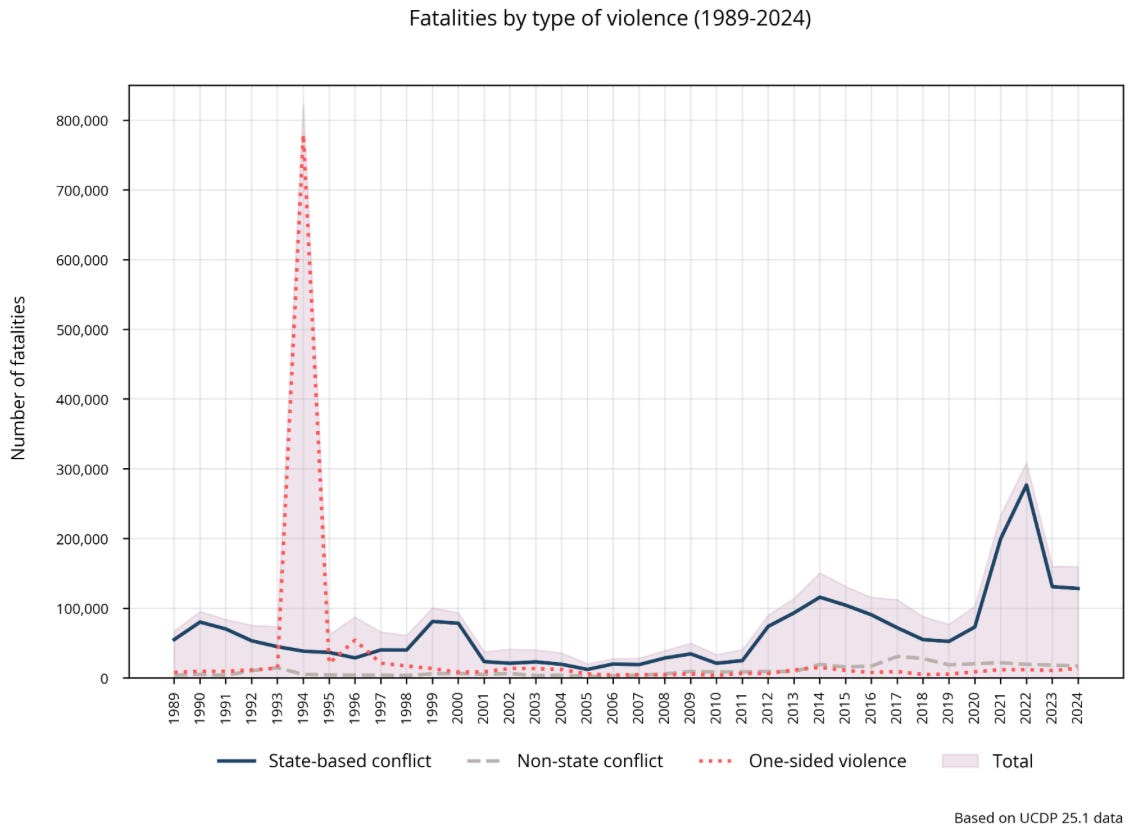
Rwanda clearly stands out. But other than that, the era of peak “CNN effect” wasn’t much worse than today in terms of one-sided violence and non-state conflict. Perhaps it was the scale of Rwanda plus the fact that the Balkans saw mass killings in Europe that brought the idea of stopping atrocities to the forefront of the culture. But then why was Sudan still such a big deal in the aughts?
“One-sided violence” collapsed in the late 1990s and has remained low since. “Non-state conflict” actually starts increasing in 2017 from a very low base. Meanwhile, actual wars involving states picked up with the Syrian Civil War beginning in 2011 and the subsequent rise of ISIS. As that was dying down, we got Ukraine and Gaza.
Perhaps focus on Gaza and Ukraine has crowded out attention that could otherwise go toward horrible things happening in Africa.
This raises an interesting question: let’s say that the conflicts in Ukraine and Gaza were settled. Would there be as much pressure for the US to intervene in one-sided mass killings and atrocities as there was in the 1990s? In my book Public Choice Theory and the Illusion of Grand Strategy, I argued that once you have a big military-industrial complex and a think tank and intellectual ecosystem that exists around it, there will always be pressure to do something with American forces. So when the Soviet Union was still around, that was the focus. There was nobody really to fight for a decade after that, until 9/11, and this interregnum happened to be the exact period of time during which we realized we had a responsibility to protect the helpless. After the Twin Towers came down, it was back to actual security concerns. As the War on Terror no longer grabs people, we’ve seen talk of pivoting to China. And now we have Gaza and Ukraine to talk and argue about, so there’s not much attention space left for other bad things going on in the world.
A society can be understood to be like a person: there’s only so much bandwidth, or so many things you can be dealing with at one time. Countries are going to mostly focus on their internal affairs under most circumstances. The discourse space we allocate to what is happening abroad is therefore limited. According to this theory, the CNN effect went away due to the fact that classic wars made a comeback. Maybe it will return once the situations in Ukraine and Gaza settle, assuming there aren’t new major wars.
But I don’t think this is the full story. Given American political realities and the state of the culture, I can’t see us today caring about ongoing conflicts in Sudan, Haiti, or the Congo as much as we did analogous events occurring between the mid-1990s and Kony 2012. The R2P doctrine was born in a society that was confident in itself, one that could be magnanimous at the end of history and felt like things were going well enough that the serious issues facing our own societies were mostly solved. Today, victimization narratives have triumphed, and no one is interested in the problems of the truly unfortunate from a global perspective.
It’s easy to make fun of poor Jason Russell playing the role of white savior, and his delusions of grandeur. Incredibly enough, it’s been fourteen years now and Joseph Kony is still at large. But the theory of how he would be caught wasn’t bad, and the warlord did largely have to stop his activities. A March 2026 article describes his remaining group as being composed of 12 to 20 fighters. So Kony wasn’t put behind bars, but he ended up much less dangerous.
Of all the things in the world people can virtue signal and get smug about, focusing on children suffering malnourishment, mutilation, and disease in Africa beats almost all other alternatives. It’s certainly better than the parochial narrow-mindedness that leads to an obsession with microaggressions and the mental trauma suffered by American college students, or, on the other side of the political spectrum, conservatives adopting the template of sacred victims and applying it to overweight rednecks in Appalachia. Once we start caring about suffering Africans again, it will be a sign that our culture is getting back on the right track.
Thanks for reading. One thing I’ve learned is that when you have a book coming out, you can never assume that even regular readers are aware of it.
For that reason, over the next few months I’m not going to miss any opportunity to inform my audience that I have a new book called Kakistocracy: Why Populism Ends in Disaster coming out in July – details here. If you enjoy articles like this, appreciate me as a truly independent writer, and would like to support my work, the best way to do so is to preorder the book, which you can do at the links here to Amazon or Barnes & Noble. All preorders count toward opening day sales, and will help determine how much attention it receives.
I will be reading the audiobook, in case that makes it more appealing.
On a different note, if a little box appears below, it means that you are not yet a free or paid subscriber. Sign up to get more articles and updates in the future.
I think The US stopped caring for reasons that track the 2 sides: Red America isn't really evangelical anymore (they LARP as Christians more than they act like them), and Blue America only sees Africa as a cudgel for why the West needs to change, prostrate, or destroy itself for minorities. Neither side actually cares about African suffering on its own terms. Red America is too Social Darwinistic and Blue America is too Fanon-esque to actually care about Africa.
To build on your Sudan point: there was a time when evangelicals were the ones dragging Washington into Sudan. Going back to the H.W. Bush era and through the 1990s, when Khartoum's militias were enslaving southerners (Dinka women and children abducted and marched north) and the "Lost Boys" were fleeing the war on foot, it was the Christian right that kept the pressure on, from Operation Lifeline Sudan through the eventual Sudan Peace Act. His son also was tough on Khartoum for how they treated the non-Arabs in Darfur. I wrote about that here: https://yawboadu.substack.com/p/the-economic-and-political-history
Now picture today's GOP mobilizing to stop ethnic cleansing, extermination, and slavery in Africa, which is exactly what's happening in Darfur in the current civil war. It's laughable. They wouldn't do it. They don't even know about it.
The deeper problem is that R2P is just hard to defend once you stop believing American intervention actually helps. The only time it was really invoked was Libya, and that was a shitshow. Gaddafi was massacring civilians, so NATO and the Arab League backed the rebels and took him out. What we got afterward was a country split between Khalifa Haftar in the east and the recognized government in the west, with no real path to reunification (or maybe Haftar's sons inherit the whole thing one day).
And after Libya's collapse post-Gaddafi, it caused havoc in the Sahel. Right now JNIM (al-Qaeda's arm in West Africa) and the Islamic State's Sahel branch are terrorizing Mali, Burkina Faso, and Niger. After Gaddafi fell, his Tuareg mercenaries grabbed his weapon stockpiles and went home to northern Mali wanting their own state. The Tuareg then allied with Jihadists to carve a state in North Mali called Azawad. Mali asked for international help, the UN authorized it, and then France went in. During that time, it was basically a stalemate, and in those years, jihadists spread into Niger and Burkina Faso, Russian spread disinfo about the West, and France was constantly nagging Mali toward negotiations. Eventually Mali, Burkina, and Niger all had coups, the juntas turned hard against the West, expelled anything Western, and invited in Russia. Russia has been a terrible partner to them, and all three are more unstable than before. Burkinabè state propaganda now runs on anti-Westernism.
To add insult to injury: the US has poured far more aid into those countries than Russia ever has, and they still turned into beacons of anti-Westernism. The coups showed how thin American soft power actually is.
Which is why I think the center-left and center-right both quietly gave up on most of Black Africa, and South Sudan is the clearest reason. America helped the South win independence from a Khartoum that had spent decades murdering, enslaving, and neglecting them. The world's newest democracy then collapsed into civil war two years after independence, because the Dinka and Nuer have never gotten along. The leader we helped put in power still refuses to hold elections, and the country is on the verge of another civil war. I covered that here: https://yawboadu.substack.com/p/the-economic-and-geopolitical-history-5eb.
At this point there's basically no expectation or hope left for much of Africa. My bet is that the next time America really thinks about Africans, it won't be about saving them. It'll be about deterring immigration driven by high birth rates.
Bill Gates did a lot for Africans but in return his reputation was tarnished. By making conspiracies about vaccines or criticism of him over patents.
America intervened in Somalia just to help feed people still so many people criticize it.
The issue with helping Africans is that instead of praise you get criticism. But if you only do virtue signaling it doesn’t cost you anything. So incentive is to do nothing.