
Lately, I’ve had a nagging feeling that we’ve been looking at the fertility crisis in the wrong way. The collapse seems too precipitous, sudden, and universal to simply be the result of the shallow proximate causes that are usually invoked.
For those who haven’t been paying attention, here’s what’s been happening to birth rates across the world over the decades, particularly the last 15 years.
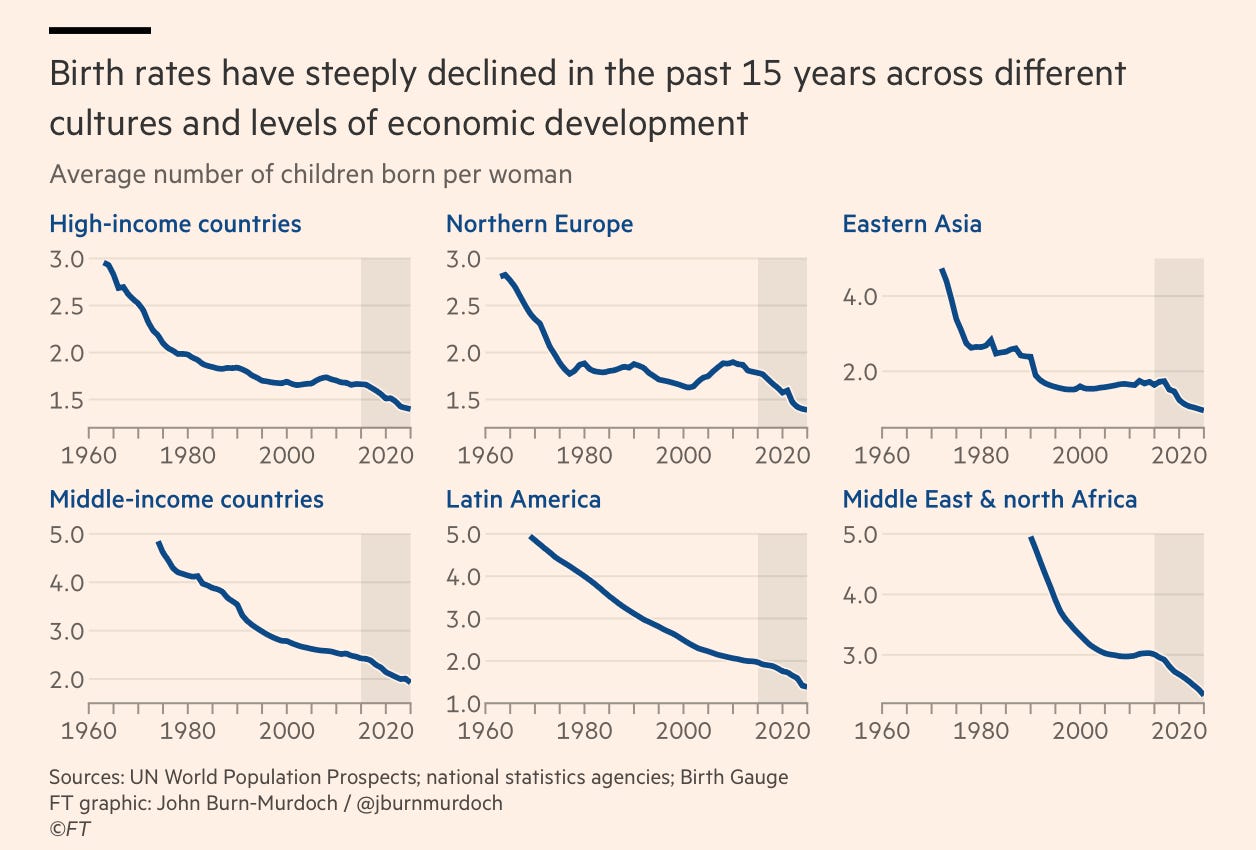
I’ve shown that birth rates are collapsing even when controlling for the fact that the world is getting wealthier.
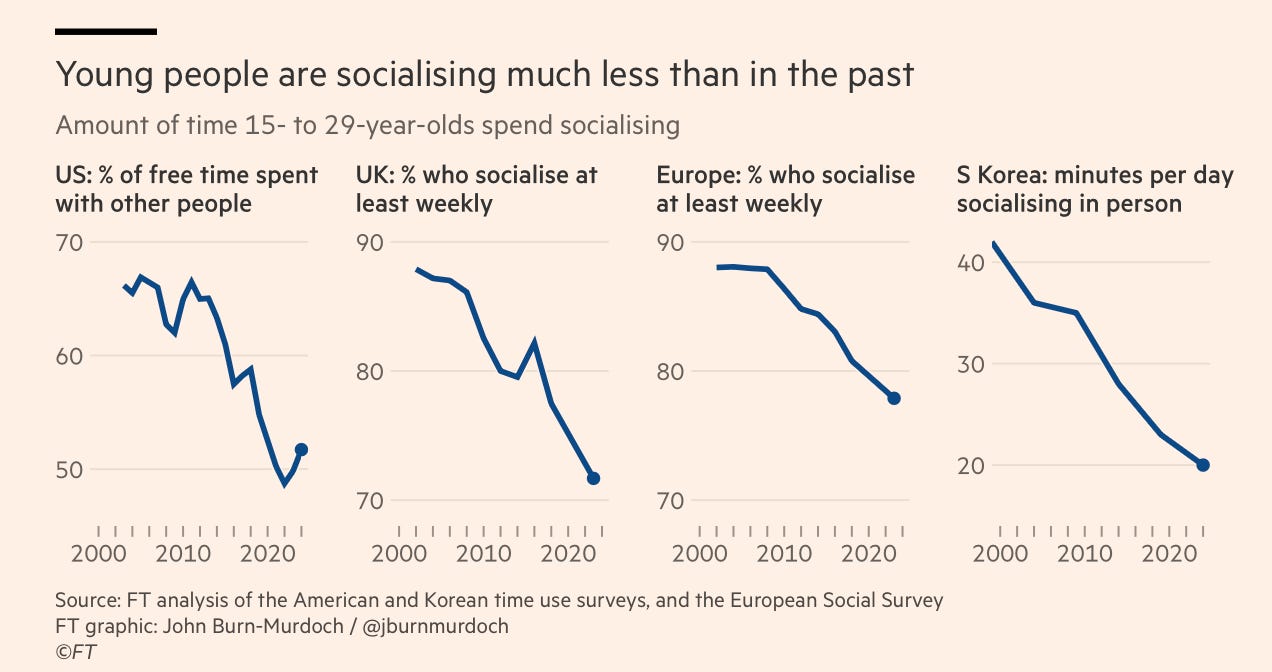
And here’s what’s happened to socializing among young people.
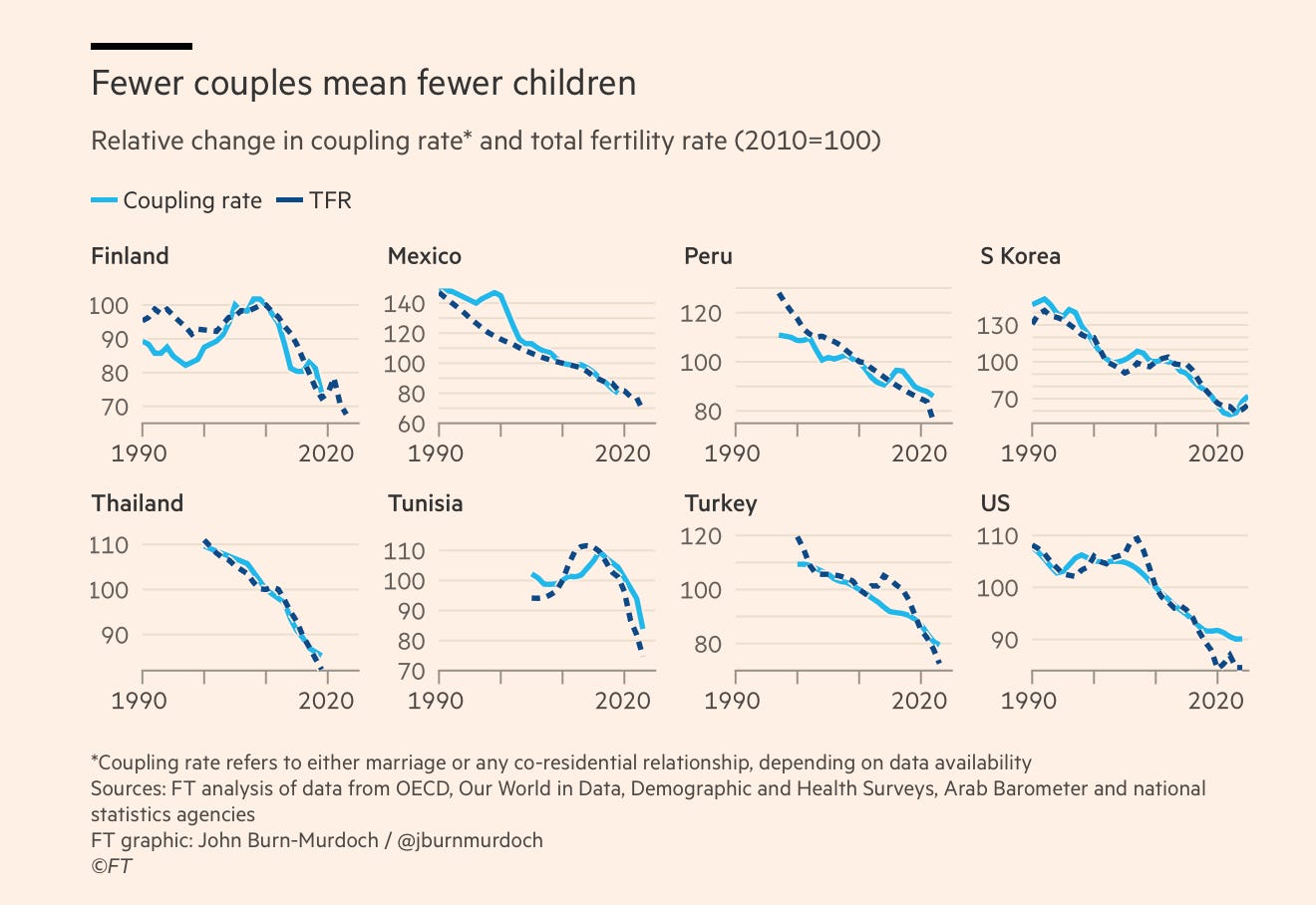
The fertility crisis is in part a coupling crisis. In the United States, fertility among married couples has remained relatively stable, though this may be a statistical artefact.
One of the standard demonstrations of the ability of evolutionary psychology to help understand the world is its explanation of the rise of obesity. Once, humans lived in calorie-deprived environments. Starvation and malnourishment were real possibilities. So we evolved to gorge on calorie-dense food when it is available. We also moved around a lot, ensuring that we burned off energy. Today, food is cheap and all around us and work is often stationary, so we eat ourselves into poor health and an early grave. The mismatch between our evolutionary environment and the modern world is why people now get fat.
Countries seeing collapsing birth rates as they get wealthier is a pattern nearly as universal as them getting fatter. People sometimes blame feminism or social norms. Others point to technology, particularly iPhones, to explain more recent trends. But what if these are the wrong ways to look at the issue? It would be misguided to refer to the rise of obesity as fundamentally linked to one particular technology like the development of high-fructose corn syrup, or a cultural change. Evolution provides the most satisfying explanation. People may like high-fructose corn syrup, but if that hadn’t been invented other things would play a similar role. The more fundamental causal factor is that people seek out food that is bad for them under modern conditions.
Consider the possibility that humans evolved to seek solitude in the same way we evolved to eat calorie-dense food.
The idea that humans naturally desire to be alone might seem bizarre at first glance. Don’t we need to find friends, allies, and mates? We are social creatures, and our ancestors couldn’t survive and reproduce without other humans.
This simple story breaks down, however, when we consider what things were like across the vast majority of our evolutionary history. Imagine that for humans there is some optimal mix of socializing and solitude. It’s a bad idea to be a hermit. But there are also drawbacks to never having time alone at all. Maybe solitude allows people to think through their problems, and decompress in the midst of the pressures of life. Perhaps there’s a secret that you need to keep from your family and the members of your band, like a stash of food or something else you want to hide.
Yet man in his ancestral environment was rarely alone. Primitive humans did most things communally, including hunting, sleeping, and leisure activities. Anthropologists are increasingly skeptical of the idea that you can derive lessons about the lives of our ancestors from studying modern hunter-gatherers, and have argued that there was probably a diversity of cultures and norms among them. Regardless, taking into account this likely variation, it’s probably safe to say that there were always a lot fewer opportunities to be alone than there are today, and this is true up through the rise of agriculture and the early days of industrialization, when individuals often lived with or near large numbers of kin and depended on their local communities.
So we evolved a simple rule to go through life: “Whenever you have a chance to be alone, take it. You might not get another for a long time.” This of course coexists with other instincts, so it is not an absolute guide to behavior. But the rule did create a tendency that has become more prominent throughout history.
As societies become wealthier, innovation and economic developments cater to human preferences. Hence, we got fast food and delicious cakes sold at the supermarket, and also entertainment options that keep us in our rooms. People debate whether the iPhone is responsible for the decline in sociability and fertility. It probably is, but the question is why the iPhone has been such a successful product in the first place. In a sense, candy bars and potato chips cause obesity, but ultimately there are deep reasons in our evolutionary past why we find such foods appealing. Banning certain junk foods doesn’t help much, as people simply eat something else. The only thing that seems to work on a wide scale for people susceptible to being overweight is fiddling with our biology, hence the rise of GLP-1 drugs.
There is too much of a tendency to treat economic and technological developments as arbitrary. But they’re driven by human nature. We could have used our wealth for different purposes. Greater disposable income might have gone toward things like more social clubs and nights out on the town. For all the talk of kids being unaffordable, objectively speaking there’s never been a time in human history when it was more feasible to have large numbers of children. But we didn’t buy more children or more social experiences. Instead, we purchased solitude. You can blame Silicon Valley for making us addicted to phones in the same way you can blame food manufacturers for what they’ve done to our waistlines, but in the end the market is shaping itself around our preferences.
In Factory Girls, Leslie T. Chang profiles Chinese women who couldn’t wait to get out of the countryside and work in what we in the West have called “sweatshops.” They felt absolutely crushed by the social obligations and limitations put on them by their extended families as part of rural life. The women preferred the company of friends and boys they could meet. Before long, the young people of East Asia would retreat even from peer relationships and get buried in their phones. Each step is toward greater solitude. East Asians seem particularly susceptible to negative trends that are hitting practically everyone, a phenomenon I discussed here.
David Oks writes about the crushing burdens of communal norms in Africa.
The result is a constant process of redistribution from the most productive members of a kinship group to the least productive. This informal redistribution is a constant feature of life in African societies: 93 percent of Kenyan entrepreneurs agree that success in business leads to financial demands from family and friends. South Africans even have a name for the sharing obligations that define African kinship groups: “the black tax.”
This is, of course, a bad deal for the ambitious and productive within the society. But because refusal is impossible, sharing obligations lead to all sorts of attempts at obfuscation. One experiment found that rural Kenyan women were willing to pay significant sums in order to hide their income from relatives; likewise, in Cameroon, it’s common for people to pretend to be poorer than they are, and thus avoid sharing obligations, by taking out unnecessary bank loans fully collateralized by their savings.
It’s easy to see how under such conditions it would be difficult to go beyond the optimal level of solitude. Individuals should be always taking whatever privacy and alone time they can get.
Whenever I pick my kids up from school or daycare, they seem happy. They’re running around with their friends, laughing, smiling, and playing. That said, when I asked Girl last Thursday morning whether she would rather stay home for the day, she said yes. It’s like this with the other one that can talk too. Whenever the option comes up, they choose home over school. I was reflecting on this paradox while dropping them off later that morning.
What I concluded was that people having evolved to seek solitude does not mean that they don’t enjoy being around others once they’re in social situations. We’ve probably all had the experience of not feeling like going to a party or on a date, but when we get there things unfold much better than we imagined they would. People evolved to get along with others and form relationships with them, but the seeking out part is something we don’t do that much. This is why churches are valuable. The theological beliefs are in many cases secondary. The point is that religious traditions create obligations that bring people together in structured ways.
If all of this is true, what should we do? Maybe we should just accept people choosing to lie in bed and watch TV and stare at their phone all day. It’s simply them doing what they want. But again, the obesity analogy is helpful. It was difficult if not impossible to get fat throughout most of our evolutionary history. Yet people who overeat today end up with health problems and not feeling good about the results. Likewise, the rule that you should maximize solitude probably now leaves people feeling empty and alone. Moreover, low fertility is an economic and social disaster.
Pharmaceuticals are in the process of changing the trend in obesity after decades of failure when trying other things. See Scott Alexander, “Society is fixed, biology is mutable”. Perhaps we need something similar in this area? Note that people already drug themselves in order to make socializing more enjoyable. They mainly use alcohol, but every once in a while there’s a panic about some new party drug. At this point, I would be optimistic if I heard there were an uptick in young people using alcohol, cocaine, or ecstasy, though not heroin, even though it’s by far the most fun of all drugs and must be what heaven feels like. We also give people legal medications for anxiety and depression, which pushes in the opposite direction of campaigns against the abuse of illegal drugs.
At some point, societies need to get serious about collapsing fertility. The reason we couldn’t stop obesity from increasing before GLP-1 drugs was that the evolutionary impulses towards sloth and overeating are too strong. Governments believe in economic growth too, and the wealthier we got, the more difficult it became to stay in good physical shape because it just meant we had more options and could afford more food. Likewise, the desire to get fertility up is going to conflict with other things people want, namely freedom of choice and increasing options regarding how to live one’s life.
Economic incentives for having kids might help, if large enough. How could they not? But we’re also going to be constantly pushing up against the limits of human nature if we want modern people to socialize and have kids. Giving up is unacceptable. But we need to realize the enormity of the challenge. Perhaps pharmaceutical companies might look into a GLP-1-like drug for sociability. One thing government might do is encourage development in this area by preemptively announcing that something that improved sociability and the likelihood of pairing up would be covered by national health insurance plans. Once low fertility is seen as an issue of evolutionary mismatch rather than any particular innovation or idea, we might be better equipped to come up with solutions.
When it comes to other fixes, the concern just has to be getting people socializing. To worry about fertility itself is jumping too far ahead. Sex, sociability, marriage, and children rise and fall together. Movements like Haidt’s war on iPhones and calls for kids to go play outside do not seem directly related to the fertility crisis, but can have beneficial downstream effects in this area. It’s an open question whether changes in norms can be enough, or, if as with obesity, the evolutionary forces at play are too strong for anything but pharmaceutical interventions to fix the problem for large numbers of people. But the only way to find out is to support movements, intellectual trends, and market innovations that bring humans together in close physical proximity.
Thanks for reading. One thing I’ve learned is that when you have a book coming out, you can never assume that even regular readers are aware of it.
For that reason, over the next few months I’m not going to miss any opportunity to inform my audience that I have a new book called Kakistocracy: Why Populism Ends in Disaster coming out on July 7 – details here. If you enjoy articles like this, appreciate me as a truly independent writer, and would like to support my work, the best way to do so is to preorder the book, which you can do at the links here to Amazon or Barnes & Noble. All preorders count toward opening day sales, and will help determine how much attention it receives.
I will be reading the audiobook, in case that makes it more appealing.
On a different note, if a little box appears below, it means that you are not yet a free or paid subscriber. Sign up to get more articles and updates in the future.
Hmm. I like the evolutionary framing, but don´t know if `the desire for solitude´ is what is being searched for.
It was perfectly possible to be alone before phones. In fact, you could truly be alone, in a way that's difficult now.
The phone gives me a constant stream of optimized semi-sociability. I feel like I'm interacting with people, but without any of the annoying constraints that accompany physical social life. I can respond when I choose. I can listen to the most interesting people talk, etc.
I think it rather has to with anxiety. We like social interaction. We don't like social confrontation, the feeling of talking to strangers, etc. Markets and technology cater to that and give us low-effort digital wall-e land. We are not forced to overcome anxiety, which is so important for romantic life.
Also, digital life makes that our digital social graph and our physical ones barely overlap, so we have less in common with the people physically surrounding us, qua values, conversation topics, etc.
Also, being able to be constantly in touch with one's high school friends, family, etc, through WhatsApp / FaceTime also takes up social energy without giving opportunities for new (local) friend groups and romantic prospects
Also, chat groups create a harder "in vs. out"-dynamic for social groups, decreasing serendipity and "friend of a friend"-dynamics that were so typical for romantic adventures.
And there's probably countless other ones.
Thus I don't think it's "our evolutionary desire for loneliness" but rather "there is a difference between our social preferences and the social environments that are best for finding romantic partners, and wealth and especially the internet have allowed us to optimize for the former"
Evolution is the prism through which all behavior should be viewed in order to be properly understood.