
During the 2016 presidential campaign, when Trump seemed to be doing something ridiculous, his supporters would sometimes say that he was “playing 4D chess.” This became a running joke among those who doubted the candidate’s genius and thought that his more outlandish behavior could better be explained by things like foolish pride and low impulse control.
I’m reminded of the 4D chess meme when I hear some of the arguments of social conservatives who want more restrictive policies towards things like abortion, euthanasia, pornography, and prostitution. Their opponents are more likely to rely on straightforward appeals to direct utilitarian and liberty concerns. In contrast, social conservatives say stuff like that by “commodifying all of human sexuality” you make it more difficult to have “long-term relationships based on mutual solidarity and love.” Or that euthanasia “creates hierarchies of personhood by calling into question the worth and value of certain individuals based on their strengths and abilities.”
It’s understandable why they make such claims. If one doesn’t share their moral intuitions or accept their arguments that pornography, euthanasia, or abortion are inherently wrong, then the only way that they can convince skeptics of their positions on these issues is to make connections between their positions and some greater good that other people also value. It’s difficult to make someone care about an embryo if they don’t already. However, you can at least try to convince them that an embryo needs protection because if you let it die, society is coming for you and your children next.
The problem with these arguments relying on higher-order effects is that they make claims that depend on complex causal mechanisms for which there is little evidence. If there were negative downstream effects of socially liberal policy, we would find some indication of them in cross-national comparisons. Yet we generally don’t. For example, here is a map of the status of euthanasia across Europe.

Spain, Portugal, Belgium, and the Netherlands allow doctors to commit the final act, so have become as permissive as realistically possible. If euthanasia leads to a Nazi-like devaluing of human life, you would find some indication of this in those countries. Do they have higher murder rates? Do parents abandon their sick children at orphanages more often? Cross-country comparisons can be problematic when the relationships one is looking for are small, but social conservatives are the ones who believe that higher-order effects are relevant enough to be part of the policy discourse, so the burden of proof is on them. Yet they either don’t exist, or are so small that they can’t be found. And you would think if there was one situation where you would find higher-order effects, it would be here, where the policy space stretches from euthanasia being completely legal to totally forbidden. I’m unaware of any attempt having been made to argue that there’s any measurable way that euthanasia has made the Netherlands and Belgium worse places to live than say France or Denmark.
One thing I’ve pointed out before is that Korea is something of a trad paradise in terms of policy among first world nations. It bans pornography, banned abortion until it was decriminalized by court order in 2021, and has no civil rights protections for trans or LGBT. Needless to say, prostitution and euthanasia are strictly prohibited. It also has the lowest birth rate of any large population ever recorded in human history. So much for the idea that socially conservative policy creates a culture in which people are more likely to form families!
When I made this argument with regards to euthanasia on X, Ross Douthat replied that in the case of the Netherlands, we have actually observed a slippery slope, since the euthanasia program in that country has been expanded over time, a process we are similarly observing in Canada. I responded that this is circular. People who don’t like euthanasia worry that it will lead to more euthanasia. Fine, we can have the debate about this, and I think they’re completely wrong on the merits. There’s a lot of suffering out there, and I don’t see any reason why in an ideal world euthanasia should be an extremely uncommon act.
Social conservatives are free to disagree, but often make much broader claims, arguing that their preferred policies are about creating a “culture of life.” Here’s Pope John Paul II:
In fact, while the climate of widespread moral uncertainty can in some way be explained by the multiplicity and gravity of today's social problems, and these can sometimes mitigate the subjective responsibility of individuals, it is no less true that we are confronted by an even larger reality, which can be described as a veritable structure of sin. This reality is characterized by the emergence of a culture which denies solidarity and in many cases takes the form of a veritable "culture of death". This culture is actively fostered by powerful cultural, economic and political currents which encourage an idea of society excessively concerned with efficiency. Looking at the situation from this point of view, it is possible to speak in a certain sense of a war of the powerful against the weak: a life which would require greater acceptance, love and care is considered useless, or held to be an intolerable burden, and is therefore rejected in one way or another. A person who, because of illness, handicap or, more simply, just by existing, compromises the well-being or life-style of those who are more favoured tends to be looked upon as an enemy to be resisted or eliminated. In this way a kind of "conspiracy against life" is unleashed. This conspiracy involves not only individuals in their personal, family or group relationships, but goes far beyond, to the point of damaging and distorting, at the international level, relations between peoples and States. (emphasis added)
In other words, if first world nations allow abortion, they’ll be more likely to start conducting imperialist wars that seek to enslave the global poor. Well, since abortion laws vary across jurisdictions, one can test the hypothesis that these things are in any way related. The United States is the Western country with the most powerful anti-abortion movement, but also the most militarily aggressive foreign policy, in addition to being the only one to still use the death penalty. Globally, there doesn’t seem to be any evidence for the idea that you can place societies on a kind of “culture of life spectrum.” The nations of the Middle East and Africa see the most war but “value life” the most when it comes to abortion and euthanasia policy. Meanwhile, European states that let a doctor put you out of your misery or a woman terminate a pregnancy for any reason are relatively pacifist in foreign relations and won’t execute even the worst criminals, letting them spend their years in dorm-like facilities.
Catholic doctrine bundles opposition to abortion, euthanasia, capital punishment, and war as intimately related. Yet it seems much more likely that these positions are not that strongly correlated, or if anything, there’s a negative correlation between opposing abortion and euthanasia, on the one hand, and opposing capital punishment and war, on the other. The US configuration where Republicans are “pro-life” in certain ways and Democrats are in others seems to be the norm across the world. The Catholic culture of life doctrine is sort of like if Bin Laden looked at the world and decided that there was an inherent connection between societies where women wear burkas and those where they don’t eat pork. He’d be confusing his theological commitments with the way the world inherently works. But Bin Laden would at least find a correlation from the descriptive data, while the Catholics don’t even have that.
What is the upshot of all this? The midwit meme might be getting a bit old, but indulge me this one, hopefully last, time.
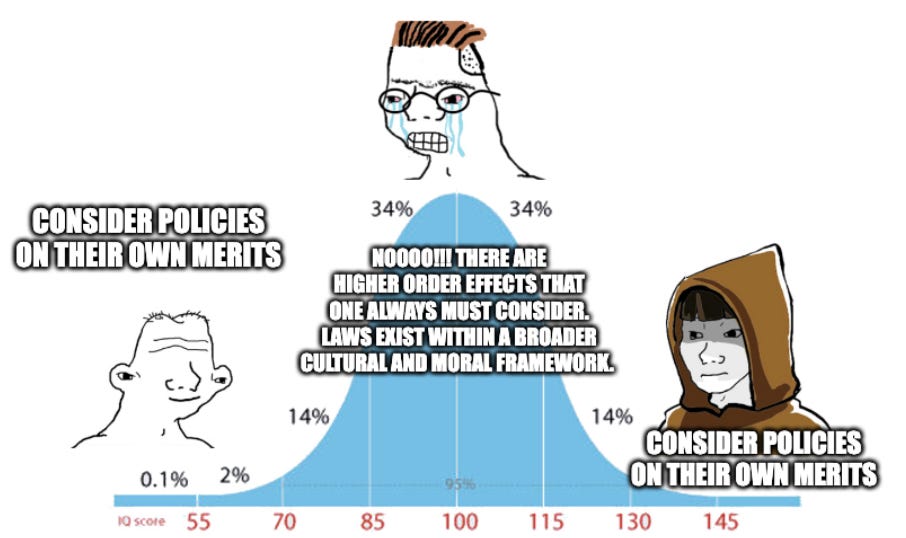
Slippery slope arguments are sometimes legitimate, but they must be restricted to their own domain. “Allowing abortion at less than 8 weeks can lead to allowing abortion at 16 weeks” is a valid argument, if you think abortion at 16 weeks is a bad thing, but “allowing abortion at 8 weeks gets us closer to Nazi-style extermination campaigns” isn’t.
Every “commodification” argument has a similar problem. Legalizing prostitution might change the way people think about prostitution. But does it shift how individuals think about things like sex and marriage more generally? I see no evidence of this. Currently, 10 European countries, including Turkey, have legalized prostitution. The laws also vary across state in Australia. If the “commodification” argument was correct, and letting men pay for sex weakened marriages and families, we should see some indication of that somewhere.
I’ll say two things here to preempt any misunderstandings about what I’m arguing. First, I don’t doubt that culture influences the way people behave in very significant ways. I simply reject the idea that in most cases government policy in a free country can do all that much to change the culture in a predictable direction. Dictatorships might be better equipped to have a significant impact on how people think and behave in their personal lives, but even their policies can backfire, as they have in Iran. The premise of The Origins of Woke is that civil rights law led to wokeness, but this is a rare exception. When the federal judiciary legalized abortion across the country and banned prayer in public schools, one might have thought that this would have resulted in a more secular country, but a generation later the US was by far the most religious nation in the West. Covid tyranny was similarly the best thing that ever happened to the anti-vaxx movement. Most laws don't shape culture, and those that end up actually impacting social life rarely do so in predictable ways. The world is too chaotic, and government too bad at planning. We should therefore debate individual issues on their own merits.
Second, I’m not totally unsympathetic to all aspects of social conservatism as a cultural project. I think most people should have monogamous marriages at an early age, create a lot of children, refrain from getting tattoos, have hairstyles appropriate for their sex, and not go to Aella’s gang bangs. If I was convinced that there were laws that could predictably lead to these outcomes that didn’t involve totalitarian methods, I could perhaps be talked into supporting them. The problem with social conservatism isn’t necessarily that its goals are often wrong, but that, inspired by motivated reasoning, it lacks epistemological humility.
Agreed. I have spent a large part of my time in the last years in Saudi Arabia. Noticing that even there, the "hearts and minds" of the young were with liberalism, wealth and freedom put the nail in the coffin of social conservatism for me. If a popular absolute monarchy with sharia law in the heart of Islam cannot pull it off, who can? I think really the only way might be to go full Taliban, luring a backwards population into a state of paranoia and economic misery.
Also, the Middle East is full of prostitution, gambling, gay Filipino tea boys that provide a variety of services, etc. The Saudi youth goes to Bahrain to sniff coke, gamble and fuck Moroccan escorts. I think the actual bulwark against the acceptance of visiting prostitutes is feminism. In Northern Europe it's considered very low-class, women would condemn you and you would feel obliged to be honest and open to your future wife. In the Middle East your buddies applaud you, and you don't really concern yourself with the opinions of women, nor be honest to them.
I would say there is straightforward evidence that "commodifying sexuality" (widely interpreted) in combination with the Internet is damaging the formation of long-term relationships in our society.
The writeup doesn't seem to address the most salient point: there's likely an evolutionary reason for socially conservative ideas that appear in broad swathes of the population or across cultures. The appeals to "higher-order" effects are just attempts to reverse engineer what it might be.
I think the burden of proof is on--or at least shared by--the person trying to overturn the instinct. Just because Holland has euthanasia doesn't mean we can do an analysis on Holland and immediately see the negative effects (if there are any). Beliefs have to be compatible not only with well-being in the present, but with the long-term survival of the believers. There are lots of examples where the "higher-order" (evolutionary) reason for the gut reaction is obvious... like not sending your women to fight in wars.
This post about high IQ people starting trends that are crippling to the below-average masses also stands out:
https://twitter.com/CEBKCEBKCEBK/status/1747298554765336870
Of course, not all socially conservative ideas have a useful function, and you can never prove that there isn't one you missed. But I think the people in charge ought to be thinking hard about all the changes they make to society, instead of just doing stuff, checking if the consequences will hurt them personally in the next 10 minutes, throwing some census data into Excel, and calling it a day.